Let me start with something every experienced worker already knows but a lot of new guys don’t believe until they see it themselves:
People don’t usually fall from the top of the ladder.
They fall from the middle… or the third step… or even when stepping down.
I’ve seen people fall from four feet and break an arm.
I’ve seen someone twist an ankle from two steps up because they came down too fast.
And I’ve definitely seen guys who thought, “It’s just a quick climb, no need to be careful,” only to end up at the clinic a few minutes later.
So when someone asks me:
“Do I need fall protection at ANY height on a ladder?”
I get why they’re confused. Ladders feel harmless—until they’re not.
Let me break it down for you the way we talk on the jobsite, with real experience and no corporate voice.
The Quick Answer (And Why It’s Not That Simple)
Alright, let’s get this part out of the way:
OSHA does NOT require fall protection for most portable ladders, even if you’re 10 or 15 feet up.
That surprises a lot of people.
But here’s the catch:
- The kind of ladder matters
- The height sometimes matters
- What you’re doing on the ladder matters
- And your company’s rules might be stricter than OSHA’s
So, is it “fall protection at ANY height”?
No… but sometimes yes.
Confusing? I know. Let’s talk through it.
Where the Rules Come From
| Rule Source | Fall Protection Required on Portable Ladders? | Notes |
|---|---|---|
| OSHA | ❌ No | OSHA focuses more on ladder setup and use. |
| Construction companies | ✔ Sometimes | Many enforce stricter rules. |
| General industry employers | ❌ Usually no | Depends on hazards. |
| High-risk job sites | ✔ Yes | Often tie-off required above 6 ft. |
| Ladder Type | Fall Protection Required? | OSHA Notes / Exceptions |
|---|---|---|
| Step Ladder (A-Frame) | ❌ No | Normal use requires no fall protection. |
| Extension Ladder | ❌ No | Must be set at correct angle (4:1). |
| Portable Straight Ladder | ❌ No | Same as extension ladder rules. |
| Fixed Ladder < 24 ft | ❌ No | Fall protection optional but recommended. |
| Fixed Ladder ≥ 24 ft | ✔ Yes | Must use ladder safety system or PFAS. |
| Job-Made Ladder | ❌ Usually no | Depends on design & task. |
| Platform Ladder | ❌ No | Only when used as intended (not as scaffold). |
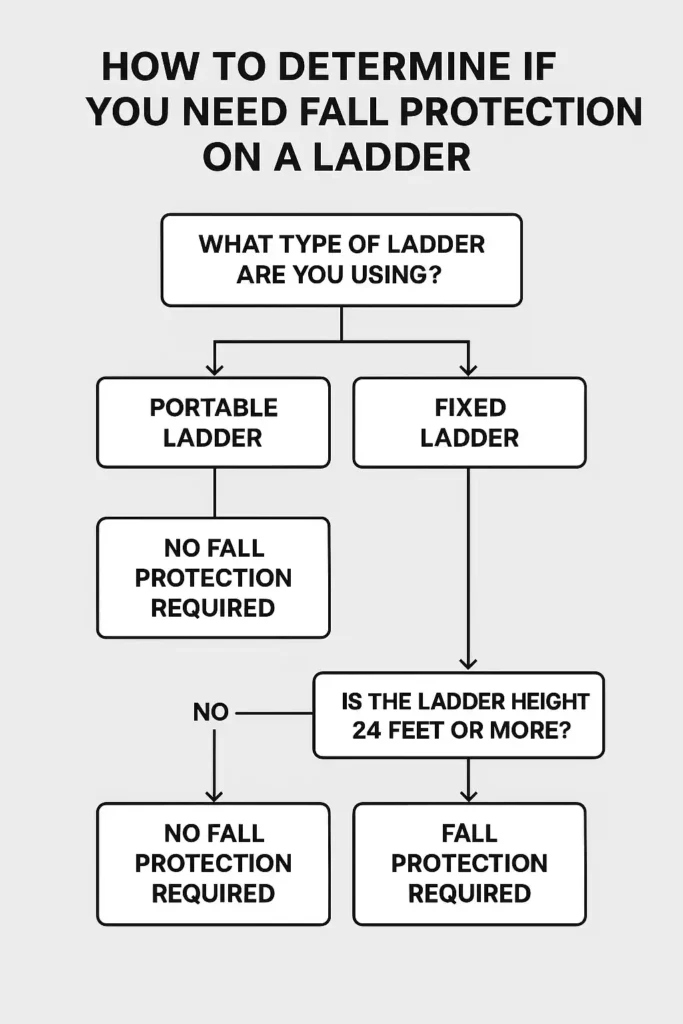
Here’s the simplified version of the OSHA ladder rules:
1. Portable ladders (A-frame, step ladders, extension ladders)
➡ You don’t need fall protection for normal use.
Even if you’re 20 feet up on an extension ladder.
That’s the rule.
2. Fixed ladders (the ones permanently attached to buildings or tanks)
➡ Over 24 feet: fall protection IS required.
These need a ladder safety system or a personal fall arrest system.
Cages used to be acceptable. Not anymore.
3. If a ladder is being used like a work platform
➡ Rules change. A ladder becomes “scaffolding” in OSHA language without you realizing it.
This is where people get in trouble, because they think,
“I’m just standing here for a few minutes,”
and suddenly they’re violating three different standards.
When Fall Protection May Be Needed on a Ladder
| Situation | Is Fall Protection Recommended? | Why |
|---|---|---|
| Ladder near roof edge | ✔ Yes | High risk of swinging or falling off the side. |
| Ladder on uneven/slippery ground | ✔ Yes | Increased instability. |
| Using power tools requiring force | ✔ Yes | Sudden movement can knock you off balance. |
| Working in high winds | ✔ Yes | Ladder sway risk. |
| Standing on ladder for long periods | ✔ Yes | Fatigue increases fall risk. |
| Only climbing briefly | ❌ Probably no | Low exposure time. |
| Indoors on stable surface | ❌ Usually no | Controlled environment. |
So Why Don’t We Use Harnesses on Ladders?
Good question. And here’s the real answer:
Because tying off while using a portable ladder can actually make it MORE dangerous.
You anchor the lanyard wrong, and the force of a fall can pull the ladder over.
You tie off to something weak, and the anchor fails.
You tie off too low, and you won’t have enough clearance for the fall arrest to work.
And let me tell you—from someone who has actually tried climbing while tied off—it’s awkward, unbalanced, and not something you want to do unless you really need to.
So OSHA avoids forcing workers to do something that’s actually riskier.
But Do You Need Fall Protection at Low Heights?
Officially, no.
Reality? It’s complicated.
Let’s talk about the real jobsite—not the textbook.Situations When Fall Protection Makes Sense (Even If OSHA Doesn’t Require It)
There are certain times when I tell workers:
“Harness up. I know OSHA doesn’t require it here, but trust me—you need it.”
Here’s when:
1. You’re working near an edge
If a ladder is close to a roof edge or mezzanine, you’re basically one slip away from a serious fall.
I’ve seen a guy step off the ladder sideways and forget there wasn’t a floor next to him.
2. The ladder is on uneven or sketchy ground
Gravel, mud, sand, wet concrete, or soft soil.
Those are ladder killers.
3. You’re using both hands for heavy or forced work
Grinding
Drilling
Hammer-drilling overhead
Tightening a stubborn bolt
If the force you’re applying is strong enough to move your whole body, you’re at risk.
4. You’re working in high winds
I’ve been on outdoor sites where you could feel the ladder move a little with each gust.
No fun.
5. You’re standing on the ladder for a long time
The longer you stand there, the more tired your legs get… and tired legs make mistakes.
Why People Actually Fall (This Is the Part Workers Don’t Want to Admit)
| Worker Behavior | Risk Level | Why It Causes Falls |
|---|---|---|
| Overreaching sideways | 🔥 Very High | Shifts center of gravity. |
| Carrying tools by hand | High | Loses balance, no free hand. |
| Wrong ladder angle | High | Ladder slides or tips. |
| Standing on top cap | High | No stability. |
| Using A-frame while closed | High | Structure not designed for load. |
| Slippery footwear | Medium | Feet slip on rungs. |
| Rushing up/down | Medium | Missed steps. |
The ladder doesn’t cause the fall.
The worker causes the fall.
And I’m not judging—we’ve all done at least one of these:
✔ Overreaching
You know that moment when you think, “I can reach this; I don’t need to climb down and move the ladder.”
That’s the #1 reason for ladder accidents.
I’ve seen guys fall sideways from 8 feet because of this.
✔ Rushing
Coming down fast.
Skipping steps.
Not keeping 3 points of contact.
✔ Carrying tools in one hand
Instead of using a tool belt.
A cordless drill has taken more workers down than rain has.
✔ Climbing with slippery boots
Wet soles, muddy soles, or dusty soles.
You don’t notice it until the ladder starts wobbling.
✔ Wrong ladder angle
Especially for extension ladders.
Too steep or too shallow = unstable.
✔ Using a closed A-frame ladder like an extension ladder
Yes, everyone has seen this.
And yes, it’s a fall waiting to happen.
When I DO Tell Workers to Wear a Harness on a Ladder
Even though OSHA doesn’t require it, there are cases where a harness is the smarter move:
✔ Working at height inside a structure with good anchor points
Like beams, overhead rails, or solid steel.
✔ Ladder work near machinery, conveyors, or dangerous drop-offs
You might not fall far, but you could fall into something much worse.
✔ Ladder work inside towers or tanks
You’re in a confined space with weird angles and slippery surfaces.
✔ When climbing a ladder repeatedly all day
Fatigue builds up and mistakes happen.
✔ Where company policy says so
Some job sites follow stricter rules than OSHA.
And if that’s the case—follow them. The foreman makes the call.
But Let’s Be Really Honest Here…
Even if OSHA doesn’t require fall protection, the danger is still real.
Just because the law says you don’t need a harness doesn’t mean the fall won’t hurt.
I’ve seen:
- Broken wrists
- Sprained ankles
- Fractured ribs
- Torn shoulders
- Concussions
- Ruptured discs
—all from ladder falls under 10 feet.
10 feet doesn’t sound like much until you’re the one falling backward with no control.
So even without a harness, you STILL have to treat ladder work like it matters.
Because it does.
If You Are Going to Use a Harness, Do It Right
Using fall protection on a ladder safely is an art.
Here’s how to do it without creating more danger:
Use a self-retracting lifeline (SRL)
A long lanyard will give you too much fall distance.
You’ll hit the ground before it catches you.
Anchor overhead, not to the ladder
Never—seriously, NEVER—clip to the ladder itself.
Check your fall clearance
If you only have 8 feet of space but need 14 feet of clearance, the fall arrest won’t save you.
Make sure the anchor is solid
Some people tie off to pipes or rails that can’t support 5,000 lbs.
That’s how anchors snap off and become missiles.
What I Tell New Workers on My Sites
When guys ask me if they need fall protection at any ladder height, I tell them this:
1. Know the rule: portable ladders don’t require fall protection.
No need to argue with OSHA.
2. But also know the reality: falls still happen.
And they don’t care what the rulebook says.
3. Think about your specific situation.
Is the ladder shaky?
What are you doing?
What’s around you?
Are you tired?
4. If it feels unsafe, it IS unsafe.
No rulebook can replace common sense.
5. When in doubt, ask your foreman or competent person.
Every jobsite is different.
A Few Quick Worker FAQs (Real Answers, Not Corporate Ones)
“Do I need a harness on a 6-foot ladder?”
No. Not required. But be smart.
“Is it illegal to use fall protection on a ladder?”
No. It’s allowed—just make sure you’re anchored safely.
“Does OSHA require fall protection at 4 feet?”
For ladder work: no.
For walking/working surfaces: yes.
For scaffolds: 10 feet.
For steel erection: 15 feet (mostly).
“Can my employer require fall protection even if OSHA doesn’t?”
Absolutely. Their site, their rules.
“Do I need fall protection if I’m just going up and down all day?”
Not required. But fatigue increases your risk.
Final Thoughts: You Don’t Always Need Fall Protection… But You Always Need to Think
Here’s the truth workers respect:
Ladders don’t seem dangerous until you fall—then they become very dangerous.
Fall protection isn’t always required, and honestly, it isn’t always the right tool for ladder work.
But climbing smart?
Setting up properly?
Not rushing?
Using a tool belt?
Keeping 3 points of contact?
Those can prevent almost every ladder fall I’ve ever seen.
So no—you don’t need fall protection at ANY height on a ladder.
But you DO need judgment, awareness, and respect for what a simple slip can do to you.

Mike Pattenson is a construction safety trainer who loves helping workers stay safe on the job. He explains safety in a simple, practical way so crews can easily understand what to do — and why it matters.
Mike Pattenson is a construction safety trainer who loves helping workers stay safe on the job. He explains safety in a simple, practical way so crews can easily understand what to do — and why it matters.
View All Articles