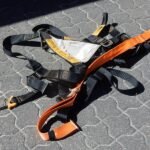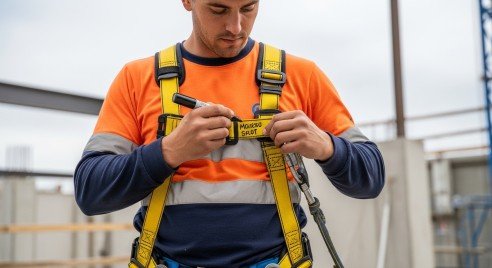
Let me tell you something I’ve seen more times than I can count: a worker opens a brand-new, still-crisp fall protection harness… and before even adjusting the chest strap, he whips out a fat black marker and writes his name in giant letters across the shoulder strap.
And then everybody on site starts asking the same question:
“Is it okay to write on a fall protection harness?”
Honestly? It depends.
And the answer isn’t as simple as “yes” or “no”—but I’ve been around long enough, and I’ve seen enough harnesses ruined by overzealous markings, that I can give you the real-world version of the answer.
Not the textbook version. Not the stuffy safety-manual version. The “I’ve worn harnesses every day for years, and I know what works and what gets you in trouble” version.
So let’s talk about it.
Why People Want to Write on Their Harnesses in the First Place
Before we even talk about rules, let’s be honest: writing on your harness is convenient.
Workers do it for a reason.
Here’s what I’ve seen:
✔ Everyone’s harnesses look the same
Especially during training classes or site orientations. Twenty people show up, twenty harnesses get handed out, and suddenly nobody remembers which one they grabbed first.
✔ People get tired of coworkers “borrowing” their gear
This happens daily on jobsites.
You hang your harness on your locker or on your hook in the gang box… and by lunch it magically disappears and someone else is wearing it.
✔ Labels fade, peel, or get torn
Most harness tags don’t survive long. After a few months of sweat, rain, sun, and friction, the label looks like it survived a war. Writing your initials helps you identify your harness quickly.
✔ It’s faster than filling out an inspection log
A quick “JP-07” marked on the end of a strap can help you match your harness to its entry in the equipment log.
So I get it.
Workers aren’t trying to break rules—they’re just trying to keep track of their gear.
But convenience doesn’t always mean it’s safe… or allowed
Does Writing on a Harness Make It Unsafe? Let’s Clear Up the Myths
One of the oldest rumors on jobsites is this:
“Writing on the webbing weakens the harness.”
Guys repeat this like gospel, but most don’t know where it came from.
Here’s the truth:
Ink from a normal marker does NOT magically destroy polyester webbing.
Polyester fibers are incredibly tough. They’re designed to handle thousands of pounds of force during a fall arrest. A few milligrams of Sharpie ink won’t dissolve them.
BUT…
there are a few things you DO need to watch out for:
⚠ Some industrial markers use solvents
Certain paints, inks, or industrial markers have chemicals that can weaken fibers over time—especially if you soak the webbing.
⚠ If you write over stitching, it can hide damage
A major part of harness inspection is spotting broken threads, frayed stitching, or cuts. Writing over stitching makes this much harder.
⚠ Covering the label can void the harness
If an inspector can’t read the label, the harness becomes “questionable”—and questionable usually means “remove from service.”
So no—writing doesn’t usually “weaken” a harness.
But writing in the wrong place can make it fail inspection, which is basically the same thing.
Safe vs Unsafe Areas to Write on a Fall Protection Harness
| Safe to Write On | Why It’s Safe | Unsafe to Write On | Why It’s Unsafe |
|---|---|---|---|
| Inside of shoulder strap | Hidden, non-load-bearing | Labels / Tag | Covers inspection info; makes harness non-compliant |
| End of leg strap (loose end) | Easy to identify, away from stitching | Load-bearing stitching | Hides thread damage; inspection failure |
| Back D-ring plate (plastic) | Doesn’t affect webbing | Shock pack / energy absorber | Can hide deployment indicators |
| Inside of waist strap | Protected, low stress | Main torso straps under tension | Writing here risks covering damage |
| Extra non-structural webbing tabs | Not weight-bearing | Hardware connectors / metal parts | Writing may hide cracks or manufacturer details |
Acceptable vs Not Acceptable Markings
| Acceptable Markings | Reason | Not Acceptable Markings | Reason |
|---|---|---|---|
| Initials (e.g., “JP”) | Small, non-intrusive | Large graffiti names | Covers too much surface area |
| Employee number | Helps with ID tracking | Drawings, logos | Distracts from inspection |
| Harness ID / serial match | Supports equipment logs | Offensive words / phrases | Unprofessional & often prohibited |
| Small inspection code | Helps simplify inventory | Phone numbers / big text blocks | Too large; may hide damage |
| Crew / department initials | Useful for group gear | Anything over 2 inches wide | Excessive, may interfere with inspection |
What OSHA and Harness Manufacturers Actually Say
Let’s keep this simple.
OSHA:
They don’t have a rule that directly says,
“Thou shalt not write on thy harness.”
Nothing like that.
OSHA stays more general. They say employers must use fall protection equipment according to the manufacturer’s instructions.
And that’s where things get serious.
Manufacturers:
They’re the ones who decide whether writing on the harness is permitted, because they designed and tested it.
Most manufacturers fall into one of three categories:
1. “You can write on it, but only in approved areas.”
They typically allow marking:
- on the inside of straps
- on non-load-bearing areas
- on plastic hardware, like the D-ring plate
- on the ends of straps, away from stitching
This is the most common stance.
2. “Limited marking only.”
Some manufacturers allow only initialing, and only with a fine-tip marker.
3. “No marking at all.”
A few are strict and don’t want writing anywhere.
They claim it could void warranties or interfere with inspections.
If you’re not sure, check the little booklet that came with your harness… you know, the one nobody reads. Manufacturers always include that instruction in there.
| Manufacturer Stance | Description | What Workers Can Do |
|---|---|---|
| Allows marking in approved areas | Most common policy | Write on strap ends, inside areas, plastic plates |
| Limited marking only | Very strict instructions | Initials only, fine-tip marker |
| No marking allowed | Rare but exists | Use ID tags, labels, or sleeves instead |
So Where Can You Write on a Harness?
Okay, now let me tell you what we do on real jobsites — the stuff that’s worked for years without anyone getting written up or failing an inspection.
Here’s where it’s generally safe to mark:
✔ Inside of the shoulder strap
It’s hidden, protected, and not a load-bearing area.
✔ End of the leg strap (loose flap part)
This is one of the most common places people put initials.
✔ Back D-ring plate (plastic or metal plate)
Perfect for labels or small initials.
✔ Inside of the waist strap
As long as it doesn’t interfere with adjusting it.
✔ On a small fabric tab away from stitching
Some harnesses have little extra webbing pieces that aren’t structural.
And here’s where you NEVER write:
❌ On the labels
This is the #1 thing that gets people in trouble.
If you cover or damage the label, your harness is basically done.
❌ Across the load-bearing stitching
Those pretty rows of threads? Yeah, inspectors look at those.
❌ On the shock-absorbing lanyard cover
NEVER write on or modify anything connected to a shock pack.
❌ Anywhere the manufacturer warns against
Simple rule: If they made the harness, trust their instructions.
This isn’t just “rules.”
It’s common sense backed by years of experience.
What You Should Write (and What You Shouldn’t)
If you have to write on your harness, keep it simple.
✔ Good things to write:
- Your initials (JB, MT, RP…)
- Your employee ID number
- A small equipment tracking number
- A tiny inspection code (if your company uses them)
❌ Bad things to write:
- Big graffiti-style names
- Drawings or large letters covering the webbing
- Phone numbers
- Jokes or offensive words (yes, I’ve seen this)
- Anything over 1–2 inches wide
- Anything that covers tags or stitching
If you’re writing so much that the harness starts looking like a middle-school notebook, you’ve gone too far.
Better Alternatives Than Writing Directly on the Harness
Here’s the part nobody tells you—but every experienced safety guy knows.
There are better options than taking a Sharpie to your gear.
✔ 1. Zip-tie ID tags
Attach it to the D-ring or strap end. Easy and removable.
✔ 2. ID sleeves or pouches
Some harness brands actually sell official ID pockets made for this.
✔ 3. Manufacturer-approved stickers
Certain brands allow small adhesive labels on the plastic D-ring plate only.
✔ 4. Color-coded Velcro wraps
Great for identifying departments, crews, or training groups.
✔ 5. A proper inspection log with serial numbers
Not fancy, but reliable.
Writing is always the last resort, not the first.
| Alternative Method | Strengths | Weaknesses |
|---|---|---|
| Zip-tie ID tags | Cheap, removable, easy | Can break or be lost |
| ID sleeves / pouches | Designed for harnesses | Costs more |
| Approved stickers on D-ring plate | Clean, visible | Limited space |
| Color-coded wraps | Great for crew identification | Not good for detailed info |
| Inspection log with serial numbers | Official & reliable | Requires daily discipline |
What Happens if You Write on the Wrong Part of the Harness?
Let me paint you a real picture.
A worker once wrote his name across the chest strap… big, bold letters, thick marker, right across the stitching. The harness looked like a billboard.
During a routine inspection, our competent person took one look at it and said:
“Nope. Pull it.”
Why?
Because:
- stitching was covered
- the label was partially marked over
- the webbing was saturated with ink
- the identification tag couldn’t be read clearly
That worker lost a $150 harness because someone told him writing was “fine.”
Moral of the story:
Writing isn’t dangerous… but writing in the wrong place absolutely is.
So… Can You Write on a Fall Protection Harness? Here’s the Real Answer.
Let’s wrap it up in plain language — the way I’d explain it to a new guy on the job.
✔ Yes, you CAN write on a harness…
…but ONLY in the right spots, with the right marker, and without covering anything important.
✔ You MUST follow the manufacturer’s guidelines
They determine what’s acceptable.
✔ Never write over stitching, labels, or load-bearing areas
Those are deal-breakers.
✔ Use initials or small ID marks, not giant artwork
Keep it simple, keep it readable.
✔ If in doubt, use a tag or sticker instead
It’s safer and avoids headaches during inspection.
At the end of the day, your harness is what keeps you from hitting the ground.
Treat it with the same respect you’d treat anything that’s supposed to save your life.
Write on it if you need to…
Just do it smartly.

Mike Pattenson is a construction safety trainer who loves helping workers stay safe on the job. He explains safety in a simple, practical way so crews can easily understand what to do — and why it matters.
Mike Pattenson is a construction safety trainer who loves helping workers stay safe on the job. He explains safety in a simple, practical way so crews can easily understand what to do — and why it matters.
View All Articles