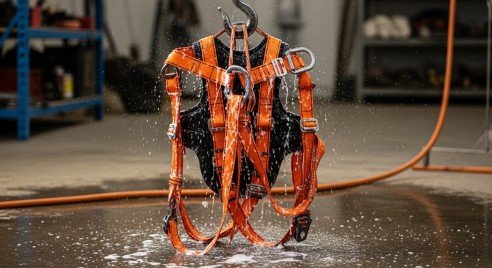
Let’s be honest—if you’ve used your fall protection harness for more than two shifts in a row, you already know it gets dirty fast.
Sweat, cement dust, grease, mud, grime, that random sticky stuff nobody wants to identify… it all ends up on your straps.
I’ve picked up harnesses that felt like a stale tortilla chip. I’ve grabbed ones that smelled like they were stored in a gym bag inside another gym bag.
And yes—I’ve also seen a guy try to “clean” his harness using brake cleaner. (Please don’t be that guy.)
So, let’s clear this up once and for all:
Yes, you can wash a fall protection harness.
But there’s a right way and a very wrong way to do it.
As someone who has cleaned plenty of harnesses—some so stiff you could stand them in the corner like a traffic cone—I’ll walk you through the exact do’s, don’ts, and what actually works without ruining your gear.
Why This Even Matters (Besides the Smell)
First things first: we’re not talking about washing a T-shirt here. Your harness is life-support equipment. The only thing standing between you and a 20-foot fall is a few inches of webbing and stitching.
If that webbing gets weakened—even a little—you don’t see it right away. It doesn’t tear in the bucket. It tears when you least want it to.
So the goal when cleaning a harness is:
Remove dirt, sweat, and grime without damaging anything.
Simple concept, easy enough to follow… unless people start bringing out pressure washers and chemicals like they’re prepping an engine block.
Let’s break it down.
Can You Actually Wash a Fall Protection Harness? Yep—Here’s How.
| Cleaning Method | Allowed? | Notes / Why |
|---|---|---|
| Mild soap + water | ✔ Yes | Safest and recommended by all manufacturers |
| Soft brush | ✔ Yes | For stubborn dirt; avoid harsh scrubbing |
| Damp rag/sponge | ✔ Yes | For light cleaning |
| Air drying | ✔ Yes | Keep out of sunlight |
| Washing machine | ✘ No | Twists/stretches webbing; damages stitching |
| Dryer | ✘ No | High heat weakens fibers |
| Pressure washer | ✘ No | Cuts into webbing like a blade |
| Bleach, solvents, gasoline | ✘ No | Chemically damages fibers |
| Soaking for hours | ✘ No | Weakens webbing & rusts metal parts |
Common Contaminants vs. How to Clean Them
| Contaminant | Cleaning Method | Notes |
|---|---|---|
| Sweat | Mild soap + water | Gentle scrubbing only |
| Dirt/mud | Soft brush + soap | Rinse lightly |
| Cement dust | Damp cloth + soap | Don’t inhale dust while cleaning |
| Grease/oil | Spot clean only | If deeply soaked → replace harness |
| Paint | Usually cannot be removed | May require replacement |
| Chemicals | Replace harness | Never attempt to wash chemical contamination |
1. Mild Soap + Water = Your Best Friend
If you only remember one thing from this entire article, let it be this:
Mild soap and water is the ONLY cleaning method most manufacturers approve.
Not industrial degreasers.
Not solvents.
Not whatever you found under the truck seat.
I use regular dish soap—nothing fancy. A few drops in a bucket of lukewarm water does the job. Not hot water, not cold enough to freeze your hands—just warm.
Grab a sponge or soft rag, dip it in the soapy water, and start wiping the webbing. You’re not trying to drown the harness. You’re just cleaning the surface.
2. For Stubborn Dirt, a Soft Brush Works
You can use a soft-bristle brush, not a wire brush, not a Scotch-Brite pad, and definitely not sandpaper. (Yes, someone tried that once. No, it didn’t end well.)
A nylon brush—like a “baby toothbrush for harnesses”—is perfect.
3. Rinse It Gently
After scrubbing, rinse lightly with clean water.
And when I say “rinse lightly,” I mean:
No pressure washer.
No fire hose.
No blasting it with the truck wash.
Just enough water to remove the soap.
4. Air Dry Only
This is another big one.
Never throw a harness in a dryer.
Never hang it under direct sunlight to “dry faster.”
High heat and UV rays weaken the fibers.
I hang mine in a well-ventilated area—usually inside the tool room or in the shade. Let it drip-dry naturally. It usually dries overnight.
Material Type vs. Cleaning Risk
Every part of your harness handles cleaning a little differently. The webbing, the stitching, the metal D-rings, the padding—they’re not all built to survive the same soaps or the same kind of scrubbing.
Some parts are pretty tough, others get damaged way easier than you’d think. And if you clean the wrong piece the wrong way, you can weaken the whole harness without even realizing it.
So here’s a quick breakdown of what you can safely clean… and what you really shouldn’t mess with.
| Harness Component | Safe Cleaning Method | High-Risk Method | Notes |
|---|---|---|---|
| Webbing straps | Mild soap + water | Solvents, heat | Most sensitive part |
| Stitching | Light brushing | Harsh scrubbing | Damage may be invisible |
| Metal D-rings | Wipe clean | Chemical rust removers | Avoid rust buildup |
| Buckles | Mild soap | WD-40, lubricants | Lubrication often prohibited |
| Padding | Damp cloth | Soaking | Can trap water & mildew |
Signs You Should Clean It vs. Signs You Should Replace It
Sometimes your harness just needs a good cleaning… and sometimes it’s telling you it’s done for.
Dirt and sweat can be washed off, but damage is another story. Here’s how to tell when a simple scrub will fix the problem—and when it’s time to retire the harness for good.
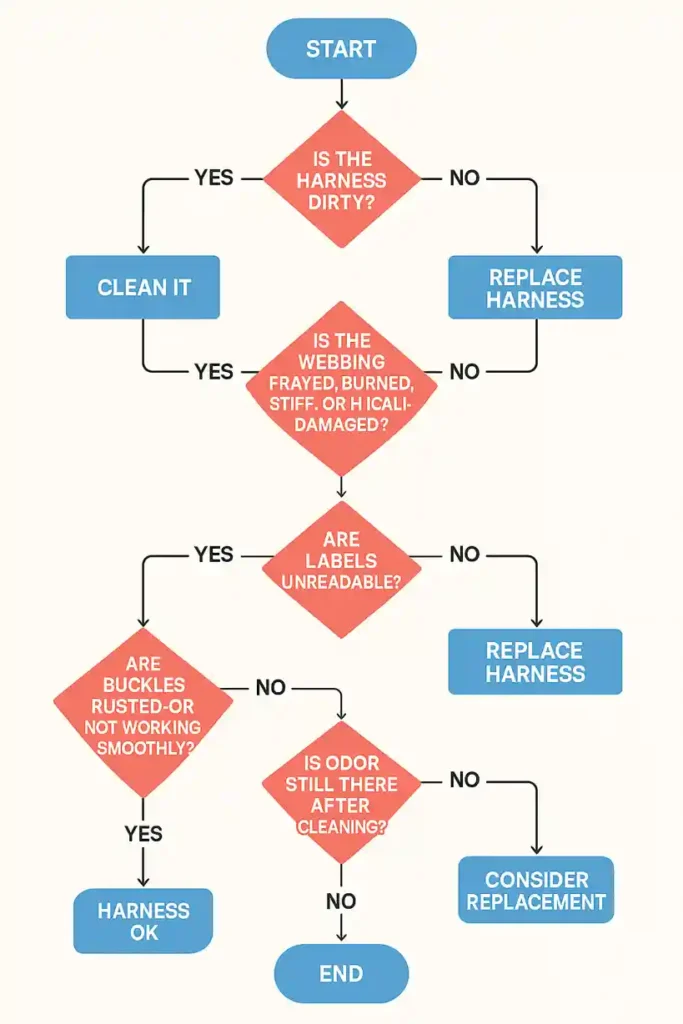
| Condition | Clean It | Replace It | Notes |
|---|---|---|---|
| Dirty, dusty, muddy | ✔ | ✘ | Regular washing is fine |
| Sweat smell | ✔ | ✘ | Cleaning helps unless fibers are damaged |
| Grease on surface | ✔ | ✘ | If only surface-level |
| Grease soaked into webbing | ✘ | ✔ | Cannot be safely washed |
| Faded color | ✔ | ✘ | Cosmetic only |
| Frayed webbing | ✘ | ✔ | Unsafe — retire harness |
| Burn marks | ✘ | ✔ | Heat damage cannot be fixed |
| Rusty buckles | ✘ | ✔ | Replace immediately |
| Unreadable labels | ✘ | ✔ | Automatically fails inspection |
Weekly vs. As-Needed Cleaning Scenarios
Not every harness gets dirty at the same rate. Some jobs beat it up daily, others barely touch it. Instead of guessing, here’s a quick way to figure out when your harness needs a regular weekly cleaning—and when the mess you’re dealing with calls for an immediate wash.
| Work Environment / Condition | Cleaning Frequency | Notes |
|---|---|---|
| Hot climate, heavy sweating | Weekly or every few shifts | Prevents odor buildup |
| Cement/concrete work | After shifts | Dust hides damage |
| Oil & grease areas | As needed | If absorbed → replace harness |
| Rainy/muddy jobsite | After shifts | Mud stiffens webbing |
| Light indoor work | Every 1–2 weeks | Minimal dirt exposure |
Safe vs. Unsafe Drying Methods
Drying a harness seems simple, but doing it wrong can ruin the webbing faster than the dirt ever did. Some drying methods keep your gear in good shape, and others quietly weaken it. Here’s the quick breakdown of what’s safe—and what you should stay far away from.
| Drying Method | Safe? | Notes |
|---|---|---|
| Hang in shade | ✔ Yes | Best option |
| Hang in well-ventilated room | ✔ Yes | No heat exposure |
| Under direct sunlight | ✘ No | UV weakens fibers |
| Clothes dryer | ✘ No | High heat damages webbing |
| Space heater/hot air | ✘ No | Heat degradation risk |
| On truck dashboard | ✘ No | Direct sunlight magnifies through windshield |
Frequently Asked Questions Workers Always Ask
“Can I wash it every day?”
Sure. As long as you’re using mild soap and rinsing lightly, there’s no harm.
“Can I spray it with Febreze?”
Technically you shouldn’t spray anything with chemicals on it.
But if you must, spray VERY lightly and let it fully dry. Don’t soak it.
I still prefer soap and water.
“Can washing a harness make it fail inspection?”
Not if you wash it correctly.
But washing it wrong absolutely can.
“Can I soak it?”
No. Long exposure to water weakens fibers.
“Do I need to wash the metal parts?”
Just wipe them. Make sure they’re clean and not rusting.
“Can I dry it with a fan?”
Yes, that’s fine.
Final Thoughts: Keep It Clean, Keep It Safe
A fall protection harness is expensive, but not nearly as expensive as a hospital bill—or worse.
Cleaning your harness isn’t just about looking good. It’s about making sure:
- Inspections are accurate
- Damage isn’t hidden
- Straps stay flexible
- Buckles work smoothly
- You’re comfortable wearing it
- And most importantly: it keeps you alive
If there’s one thing I’ve learned from years on the job, it’s this:
A clean harness is a safe harness.
A dirty harness is a gamble.
And when you’re working at height, gambling is the last thing you want to do.

Mike Pattenson is a construction safety trainer who loves helping workers stay safe on the job. He explains safety in a simple, practical way so crews can easily understand what to do — and why it matters.
Mike Pattenson is a construction safety trainer who loves helping workers stay safe on the job. He explains safety in a simple, practical way so crews can easily understand what to do — and why it matters.
View All Articles