Let’s be honest for a second.
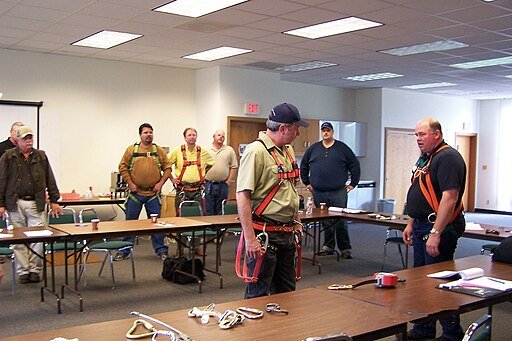
If you’ve worked in construction, maintenance, telecom, steelwork — anywhere people climb or work at height — you’ve seen harnesses being shared all the time.
Sometimes it’s one lonely harness hanging on the job trailer wall, and ten guys are expected to take turns with it. Sometimes it’s a random pile of tangled straps thrown inside a gang box, and whoever gets to it first gets the “best” one.
I’ve been that guy who grabbed a harness that was still warm from the last person who wore it. I’ve smelled sweat that wasn’t mine. I’ve tightened straps that were basically cemented into place.
And yes, I’ve worn a harness that clearly survived something dramatic — because the stains on it told a whole story.
So the question comes up a lot:
Can fall protection harnesses be shared?
Well… technically, yes.
But the better question is: Should they be?
Let’s talk about it the same way we’d talk on the jobsite — straight, real, and with a little bit of “I’ve seen some things.”
What OSHA Says About Sharing Harnesses
Let’s clear up the legal side first, because people love to say “OSHA doesn’t allow sharing!”
Actually, OSHA never said, “Thou shalt not share harnesses.”
Here’s what OSHA does say:
✔ Harness must fit the user
(OSHA 29 CFR 1926.502(d))
Does a shared harness always fit? Absolutely not. I’ve tried on shared harnesses where the torso strap ended somewhere around my neck and the leg straps felt like a medieval torture device.
✔ Harness must be inspected before each use
(OSHA 1926.502(d)(21))
Now be real with me:
Which crew is actually doing a full inspection every time ten people share one harness?
Exactly.
✔ Harness must be in good condition
(OSHA requires equipment to be removed if damaged or defective)
When five workers use the same harness, the chances of someone noticing — and reporting — damage? Pretty low.
So OSHA isn’t against sharing, but OSHA is VERY against unsafe harness use.
And shared harnesses become unsafe real quick if nobody takes care of them.
| OSHA Requirement | What OSHA Says | Common Problem When Harnesses Are Shared |
|---|---|---|
| Harness must fit the user | Proper fit is mandatory under 1926.502(d) | Shared harnesses rarely fit everyone; straps left in wrong positions |
| Harness must be inspected before each use | Required before every use | People assume the previous user inspected it |
| Harness must be in good condition | Damaged gear must be removed from service | Shared harnesses get worn out faster and damage goes unnoticed |
| Labels must be legible | Needed for identification and compliance | Labels often fade quickly when many people use it |
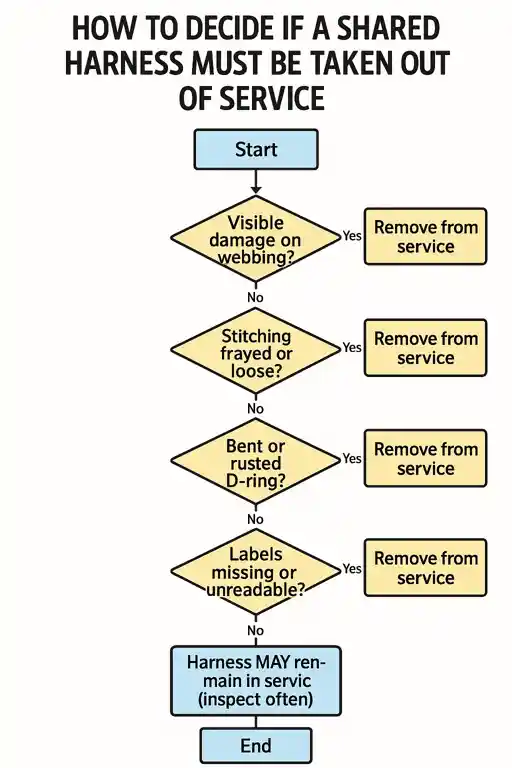
How to Decide if a Shared Harness Must Be Taken Out of Service
Situations Where Sharing Is Acceptable vs. When It Isn’t
| Acceptable to Share | Not Acceptable to Share |
|---|---|
| Orientation day | If the harness doesn’t fit properly |
| Visitors/inspectors | If damage is present or suspected |
| Emergency situations | If it was involved in a fall |
| Low-frequency use | If straps won’t adjust anymore |
| Backup/spare harness | If no one inspects it regularly |
| Small crew that maintains equipment well | If many different workers use it daily |
The Fit Problem: Harnesses Are Not One-Size-Fits-All
This is probably the biggest issue with shared harnesses.
Sure, the manufacturer may slap a big “UNIVERSAL SIZE” tag on it, but let’s be real here — that’s marketing. A harness that fits a 6’2″ 220-lb guy doesn’t magically fit a 5’4″, 140-lb worker just because the tag says so.
I’ve put on shared harnesses where:
- the shoulder straps rode up into my neck,
- the D-ring sat almost between my shoulder blades,
- the chest strap was way too high,
- and the leg straps were so loose I could’ve stepped right out of them.
A harness that doesn’t fit properly won’t protect you during a fall.
It might flip you, choke you, or fail completely.
When everyone shares one harness, nobody sets it back to “neutral.” They leave the straps in whatever awkward position they had it in — and the next poor guy has to deal with it.
Fit Problems That Happen With Shared Harnesses
| Harness Component | What the Fit Should Be | Common Fit Issues When Shared |
|---|---|---|
| Shoulder straps | Snug and even | Uneven or jammed straps |
| Chest strap | Level across mid-chest | Too high near the neck or too low |
| Leg straps | Tight but comfortable | Either too loose or painfully tight |
| D-ring | Between shoulder blades | Sits too high/low depending on user |
| Torso length | Adjusted for height | Rarely reset between users |
Hygiene: Let’s Not Pretend This Isn’t a Thing
We need to talk about the elephant in the room:
Shared harnesses get disgusting.
There’s sweat trapped in the webbing.
There’s grime rubbed into the straps.
There’s that smell that never fully goes away, no matter how many times you “freshen it up.”
Wearing someone else’s sweat is… an experience.
Not a pleasant one.
And while OSHA doesn’t care about whether the harness smells like three weeks of hard labor — your skin definitely will.
I’ve seen guys get rashes, breakouts, and irritation because they had to wear a harness that belonged to “the entire crew.”
Your harness touches your:
- shoulders
- chest
- stomach
- back
- thighs
- sometimes even your neck
That’s a lot of skin-to-strap contact for something that hasn’t been washed since Obama was president.
Inspection Problems: The More It’s Shared, the More It’s Neglected
Let’s be real:
Shared equipment = no one’s responsibility.
I’ve seen it too many times:
- Incorrectly buckled straps nobody fixed
- Torn webbing that “was already there”
- D-rings bent so slightly that only a trained eye notices
- Frayed stitching hidden in the dirt
- Rust on metal hardware
- Labels so faded you can’t read anything anymore
When a harness is shared, the mindset often becomes:
“Not my harness, not my problem.”
But OSHA requires every user to inspect before use.
In real life?
Most people only inspect gear they personally own or were personally issued.
Shared harnesses get beaten up twice as fast and cared for half as much.
Condition Issues Seen in Shared Harnesses
| Component | What Good Condition Looks Like | Typical Shared-Harness Damage |
|---|---|---|
| Webbing | Smooth, no frays or cuts | Frayed edges, paint, dirt buildup |
| Stitching | Tight and intact | Loose, pulled, or broken stitching |
| Buckles | Move freely | Jammed or hard to adjust |
| D-ring | No rust, no bend | Bent, rusted, or worn |
| Labels | Clear and readable | Faded, unreadable, or missing |
When Sharing Might Be Acceptable
Okay, sharing isn’t the devil.
There are some situations where it’s fine — or at least understandable:
✔ Orientation day
New hires need gear for their first walkthrough.
✔ Visitors or inspectors
Someone might need temporary protection.
✔ Emergency work
Something unexpected pops up and not everyone brought their harness.
✔ Small companies starting out
Budget is tight; everyone shares until the company grows.
✔ As a backup harness
Most sites keep one extra harness “just in case.”
Sharing can work when:
- the harness is cleaned,
- properly adjusted,
- inspected after every use,
- and hung in a clean, dry area.
The problem is… that’s not what usually happens.
When Sharing Becomes a Bad Idea (Most of the Time)
Let me give you the real-world version:
Sharing a harness is a bad idea when…
❌ It doesn’t fit the next guy
And no one bothers adjusting it.
❌ The straps are worn out
Shared harnesses get destroyed fast.
❌ Something feels “off”
But nobody knows who used it last or what they did with it.
❌ It was stored poorly
Thrown under a pile of tools, crushed under a compressor, soaked in rainwater, or used as a rat’s nesting material.
❌ It was involved in a fall
And everyone pretends they “didn’t know.”
❌ No one does inspections
Because everyone assumes the other person will do it.
❌ It’s a universal size harness
Which, in real life, fits nobody exactly right.
If you’re nodding at any of these, then yeah — sharing is a terrible idea.
Best Practice: Everyone Should Have Their Own Harness
This is what most safer companies eventually realize:
Giving each worker their own harness saves money — and injuries — long-term.
How having your own harness changes everything:
- You know exactly how it fits.
- You adjust it once, then only make small tweaks.
- You’re more likely to inspect it because it’s your butt on the line.
- You take better care of it.
- You’ll notice damage early.
- It lasts longer because only you use it.
It’s like having your own boots versus borrowing someone else’s.
The difference is night and day.
OSHA won’t fine you for sharing —
but they WILL fine you for:
- worn harnesses,
- improperly fitted harnesses,
- uninspected harnesses,
- equipment used beyond its service life,
- or gear not maintained properly.
Shared harnesses are a shortcut to all of those violations.
If You Have No Choice but to Share… Here’s How to Do It Safely
Look, not every company is rolling in money.
Not every jobsite has a gear room that looks like a Home Depot aisle.
Sometimes sharing is unavoidable.
So here’s how to share without being stupid about it:
✔ 1. Reset the harness after each use
Loosen all straps.
Put it back to a “neutral” state.
✔ 2. Clean the harness regularly
A little soap and warm water goes a long way.
✔ 3. Inspect it thoroughly
Every tear, every stitch, every buckle.
✔ 4. Document issues
If something looks wrong, tag it out.
✔ 5. Store it properly
Hang it up.
Keep it dry.
Keep it clean.
Don’t throw it in the back of the truck.
✔ 6. Don’t ignore weird things
If it looks like it was in a fall, DO NOT use it.
✔ 7. Limit how many people use it
If ten guys rotate one harness, that harness won’t survive a month.
My Real Answer: Yes, You Can Share Harnesses… But I Wouldn’t
After years of climbing, tying off, checking gear, and seeing what happens when people don’t respect fall protection…
Here’s my honest take:
✔ Yes, you can share fall protection harnesses.
OSHA doesn’t forbid it.
✔ But no, you probably shouldn’t.
It causes more problems than it solves.
Fit issues, hygiene, extra wear, lack of accountability — they all pile up.
And I’ll say this from personal experience:
When it’s your own harness, you trust it more. You’re more comfortable. You’re safer.
I’ve used shared harnesses, and I’ve used personal ones.
The personal one always felt better, worked better, and made me feel a whole lot less nervous when stepping off a ledge.
At the end of the day, you only fall once.
So you might as well fall wearing gear you know is in good shape.
Final Thoughts
So, can fall protection harnesses be shared?
Yes — but only if you do it right.
And if you ask anyone who’s been in the field long enough, they’ll probably give you the same answer I’m giving you:
“It’s not illegal… but it’s also not the smartest idea.”
If your company can assign personal harnesses to each worker, do it.
If you’re stuck sharing, just make sure you’re doing the inspection, maintenance, and adjustments that OSHA requires — because no one else is going to do it for you.
Your harness is the one thing that keeps you alive when everything goes wrong.
Treat it like that.

Mike Pattenson is a construction safety trainer who loves helping workers stay safe on the job. He explains safety in a simple, practical way so crews can easily understand what to do — and why it matters.
Mike Pattenson is a construction safety trainer who loves helping workers stay safe on the job. He explains safety in a simple, practical way so crews can easily understand what to do — and why it matters.
View All Articles