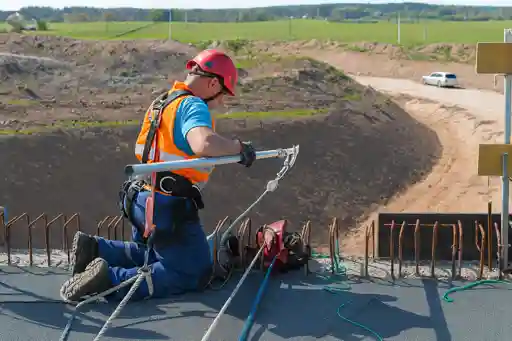
If you’ve ever worked on a roof, climbed a ladder on the job, or stepped onto a scaffold, you’ve probably heard the terms fall protection training and working at heights thrown around like they’re the same thing. And honestly?
It’s easy to mix them up. They’re often talked about together, and both relate to preventing falls—one of the biggest hazards in construction, maintenance, and industrial work.
But here’s the truth: they are not the same.
And understanding the difference is more important than most people realize. Whether you’re a worker trying to stay safe, a supervisor making sure your crew is protected, or an employer wanting to stay compliant, this comparison will make everything clearer (and much easier to explain during toolbox talks).
Let’s break this down in a friendly, simple way.
| Category | Fall Protection Training | Working at Heights Training |
|---|---|---|
| Main Purpose | Focuses on how to prevent falls and use fall protection systems safely. | Covers how to plan, work, and move safely while performing tasks at height. |
| Typical Focus Areas | Harness use, anchors, lanyards, lifelines, inspections, and basic rescue concepts. | Risk assessment, access methods (ladders, roofs, scaffolds, lifts), edge protection, and work procedures. |
| Scope | Centered on the fall protection system itself and how to use it correctly. | Broader view of all activities performed at height, including planning and job methods. |
| Hands-On Requirement | May be online-only or combined with basic hands-on practice, depending on provider. | Usually includes mandatory hands-on components with real equipment and setups. |
| Who Typically Needs It | Workers exposed to fall hazards who use harnesses, lanyards, or anchors. | Workers who actually perform tasks at height (on roofs, platforms, scaffolds, lifts, towers). |
| Typical Duration | About 1–4 hours depending on depth and format. | Around 4–8 hours, sometimes longer for full-day practical courses. |
| Regulatory Alignment | Designed to meet general OSHA/industry fall protection requirements. | Often tied to specific regional “working at heights” standards or certifications. |
| Certificate | Certificate of completion issued; acceptance depends on employer. | Formal certificate often required and more tightly regulated in some areas. |
Read Related Article: When is Fall Protection Training Required? (7 Situations)
Follow the questions to see which one you’re dealing with
Fall protection training
- Hazard recognition
- Harness fitting and use
- Anchor point selection
- Fall clearance calculation
- Equipment inspection
- Rescue procedures
Canada: Ontario WAH / ESC program
Working at heights
- Roof work
- Scaffold tasks
- Ladder use
- Aerial lift operation
- Overhead installations
- Edge work
Requires training first
What Exactly Is Fall Protection Training? (Let’s Keep It Simple)
Fall protection training is basically a crash course (pun intended) on how to keep yourself from falling—or getting hurt if you do fall.
Think of it as the knowledge and skills side of the job. It teaches workers:
- How to identify fall hazards
- How to choose the right fall protection equipment
- How to wear a harness properly
- How to connect to an anchor point safely
- How far you might fall if you slip
- How to inspect your gear
- What to do if someone falls and needs rescue
It’s about understanding the “why” and “how” behind staying safe.
OSHA also requires fall protection training—no ifs, ands, or buts. If a worker is exposed to fall hazards, they must be trained. Not “maybe,” not “optional,” not “only if they’re new.” Training must be provided, and employers are responsible for making sure workers understand it.
In short: Fall protection training gives you the knowledge to stay alive and avoid injuries when working above ground.
Read Related Article: Is Fall Protection Training an All-Day Thing? (Shorter or Longer?)
What Does “Working at Heights” Mean?
Now on the flip side, working at heights is not training—it’s the actual work being done in elevated places.
Whenever you’re performing tasks where you could fall, you’re considered to be “working at heights.” Even if you’re only 4 feet off the ground in general industry or 6 feet in construction, OSHA already considers that a fall hazard.
Here are common examples of working at heights:
- Climbing on a roof
- Standing on scaffolding
- Using a ladder
- Operating an aerial lift
- Working near unprotected edges
- Fixing overhead installations
- Installing gutters, signage, or piping
Basically, if gravity can pull you down hard enough to hurt you, you’re working at heights.
So here’s the difference:
👉 Working at heights is the task.
👉 Fall protection training is the knowledge and preparation that keep you safe during that task.
One can’t safely happen without the other.
Read More About This Topic: Does OSHA Require Fall Protection Training Annually?
Why People Confuse the Two
It’s understandable—both deal with preventing falls. But here’s a simple way to think about it.
Imagine you’re driving a car.
- Driving is like working at heights.
- Driver’s training is like fall protection training.
You wouldn’t let someone drive without learning the rules of the road, right?
Same goes for heights. You shouldn’t send someone up a ladder or rooftop without knowing how to stay safe. Experience alone isn’t enough.
Why Fall Protection Training Matters (Even If You’ve Been Working at Heights for Years)
A lot of experienced workers say things like:
- “I’ve been climbing roofs since I was 18.”
- “I don’t need training—I’ve been doing this forever.”
- “I already know how to use a harness.”
And hey, confidence is good. But experience doesn’t replace training.
Here’s why fall protection training matters, always:
1. Job sites change constantly
New layouts, new openings, new elevations, new equipment. What was safe yesterday may not be safe today.
2. Equipment changes over time
Harnesses, lanyards, SRLs, leading-edge gear—technology improves, and rules evolve.
3. Hazards can be invisible
Weak anchor points, soft roofs, unstable ladders… These things don’t announce themselves.
4. Human error happens
Even the best workers make mistakes, especially when they’re tired, rushed, or distracted.
5. OSHA requires it
Enough said.
Training is about staying updated, staying sharp, and staying alive.
What You Actually Learn in Fall Protection Training
If you’ve never taken fall protection training, or it’s been a while, here’s what typically gets covered:
- How to spot hazards: Holes, edges, skylights, uneven surfaces.
- How to choose the right system: Guardrails, personal fall arrest, travel restraint, fall restraint, warning lines, etc.
- How to wear a harness correctly: Leg straps, chest strap, D-ring position.
- How to calculate fall clearance: Because falling 6 feet with a 6-foot lanyard doesn’t mean you’ll fall 6 feet.
- How to select good anchor points: What’s safe, what’s not.
- How to inspect your equipment: Checking for defects, damage, and wear.
- What to do during a fall rescue: Suspension trauma is real and dangerous.
Good training doesn’t just tell you what to do—it tells you why.
Who Needs Fall Protection Training?
Anyone who can possibly fall from:
- ladders
- roofs
- scaffolds
- platforms
- aerial lifts
- overhead workstations
- elevated walkways
…needs training. And yes, even if the work is “quick.” Most fall accidents happen during quick jobs.
Employers must make sure workers receive this training before they start working at heights—and retraining is required if:
- the worker uses equipment incorrectly
- new equipment is introduced
- a near-miss or fall occurs
- procedures change
Fall Protection Training vs. Working at Heights: A Simple Comparison
Here’s a quick table to make it even clearer:
| Topic | Fall Protection Training | Working at Heights |
|---|---|---|
| What it is | Safety education | The actual elevated work |
| Purpose | Prevent falls | Perform tasks at elevation |
| Legal requirement | Yes, mandatory | Yes, when fall hazards exist |
| Focus | Knowledge & skills | Completing the job |
| Examples | Harness fitting, hazard ID | Roof work, ladder use |
U.S. vs. Canada: How Fall Protection Training Rules Compare
If you’ve ever worked on both sides of the border — or if you’re training crews that do — you’ve probably noticed that the terminology shifts depending on which country you’re in. In the United States, we tend to talk about “fall protection training.” In Canada — especially in Ontario — the phrase you’ll hear most often is “working at heights training.” They’re closely related, but the regulatory frameworks behind them are quite different.
Here’s a side-by-side look at how the two countries handle it:
| United States | Canada | |
| Regulatory Authority | Federal — OSHA (Occupational Safety and Health Administration) sets and enforces standards nationwide under the Department of Labor. | Provincial — each province has its own occupational health and safety regulator. There is no single national equivalent of OSHA. Examples: Ontario’s Ministry of Labour, Alberta OHS, WorkSafeBC. |
| Primary Fall Protection Standard | 29 CFR 1926 Subpart M (construction) and 29 CFR 1910 Subpart D (general industry). | Varies by province. Ontario uses O. Reg. 213/91 (Construction Projects) and O. Reg. 297/13 (Awareness Training). Alberta uses the OHS Code Part 9. BC uses WorkSafeBC OHSR Part 11. |
| Common Training Term | Fall Protection Training. This is the phrase used in OSHA standards and across the industry. | Working at Heights (WAH) Training — especially in Ontario. Western Canada more commonly uses “fall protection training” aligned with the Energy Safety Canada (ESC) program. |
| Height Trigger (Construction) | 6 feet (1.8 m) above a lower level. | Generally 3 metres (10 feet) in most provinces. Alberta also requires protection at 1.2 m (4 feet) in permanent work areas. |
| Height Trigger (General Industry) | 4 feet (1.2 m) above a lower level. | Same 3-metre general threshold applies across most sectors. Some provinces trigger protection at lower heights if there’s a hazard below (machinery, water, sharp objects). |
| Government-Approved Training Program | No. OSHA requires training content and a competent/qualified trainer, but does not approve or certify specific training programs or providers. | Yes — in Ontario, Newfoundland and Labrador, and Nova Scotia. Ontario’s WAH training must be delivered by a provider approved by the Chief Prevention Officer (CPO) of the Ministry of Labour. Other provinces do not require government-approved programs but may follow industry standards like the ESC course. |
| Trainer Qualification | Competent person (construction, 1926.503) or qualified person (general industry, 1910.30). Defined by OSHA but no certification or licensing process for trainers. | Ontario: trainer must be approved by the CPO as part of the provider approval process. Alberta and BC: trainer must be a “competent person” under provincial OHS codes. Western Canada often uses ESC-certified instructors. |
| Mandatory Hands-On Component | Not explicitly required by OSHA, though best practice. Online-only training can meet the standard if the employer supplements it with site-specific practical instruction. | Yes — in Ontario, WAH training must include a practical (hands-on) component. The course cannot be completed entirely online. Workers must pass both a written test and a practical evaluation. Most provinces expect hands-on training for fall arrest systems. |
| Certificate / Credential | Certificate of completion issued by the training provider. No government-issued credential. Acceptance depends on the employer. | Ontario: government-issued WAH certificate through the Ministry’s Prevention Certification Management System. Valid for 3 years. Alberta/BC: ESC certificate is the industry standard, also typically valid for 3 years. Nova Scotia and Newfoundland also issue formal certificates. |
| Renewal / Expiry | No fixed expiration. OSHA requires retraining only when triggered by specific conditions (workplace changes, equipment changes, observed skill gaps). No calendar-based renewal. | Ontario: WAH certificate expires after 3 years. Workers must complete an approved refresher program before expiry to stay valid. Most other provinces follow a 3-year cycle as well, either by regulation or industry practice. |
| Penalties for Non-Compliance | Up to $16,550 per serious violation; up to $165,514 per willful or repeat violation (2025 OSHA penalty schedule). | Varies by province. Ontario: fines up to $100,000 and/or 12 months imprisonment for individuals; up to $1,500,000 for corporations under the OHSA. Alberta: administrative penalties up to $10,000 per infraction under OHS Act s.41. |
| Equipment Standards | ANSI/ASSE Z359 series (voluntary consensus standards widely adopted by industry and referenced by OSHA). | CSA Z259 series (Canadian Standards Association). Equipment manufactured after March 31, 2023 must meet current CSA Z259 editions. CSA standards are referenced directly in provincial OHS codes. |
| Portability Across Jurisdictions | OSHA standards apply federally. A worker trained in Texas meets the same federal standard as a worker in New York. State OSHA plans may add requirements but cannot reduce federal minimums. | Training may not transfer automatically between provinces. Ontario only recently began recognizing Newfoundland’s fall protection certification, with additional requirements. A worker trained in Alberta may need Ontario’s WAH course to work on Ontario construction sites. Best practice for multi-province crews: get the highest-standard base course (typically ESC) and add province-specific certifications as needed. |
What This Means in Practice
If you’re a U.S.-based trainer or employer, the biggest differences to understand are these:
- Canada’s system is more standardized in some provinces. Ontario’s WAH program is government-approved, government-certified, and has a fixed 3-year expiry. In the U.S., OSHA leaves it to employers to design and deliver training that meets the standard — there’s more flexibility, but also more room for gaps.
- Hands-on training is mandatory in Ontario, not optional. OSHA doesn’t explicitly require a hands-on component, though any good program includes one. In Ontario, the course literally cannot be completed without it. Workers must demonstrate harness fitting, equipment inspection, and system setup in person.
- Certificates expire in Canada. In the U.S., your fall protection training doesn’t have a built-in expiration date — retraining is event-driven, not calendar-driven. In Ontario and most other Canadian provinces, you’re on a 3-year renewal cycle whether or not anything has changed.
- Provincial rules don’t automatically transfer. A worker with a valid Alberta ESC certificate can’t just walk onto an Ontario construction site and start working at heights. They’d need Ontario’s CPO-approved WAH training. This catches a lot of cross-border and inter-provincial crews off guard.
- The height triggers are different. OSHA construction kicks in at 6 feet. Most Canadian provinces trigger at 3 metres (roughly 10 feet). That sounds like Canada is more lenient, but Alberta requires protection as low as 1.2 metres in permanent work areas — and both countries require protection at any height if there’s a hazard below (machinery, exposed rebar, water).
The bottom line: if your crews work in both countries, don’t assume one training program covers both. Check the specific requirements for the jurisdiction where the work is being performed — not where the worker was trained.
Common Mistakes Employers Make
I’ve trained a lot of crews over the years, and honestly, the mistakes tend to repeat themselves. If you’re an employer, take this as a friendly heads-up rather than a lecture:
- Assuming experience equals competence. “He’s been roofing for 20 years” is not the same as “he’s been trained and evaluated.” OSHA doesn’t accept tenure as a substitute for documented training.
- Skipping training for “quick” jobs. A five-minute task at height still needs the same protection as an eight-hour one. Most fall injuries happen on jobs everyone assumed were too short to matter.
- Treating fall protection as a one-time checkbox. Training isn’t “done forever” after day one. New equipment, new sites, and near-misses all trigger a need to retrain.
- Not documenting anything. If you can’t produce a sign-in sheet, a topics-covered list, and the trainer’s qualifications, OSHA treats it as if the training never happened — even if it did.
- Buying the gear but not teaching the system. Owning harnesses and lanyards isn’t compliance. Workers need to know anchor selection, fall clearance math, and inspection — not just how to clip in.
- Letting “we’ve always done it this way” override the rules. This is the mindset behind almost every repeat citation I’ve seen in inspection records.
Real OSHA Inspection Examples
It helps to see how this plays out in real life, not just on paper. These are real, publicly documented OSHA cases — not hypotheticals — and every one of them ties straight back to the basics we just covered.
The “quick task” fall
In September 2025, two roofers with Pasat Roofing and Solar Energy in Florida were installing a tarp — a task that probably felt routine — when they slipped from a roof over 20 feet up and fell into an empty pool.
One worker died, the other was seriously injured. OSHA found neither employee was wearing personal fall protection, and the employer hadn’t trained workers to recognize fall hazards. The citation: one willful and two serious violations, with $172,324 in proposed penalties.
The repeat offender
Elo Roofing in Jacksonville, Florida was investigated twice within weeks after a worker fell through a residential roof while removing skylight fixtures. OSHA found no guardrails, no safety nets, no personal fall arrest systems — and no alternative protection in place.
Because inspectors had already flagged similar hazards before, the citations included four willful, three repeat, one serious, and two other-than-serious violations, totaling over $750,000 in proposed penalties.
The skylight hazard
A framing and roofing contractor in Georgia lost a 54-year-old worker who stepped on a skylight and fell about 19 feet because the skylight had no guardrail or cover.
Even after the fatality, OSHA found the same company allowing employees to work without fall protection again just two months later at a different site.
The training gap
A Wisconsin roofing contractor was cited after a fatal fall in 2024 for two willful violations and one serious violation — not just for missing equipment, but specifically for never training the crew on fall protection in the first place. OSHA had already inspected that contractor’s job sites ten times before.
Notice the pattern? None of these started as a dramatic, unusual event. They started as normal workdays where fall protection got skipped — and in more than one case, it wasn’t the first time OSHA had been there.
Actual OSHA Standards and Citations
When people hear “OSHA standard,” it can sound abstract. Here’s what the actual rule numbers cover and why they show up on inspection reports so often:
| Standard | What It Covers | Why It Gets Cited |
| 29 CFR 1926.501 Fall Protection – General Requirements | Requires guardrails, safety nets, or personal fall arrest systems for construction workers at 6 feet or higher. | OSHA’s most cited standard overall — 15 years running. Usually unprotected edges, uncovered floor or roof openings, or workers simply not tied off. |
| 29 CFR 1926.503 Fall Protection – Training Requirements | Requires employers to train every worker exposed to fall hazards, and to document it. | Consistently in OSHA’s top 10. Most common reason: no training was provided at all, not that the training was inadequate. |
| 29 CFR 1926.451 Scaffolding | Requires fall protection at 10 feet on scaffolds, proper planking, and guardrails. | Frequently cited alongside 1926.501 because scaffold fall hazards and general fall hazards often show up on the same job. |
For fiscal year 2025, Fall Protection – General Requirements (1926.501) was OSHA’s single most cited standard across every industry — the 15th year in a row it’s held that spot, with roofing, framing, and siding contractors leading the citation count.
Fall Protection Training Requirements (1926.503) and Scaffolding (1926.451) also sit in OSHA’s top 10 most cited standards.
As for penalties: a serious violation currently carries a fine of up to $16,550, and willful or repeat violations can run as high as $165,514 per violation — and those numbers stack fast when an inspection turns up multiple citations at once, the way several of the cases above did.
Lessons Learned From These Incidents
A few things stand out every time I look at real case files like these:
- Fatal falls rarely happen on the “scary” jobs. They happen on ordinary tasks — tarping a roof, pulling a skylight fixture — where nobody stopped to tie off because it “wouldn’t take long.”
- Repeat citations are common. Several of the cases above weren’t first offenses. OSHA had already been on-site, already flagged the hazard, and the employer went right back to the old habits.
- “No training” shows up again and again as the root cause — not faulty equipment, not freak accidents, but workers who were never taught to recognize the hazard in front of them.
- Willful violations cost the most, by design. OSHA reserves the harshest penalties for cases where the employer knew about the hazard and didn’t fix it. That’s the gap between an honest mistake and a pattern of neglect.
Field Experience: What This Looks Like on a Real Job Site
In my own time training crews, the near-misses almost always trace back to the same handful of habits: a worker who unclips “just for a second” to move a tool, an anchor point that was never actually load-rated for a person, or a supervisor who assumes the new hire already knows how to inspect a harness because “everyone does.”
None of that shows up as dramatic in the moment. It just quietly stacks the odds against someone — until the day it doesn’t work out. That’s really the whole point of training: it’s not about scaring anyone, it’s about closing the small gaps before gravity finds them for you.
Case Study: How Training (or the Lack of It) Changes the Outcome
Take two roofing crews doing the exact same task — tarping a roof after a storm, 20+ feet up.
Crew A skips fall protection because the job “won’t take long.” No training on record. If something goes wrong, the outcome mirrors the Pasat Roofing case above: a preventable fall, a willful citation, and a penalty north of $170,000 — on top of the human cost, which no dollar figure covers.
Crew B ties off with a properly inspected harness and rated anchor point, because every member completed fall protection training and it’s simply what they do without thinking twice. Same task, same height, same weather — but a completely different set of odds.
The equipment cost is nearly identical between the two crews. The training cost is a few hours. The difference in outcome is everything.
Final Thoughts
At the end of the day, working at heights is the job—but fall protection training is what makes that job safe. One is physical, the other is educational, and you need both to prevent accidents.
Whether you’re a worker climbing up for the first time or a seasoned pro, fall protection training gives you the awareness and skills to go home safely every day. And for employers, making sure your team is trained isn’t just about OSHA compliance—it’s simply the right thing to do.
Because the truth is simple:
You don’t rise into danger.
You rise into responsibility.
And knowing the difference between fall protection training and working at heights is a big step toward a safer job site.

Mike Pattenson is a construction safety trainer who loves helping workers stay safe on the job. He explains safety in a simple, practical way so crews can easily understand what to do — and why it matters.
Mike Pattenson is a construction safety trainer who loves helping workers stay safe on the job. He explains safety in a simple, practical way so crews can easily understand what to do — and why it matters.
View All Articles