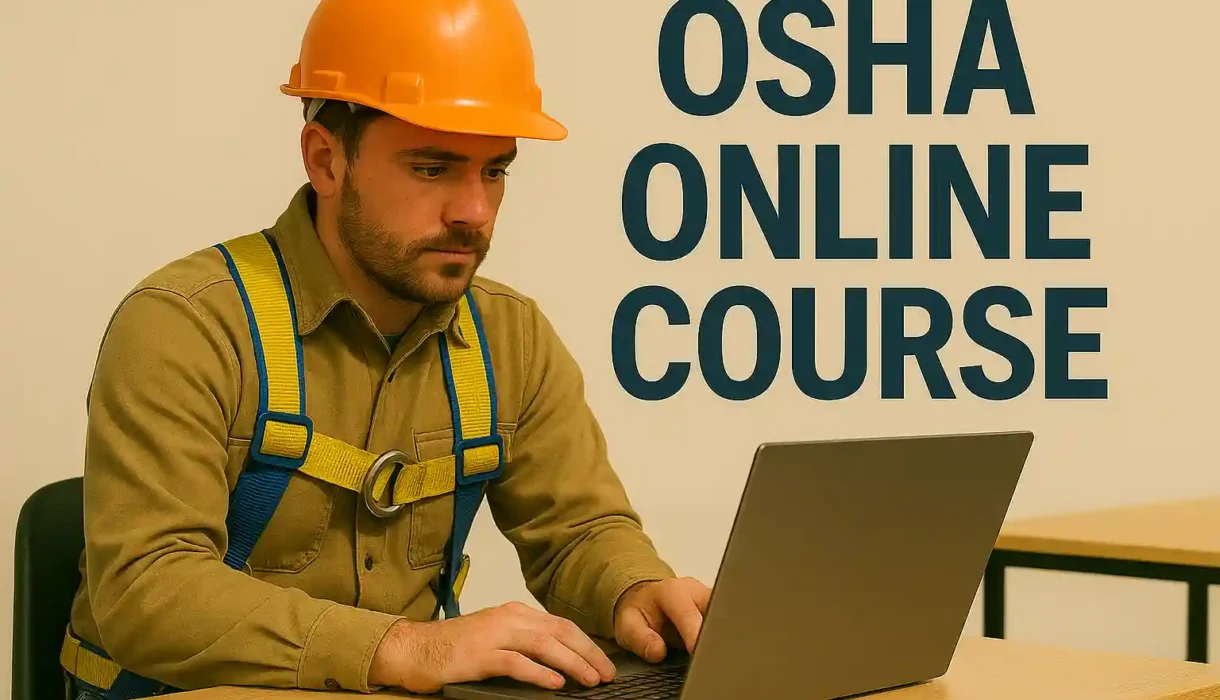
Let’s be honest—this question comes up all the time. I’ve lost count of how many workers, supervisors, or even business owners have asked me, “Boss, pwede na ba online fall protection? Tatanggapin ba ’yan ng OSHA?”
And I get it. Online training is cheap, fast, and convenient. You can do it on your phone while drinking coffee, instead of sitting in a training room for hours.
But here’s the thing: when it comes to OSHA and fall protection training, the rules aren’t as straightforward as people think.
So let’s break this down in a way that makes sense… without the legal jargon, without the complicated OSHA wording—just real talk from someone who’s seen this stuff play out on job sites for years.
OSHA Doesn’t “Approve” Courses—Let’s Clear That Up First
A lot of people think OSHA has a list of “approved courses” or “certified online providers.”
Nope. That’s not how OSHA works.
OSHA does not stamp courses with an approval logo.
OSHA does not endorse specific companies.
OSHA does not issue a certificate themselves.
What OSHA does is set the requirements for what fall protection training must include. The biggest requirement? The training has to be delivered by someone who is competent or qualified—meaning they actually know what they’re talking about.
So technically, an online course can be used for part of the training… but only part.
| OSHA Requirement | Online Training | In-Person Training | Compliant? |
|---|---|---|---|
| Classroom/theory | ✔ Allowed | Optional | Yes |
| Physical demonstration | ✘ Not allowed | ✔ Required | Yes |
| Competent person evaluation | ✘ Not possible | ✔ Required | Yes |
| Site-specific training | ✘ Not covered | ✔ Required | Yes |
| Documentation by employer | ✔ Provided (partial) | ✔ Final documentation | Yes |
Can You Do Fall Protection Training Online? Yes… But Not 100%
Here’s where most people get confused.
There are two parts to fall protection training:
1. Classroom / theory portion
This includes things like:
- OSHA rules
- Types of fall protection
- How fall arrest systems work
- Fall clearance calculations
- Hazard identification
- Worker responsibilities
This part can absolutely be done online.
No problem there. OSHA is fine with that.
2. Hands-on / practical portion
This is where online training hits the limit.
Online training cannot teach:
- How to put on your harness correctly
- How to adjust the straps so they’re not choking you
- How to connect to an anchorage properly
- How to inspect your lanyard
- How to use SRLs or horizontal lifelines
- How fall clearance really works in real life
- How to perform a basic rescue
No video or online module can replace actual physical practice. Trust me, I’ve seen workers who “passed” an online course but couldn’t even find the chest strap on their harness when OSHA walked up.
So here’s the simple rule:
✔ Online = OK for theory
✘ Online-only = NOT OSHA-compliant
| Situation | Online Training Only | Online + Hands-On | Acceptable to OSHA? |
|---|---|---|---|
| New employees | ✘ | ✔ | Yes |
| Experienced workers (retraining) | ✔ | Optional | Yes |
| Workers switching to new equipment | ✘ | ✔ | Yes |
| Office/admin staff | ✔ | Not needed | Yes |
| Supervisors needing awareness | ✔ | Not needed | Yes |
| Roofers, tower workers, high-risk jobs | ✘ | ✔ | Yes |
| Annual refresher training | ✔ | Optional | Yes |
Why Hands-On Training Matters (This Part Gets Ignored Too Often)
Let me tell you a little story.
I once visited a site where all the workers had online fall protection certificates. Looked legit. Nice designs, logos, everything. But one guy—great worker, by the way—put on his harness like he was wearing a backpack for a school field trip.
Chest strap at the stomach.
Leg straps twisted.
D-ring sitting somewhere near his shoulder blade.
If he fell, the harness would’ve done more harm than good.
That’s why OSHA insists on hands-on evaluation.
It’s not about the certificate—it’s about whether you can actually use the equipment safely.
Falls are still the number one cause of death in construction.
OSHA takes this seriously, and we should too.
What an Online Course Can Actually Teach You Well
Despite the limitations, online courses are very useful for the “classroom” part. In fact, most workers prefer listening to videos and animations instead of a monotone instructor reading slides.
Here’s what online training usually handles well:
- Difference between fall arrest and fall restraint
- How anchorage points work
- The ABCD of fall protection
- Swing fall hazards
- Calculating fall distance
- Types of harnesses and connectors
- Employer vs worker responsibilities
- Common jobsite hazards
- OSHA’s 1926 Subpart M basics
These topics don’t require physical demonstration—you just need to understand the principles. So yes, online is perfectly fine for these.
| Training Topic | Can Online Course Cover It? | Requires Hands-On? | Notes |
|---|---|---|---|
| OSHA rules & regulations | Yes | No | Fully acceptable online |
| Hazard recognition | Yes | No | Clear visuals help |
| Types of fall protection systems | Yes | No | Good for slides & videos |
| Harness inspection | Partially | Yes | Must be evaluated in person |
| Proper harness fitting | No | Yes | Needs physical adjustment |
| Anchorage selection | Partially | Yes | Depends on jobsite |
| Using SRLs or lanyards | No | Yes | Must be demonstrated physically |
| Rescue techniques | No | Yes | Hands-on required |
What Online Courses Cannot Do (And OSHA Won’t Accept It)
Here’s the part OSHA will actually check during inspections:
- Can you put on your harness correctly?
- Do you know how to inspect your equipment?
- Do you know the correct anchor point?
- Do you know how to connect safely?
- Can you adjust the harness properly so it won’t hurt you during a fall?
- Do you understand how your specific equipment works?
- Can you identify a damaged SRL or lanyard?
OSH inspectors don’t care if you watched the video.
They care if you understood it and can apply it physically.
If a worker is relying only on an online course, they’re not fully trained.
Employer’s Responsibility (This Part Surprises People)
Many people think the worker is responsible for getting trained.
Nope.
OSHA puts the responsibility on the employer.
Even if you completed the most detailed online course in the world, the employer still has to:
- Provide site-specific training
- Give hands-on practice
- Show you the actual equipment used on the site
- Evaluate that you can use it safely
- Document everything
So an online certificate is not “full training”—it’s half the job.
The employer must finish the other half.
When Online Training Is Good Enough
Online courses are great for certain situations, especially when the worker already has experience.
Online “classroom” training works well for:
- Refresher training on theory
- Retraining after new OSHA updates
- Awareness-level training for office staff or supervisors
- Supplementing toolbox talks
- Workers who already have hands-on experience
If someone has worn a harness for years, they don’t need to redo the physical part every time—unless something major changed or they forgot how to use their equipment.
When Online Training Alone Is Not Enough
But online-only training will NOT pass OSHA’s expectations when:
- The worker is new
- The worker has never worn a harness
- New equipment is introduced
- High-risk jobs are involved (roofing, tower work, elevated platforms)
- The jobsite has unique hazards
- There is a history of fall incidents
This is why the employer must step in with hands-on practice.
How OSHA Checks If Your Training Is Legit
If OSHA visits the site, they don’t just look at certificates.
They talk to the workers.
Here are the common questions inspectors ask:
- “Show me how you inspect your harness.”
- “What’s your anchor point here?”
- “Explain how your lanyard works.”
- “What’s your fall clearance?”
- “What’s the swing fall hazard in this area?”
If the worker can’t answer—or gives a wild guess—OSHA sees that as proof of inadequate training.
You can have the fanciest online certificate printed on glossy paper…
but if you can’t explain the basics, OSHA won’t consider you properly trained.
So, Are Online Fall Protection Courses OSHA-Approved? Here’s the Straight Answer
Let’s cut through all the confusion.
Online course alone = NOT OSHA-Approved
Because OSHA requires hands-on evaluation.
Online + hands-on = OSHA-Compliant
This is the proper setup:
- Do the online classroom portion
- Employer gives hands-on practice
- Employer evaluates and documents competency
This meets OSHA’s fall protection training requirements.
So the short answer is:
Online training is accepted as part of the process, but not the entire process.
What to Look For in a Good Online Fall Protection Course
If you’re planning to take (or offer) online training, here’s what you should look for:
✔ Clear, simple explanations
Not all workers are used to technical terms.
✔ Visual demonstrations
Videos showing equipment use are super helpful.
✔ A printable certificate
This is for the classroom portion only.
✔ A checklist for the employer
Some providers give a hands-on evaluation form.
This is gold—your employer can sign off after evaluating you.
✔ Up-to-date OSHA content
The course should include the latest Subpart M requirements.
✔ Easy to understand, not boring
Let’s be real—boring training doesn’t work.
Final Thoughts From Someone Who’s Seen Too Many Mistakes
After years of working with crews, doing inspections, and training hundreds of workers, here’s what I always tell people:
Online training is great—it’s convenient, fast, and affordable.
But fall protection is not something you learn entirely from a screen. Trying to do everything online is like watching YouTube videos about driving and then jumping behind the wheel for the first time.
The reality is simple:
Online fall protection courses are acceptable—but not enough on their own.
Use the online course to get your knowledge solid.
Then get hands-on practice so you’re actually safe out there.
Your life is worth more than a shortcut.

Mike Pattenson is a construction safety trainer who loves helping workers stay safe on the job. He explains safety in a simple, practical way so crews can easily understand what to do — and why it matters.
Mike Pattenson is a construction safety trainer who loves helping workers stay safe on the job. He explains safety in a simple, practical way so crews can easily understand what to do — and why it matters.
View All Articles