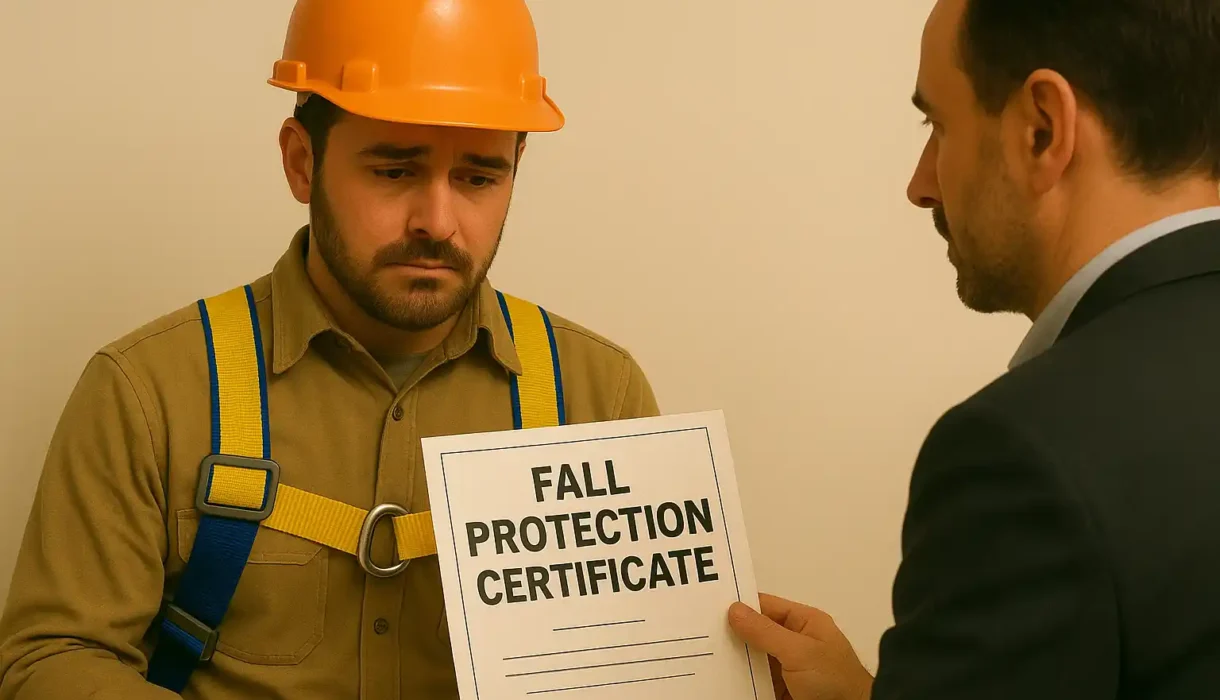
If you’ve ever switched jobs and proudly handed over your fall protection certificate—only to have your new employer say, *“Yeah… we’re gonna need you to take our training instead”—*trust me, you’re not alone. I’ve seen this happen more times than I can count.
And honestly? I get why it’s frustrating. You went through the class, passed the test, maybe even did hands-on drills. You did everything right. So the first thing that hits your mind is:
“Wait, why isn’t my old training good enough?”
Let me break this down in a way that actually makes sense—no legal jargon, no stuffy OSHA textbook language. I’ll explain it the way I explain it to new guys on the jobsite when they ask me the same thing.
And the short answer?
Yes. An employer can refuse your previous fall protection training.
But the why behind it is actually more reasonable than it seems.
Let’s get into it.
| Reason | Explanation | Real-World Example |
|---|---|---|
| Training is too old | Employers prefer 1–2 year refreshers | Certificate from 3 years ago no longer accepted |
| Not site-specific | Hazard types don’t match the new job | Old job was low-rise; new job is roof work |
| Different equipment | New employer uses SRLs instead of lanyards | Worker trained only on basic lanyards |
| Company policy | Employer wants everyone trained the same way | Standardized in-house training program |
| Low-quality past training | Previous course lacked hands-on practice | Online-only 20-minute course |
| New hazards/changes | Jobsite has different anchor points or rescue plan | New lifeline system on-site |
OSHA Isn’t the One Who Decides—Your Employer Does
A lot of workers think OSHA hands out some kind of official card like a driver’s license that magically works anywhere. Nope. OSHA doesn’t approve specific schools, doesn’t issue certification IDs, and doesn’t give you a card that works nationwide.
Here’s what OSHA does say:
- You need to be trained.
- The training has to be specific to the hazards of the job.
- Your employer is responsible for making sure you can actually do the work safely.
So even if you show up with a certificate from three months ago, your employer still has to confirm:
- It covers the right topics,
- It meets their standards,
- And it applies to the hazards you’ll face on their site.
It’s not that they don’t trust you—it’s that they’re legally on the hook for your safety.
| Employer Standard | Accepted? | Notes |
|---|---|---|
| Training less than 1 year old | Often yes | If hazards match |
| Training 1–2 years old | Maybe | Depends on company policy |
| Training more than 2 years old | Usually no | Considered outdated |
| Online-only training | Sometimes no | Many require hands-on |
| Union/apprenticeship training | Often yes | Recognized industry-wide |
| Manufacturer-specific training | Accepted when using that equipment | e.g., SRL manufacturer training |
Why Employers Sometimes Reject Old Fall Protection Training
Now let’s talk about the reasons your old training might get turned down. These come straight from real experiences on job sites—not from a textbook.
| Training Type | Commonly Accepted by New Employers? | Notes |
|---|---|---|
| General fall protection course | Sometimes | Depends on jobsite hazards |
| Online-only basic training | Rarely | Missing hands-on skills |
| Hands-on classroom + practical training | Often | High credibility |
| Manufacturer-certified training | Yes, if same equipment is used | SRLs, harness systems, lifelines |
| In-house company-specific training | No | Only valid at that employer |
| Union apprenticeship safety training | Often yes | Highly standardized |
1. The Training Is Too Old
Even though OSHA doesn’t set an expiration date, most companies like to follow:
- 2-year retraining
- Some even prefer annual refresher training
Why? Things change fast. Equipment changes. Rules change. People forget things. And the biggest one:
Employers don’t want to rely on training you took during the last company Christmas party.
If your certificate is a few years old, many employers will simply say, “Let’s get you updated.”
2. It Wasn’t Job-Specific
This is a big one.
Fall protection isn’t “one-size-fits-all.”
Training must match the hazards of the job you’re about to do.
Maybe your old job involved:
- Using ladders,
- Basic harness + lanyard setup,
- Low-rise construction.
But your new job has:
- Roof anchor systems,
- Horizontal lifelines,
- SRLs,
- A whole different type of equipment setup.
Your old training might’ve been good—but it wasn’t the right kind for this new environment.
3. They Use Different Equipment Than What You Trained On
Let’s say your old employer used shock-absorbing lanyards.
Your new employer? They use mostly SRLs (self-retracting lifelines).
Or maybe you trained on anchorage points, but they use beam clamps or mobile anchorage devices.
From an employer’s perspective, it doesn’t matter if you passed a full course—if you can’t use the gear they use, you’re not trained for their site.
4. They Want Everyone on the Same Page
Some companies are very strict with their safety culture. They want every worker trained the same way, using the same terminology, following the same rescue plan.
As someone who’s trained dozens of crews, I get it. When everyone shares a baseline understanding, it prevents:
- Confusion,
- Miscommunication,
- Arguments about “how we did it at the old job.”
It’s not personal—it’s about consistency.
5. Your Old Training Was… Let’s Just Say “Basic”
Now, I’m not here to throw shade, but let’s be real—some fall protection “courses” out there are barely training. I’ve seen 20-minute online quizzes with no hands-on work, no demonstrations, nothing practical.
A good fall protection course includes:
- Hazard identification,
- Equipment inspection,
- Anchor point selection,
- How to put on a harness,
- How to use lanyards, SRLs, and other systems,
- Rescue procedures.
If your past training didn’t include some of these—or wasn’t hands-on—your employer may reject it for being incomplete.
6. There Was an Incident or Unsafe Behavior
OSHA requires retraining if:
- You were seen using equipment unsafely,
- You misused fall protection gear,
- Something went wrong,
- Or there was a near-miss.
Even if your training was recent, an incident can trigger mandatory retraining.
What OSHA Actually Says (No Jargon)
OSHA won’t give you a card, but OSHA does give employers rules to follow. One of those rules is retraining.
OSHA requires retraining when:
- You don’t understand the previous training
- The workplace changes
- New fall protection systems are introduced
- Your performance indicates a lack of skill or understanding
Put simply:
If there’s anything new—or anything off—your employer must retrain you.
It’s not optional for them. It’s the law.
Does That Mean Employers Always Have to Reject Your Old Training?
Not necessarily. This is where things get a little more flexible.
If your training is:
- Recent,
- Hands-on,
- Matches the exact equipment they use,
- And was provided by a reputable trainer…
…many employers will accept it, especially if you can show:
- A certificate,
- A training outline,
- Proof of competency (like photos or supervisor letters).
But in my experience, this is more common in larger or more safety-mature companies. Smaller companies sometimes just want everyone to take their in-house class.
What You Can Do if Your Employer Rejects Your Old Training
Here’s the good news: you’re not powerless. And no—you don’t have to argue or get defensive. Here’s what I usually suggest to workers:
1. Ask What Specifically Needs Updating
Sometimes it’s not the entire training—just certain topics.
Maybe they want you to learn:
- How to inspect their harnesses,
- Their anchorage rules,
- Their rescue procedures.
A small refresher might be all you need.
2. Ask if a Quick Refresher Would Work
Some employers allow:
- Half-day refreshers,
- In-house orientation,
- Supplemental hazard-specific training.
It saves you time and keeps everyone happy.
3. Show Proof of Hands-On Experience
If you’ve actually used fall protection equipment daily, that’s valuable. You can show:
- Photos of you using equipment,
- Details about the gear you’ve used,
- Past job responsibilities,
- Onsite evaluations if available.
Sometimes that’s enough for an employer to say, “Okay, this person knows what they’re doing.”
4. Don’t Take It Personally
A lot of workers think employers are insulting their skills by not accepting their old training. That’s rarely the case.
Most companies are just following safety policies written after:
- OSHA citations,
- Accidents,
- Insurance audits,
- Company-wide safety meetings.
Sometimes they’re simply being cautious.
Trust me, I’ve seen companies ignore red flags to “save time,” and it usually ends badly.
When Employers Cannot Refuse Your Training
This isn’t common, but there are a few scenarios where your training might be basically “locked in.”
- If you’re staying within the same company and the hazards haven’t changed
They can’t force you to retake training “just because,” unless something new was introduced. - If your training meets all OSHA requirements and is documented thoroughly
Some larger companies will accept your training rather than waste hours retraining competent workers. - If you trained through a recognized, industry-leading program
Certain union or manufacturer-certified programs carry weight.
But again—this varies widely.
How Long Is Fall Protection Training Good For?
This is where things get funny.
OSHA says:
- There is no expiration date.
Industry says:
- Yeah right, training should be refreshed every 1–2 years.
And employers say:
- We want you to retrain annually.
- Or every two years.
- Or whenever we say so.
From experience, here’s the rule that actually works:
Training is “good” until something changes—new hazards, new gear, new job.
Skills fade. Equipment evolves. And fall hazards are always different from site to site.
So while your certificate might not expire, your competency does need to stay current.
At the End of the Day, It’s All About Keeping You Alive
I say this a lot in training sessions because it’s true:
Your employer isn’t trying to annoy you by making you retrain.
They just want you to go home in one piece.
Fall protection is one of those things where even small mistakes can be deadly:
- A wrong anchor point,
- A worn-out lanyard,
- A harness that isn’t fitted right,
- A rushed climb…
…any one of those can cost you your life.
So if an employer wants you refreshed, retrained, or re-certified, it might feel repetitive—but it’s not pointless.
The truth is, I’ve seen workers with years of experience still put harnesses on backward. I’ve seen “trained” workers tie off to pipes that would rip right out of the wall. Experience doesn’t always equal competency.
Fresh training keeps your skills sharp and your awareness high.
Final Thoughts
So, can an employer refuse to accept your previous fall protection training?
Yes, they can. And in many cases, they’re required to.
But that doesn’t mean:
- They mistrust you,
- They think your old training was useless,
- Or they want to make you jump through hoops.
They’re simply following OSHA’s guidelines and trying to keep you safe in their specific work environment.
If they ask you to retrain, don’t stress—it’s normal, it’s common, and honestly, it’s in your favor.

Mike Pattenson is a construction safety trainer who loves helping workers stay safe on the job. He explains safety in a simple, practical way so crews can easily understand what to do — and why it matters.
Mike Pattenson is a construction safety trainer who loves helping workers stay safe on the job. He explains safety in a simple, practical way so crews can easily understand what to do — and why it matters.
View All Articles