You’ve completed the training, passed the written test, survived the hands-on portion, and finally walked away with that fall protection certificate in your hand.
It feels good, right? For many workers, that certificate feels like a permanent stamp of approval—something no one can ever take away.
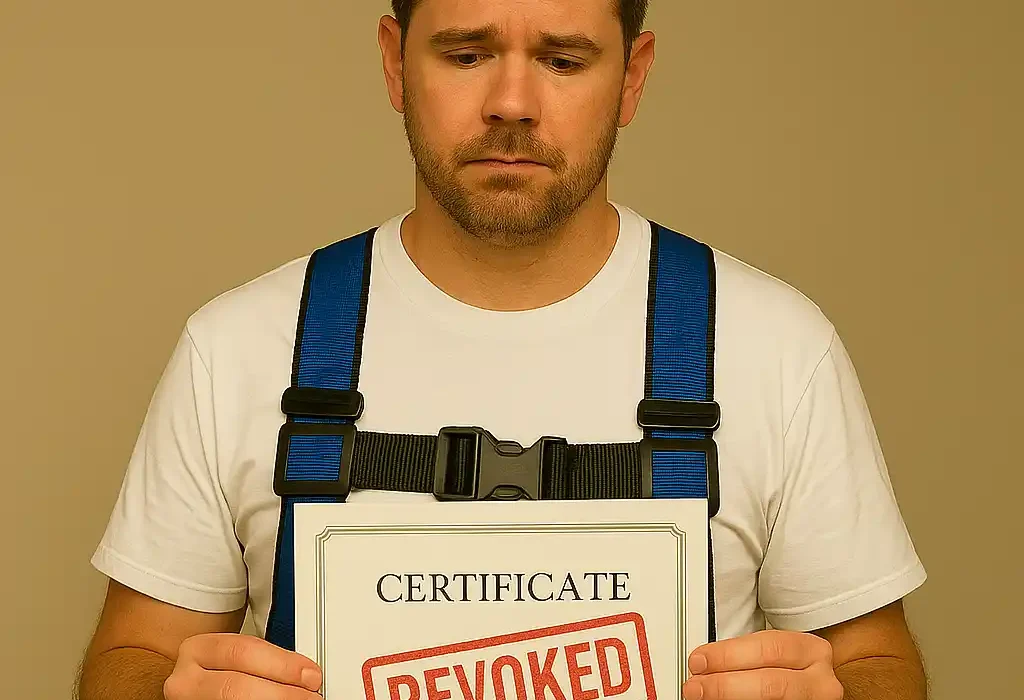
But here’s the reality most workers never hear during the course: yes, your fall protection certificate can be revoked, suspended, or considered invalid in certain situations.
This isn’t meant to scare you. It’s meant to give you the truth so you don’t end up losing your certification without even realizing it. Because the truth is, certificates aren’t just about passing a test—they’re about proving you can consistently work safely.
And if something happens that makes your employer question that? That’s when revocation enters the picture.
Let’s break it down in plain language, based on how things actually happen on worksites.
What a Fall Protection Certificate Actually Means
A lot of workers think the certificate is like a driver’s license: you pass once, you’re good forever. But fall protection certificates work differently.
Your certificate means:
- You completed OSHA-required training
- You demonstrated competency during the course
- You understood fall hazards and proper use of safety equipment
- You followed procedures correctly during the practical exam
But here’s the key: a certificate reflects your knowledge at the time of training. It doesn’t automatically guarantee that you’ll maintain safe habits forever. That’s why OSHA requires employers to ensure workers remain competent over time.
So the certificate is not permanent. It’s proof of competency—as long as you continue acting competent.
Read related article: New Equipment: Do You Need Fall Protection Retraining?
Short Answer: Yes, Your Certificate Can Be Revoked
This surprises many people.
A fall protection certificate can be revoked, suspended, or invalidated by:
- Your employer
- The training provider
- The general contractor on some jobsites
OSHA themselves won’t revoke a certificate—but they can force retraining (which essentially resets your competency status).
Think of it this way:
Your certificate can stay valid only if your actions continue to show you’re working safely.
If your employer believes you’re no longer following the training, they have every right—actually, they have a responsibility—to pull your certificate until retraining is completed.
Read related article: Who Keeps the Fall Protection Certificate—You or Your Employer?
Most Common Reasons Fall Protection Certificates Get Revoked
| Reason for Revocation | Description | Severity | Who Decides? |
|---|---|---|---|
| Repeated unsafe behavior | Worker repeatedly violates fall protection rules | High | Employer / Safety Manager |
| Dishonesty during training | Faking attendance, cheating on exams | High | Training Provider |
| Failure to follow procedures | Ignoring anchor point rules, improper harness use | Medium | Employer |
| Major safety violation | Incident caused by negligence | High | Employer / OSHA (via employer) |
| Using expired or damaged equipment intentionally | Clear disregard for safety | High | Employer |
| Involvement in a fall incident | Mandatory retraining is required | Medium | Employer |
| Certificate expired | Not “revoked” but no longer valid | Medium | Employer |
| Training provider error | Incorrect documentation, incomplete training | Low | Training Provider |
Read related article: Will Fall Protection Training Help Me Get a Job?
Let’s go through the real-world reasons employers revoke, suspend, or flag certificates. These are not theories—these are the reasons that actually happen on job sites.
1. Unsafe Behavior on the Job
This is the #1 cause.
Examples:
- Not tying off when required
- Using anchor points that are not rated
- Wearing the harness incorrectly
- Misusing lanyards or SRLs
- Taking shortcuts to “move faster”
- Climbing structures without proper protection
If your employer sees repeated unsafe actions—even after reminders—your certificate can be pulled until retraining is done.
It’s not punishment. It’s liability control. If something happens and they knew you were working unsafely, they’re responsible.
2. Repeated Safety Violations
One unsafe act usually gets a reminder. Two might get a write-up.
Three? That’s when employers start pulling certifications.
Examples include:
- Ignoring a spotter
- Skipping pre-use inspections
- Disregarding site-specific rules
- Disabling harness components because they’re “annoying”
- Using the wrong PPE for the job
Training is supposed to fix these issues. If violations continue, employers assume the training didn’t stick.
3. Not Following Company Policies
Remember: OSHA sets the baseline. Many employers go above and beyond.
Some companies require:
- Yearly refreshers
- Toolbox talks for high-hazard work
- Quarterly safety meetings
- Site-specific retraining when methods change
If you don’t show up—or worse, you refuse to comply—they can revoke your certificate until you’re back on track.
4. Using Damaged or Expired Safety Gear
Your gear’s condition is part of demonstrating competency.
If you continue using damaged harnesses, frayed lanyards, expired SRLs, or anchor points that were tagged out, you’re bypassing your training and showing unsafe behavior.
Employers will revoke your certificate to prevent accidents.
5. Long Gaps Without Using the Skills
OSHA allows employers to require retraining when a worker:
- Hasn’t used fall protection for a long period
- Is assigned new tasks
- Uses new equipment
- Moves to a site with different hazards
You might not be “revoked,” but the certificate can be suspended until you retrain.
6. Your Certificate Has Expired
Most certificates list a “valid until” date. Some last:
- 1 year
- 2 years
- 3 years (common in some industries)
But employers can set stricter rules.
If the certificate is old and you haven’t retrained, many sites consider it invalid.
Read related article: Does Fall Protection Training Include First Aid or Rescue?
Who Has the Authorty to Revoke?
| Authority | What They Can Do | Notes |
|---|---|---|
| Employer | Suspend or revoke a worker’s ability to work at heights | Most common revocation source |
| Training provider | Nullify a certificate if training was incorrect or fraudulent | Rare but possible |
| OSHA | Does NOT directly revoke but can mandate retraining | Employer enforces |
| Safety Manager / Competent Person | Can remove authorization if worker behaves unsafely | Based on site rules |
| Insurance auditors | Can require retraining after an incident | Employer must comply |
Read related article: What Age Do I Need to Be to Take Fall Protection Training?
Can OSHA Revoke Your Certificate?
This is a big misunderstanding.
Here’s the truth:
- OSHA does NOT revoke certificates.
- But OSHA DOES require retraining in several situations.
For example, OSHA mandates retraining if:
- A worker demonstrates unsafe behavior
- Procedures change
- Equipment changes
- A worker seems to have forgotten essential skills
So OSHA won’t take your certificate away—but they absolutely can require your employer to retrain you, which has the same effect.
Read related article: Are Your Fall Protection Training Records OSHA-Ready?
When Your Employer Can Revoke or Suspend Your Certificate
Let’s go deeper into the real moments when employers pull certifications.
1. After an Accident or Near-Miss
If you fall, almost fall, or misuse equipment that causes a dangerous situation, retraining is almost always required. Your certificate may be temporarily invalid until you pass the retraining.
2. During a Safety Audit
These happen all the time:
- General contractors checking subs
- Third-party safety consultants
- Insurance auditors
- Internal site safety reviews
If someone notices unsafe behavior, you might be temporarily barred from doing fall-hazard tasks until retraining is completed.
3. If Another Worker Reports Unsafe Actions
This is more common than you think. Workers report unsafe behavior—not to get someone in trouble, but to keep everyone safe. If your actions raise concerns, supervisors may temporarily suspend your certificate.
4. If the Jobsite Has Stricter Requirements
Some sites require:
- Training within the last 12 months
- Authorized person training, not just “awareness”
- Competent person sign-off
- Full practical evaluations
If your certificate doesn’t meet these stricter rules, it can be rejected.
Read related article: 7 Types of Fall Protection Training You Can Take
What Happens After a Certificate Is Revoked?
Here’s the good news: revocation isn’t permanent.
Most workers go through something like this:
- Supervisor explains the reason
- Worker attends retraining
- Worker retakes the written or practical test
- Competent person signs off
- Certificate becomes valid again
Most of the time, it’s not a career-ending issue. It’s simply a reset.
Read related article: Lost Your Fall Protection Certificate? Here’s What to Do Next
How to Avoid Losing Your Certification
Here’s the part most workers want: how do you avoid this problem altogether?
1. Always Tie Off Correctly
Even if it seems inconvenient. Even if the job is “just quick.” The fastest way to lose your certificate is to skip tie-off.
2. Inspect Equipment Every Time
If you’re caught using damaged gear, it looks like you either didn’t inspect or didn’t understand the training.
3. Don’t Rush
Most fall accidents happen because someone tried to “save a few seconds.”
4. Follow Site-Specific Rules
Every site is different. Take them seriously.
5. Ask Questions
Asking is a sign of competence—not weakness.
6. Take Refreshers Seriously
They help you keep your skills sharp and protect your certification.
Read related article: Not Fall Protection Certified? Here’s What OSHA Can Fine You
What to Do If Your Certificate Was Revoked
First of all, don’t panic. It happens more often than you think.
Here’s what to do:
1. Ask for the Specific Reason
You deserve to know exactly what triggered the decision. That way you know what needs fixing.
2. Request Retraining Immediately
Most employers will happily schedule it.
3. Correct the Issue That Caused the Revocation
Whether it was improper tie-off or skipping inspections, fix the habit.
4. Document Your Training
Keep your own copies—just in case you move jobs.
5. Treat It as a Reset, Not a Punishment
Employers revoke certificates to prevent injuries, not to get rid of workers.
Read related article: How to Renew Fall Protection Certification?
Final Thoughts: Your Certificate Is More Than a Piece of Paper
A fall protection certificate isn’t just something you hang in your locker. It represents trust—trust that you know how to work at heights safely, trust that you’ll protect yourself and your coworkers, and trust that you’ll follow the rules that keep everyone alive.
Can it be revoked?
Yes.
But it’s also something you can get reinstated just as easily with the right actions.
The important part is staying sharp, staying safe, and treating your training as a living skill—not a one-time task.

Mike Pattenson is a construction safety trainer who loves helping workers stay safe on the job. He explains safety in a simple, practical way so crews can easily understand what to do — and why it matters.
Mike Pattenson is a construction safety trainer who loves helping workers stay safe on the job. He explains safety in a simple, practical way so crews can easily understand what to do — and why it matters.
View All Articles