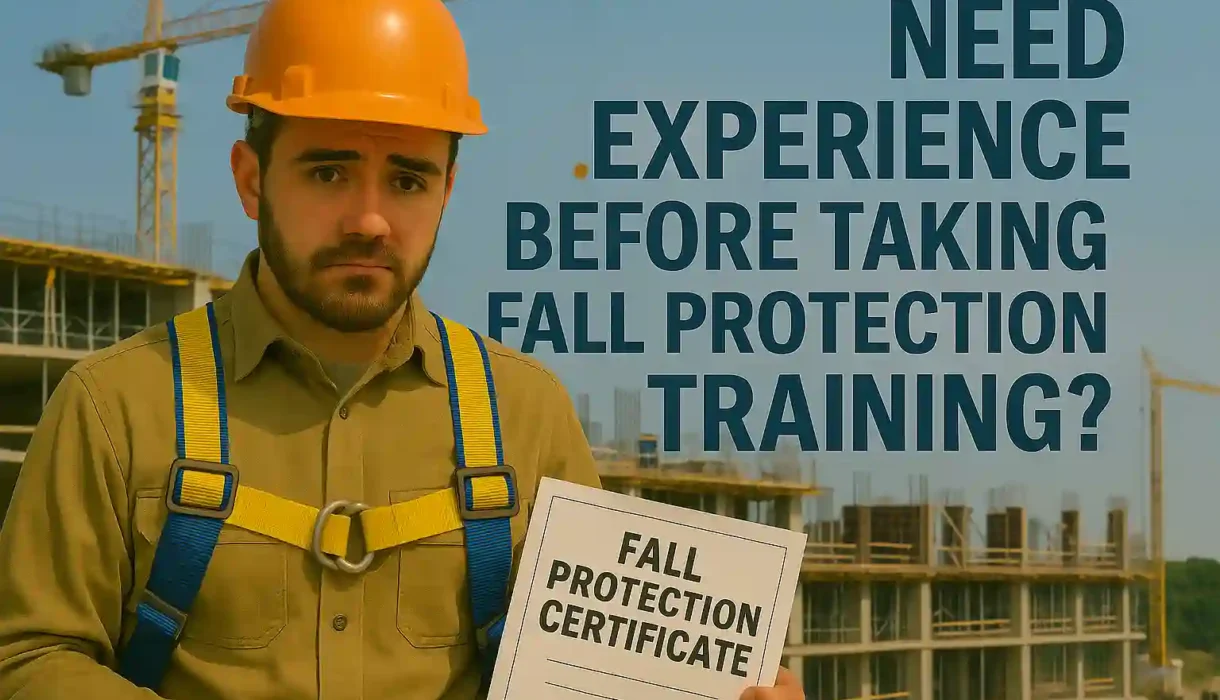
If you’re wondering whether you need experience before taking fall protection training, trust me—you’re not the only one.
I’ve met so many workers over the years who came up to me on the first day of class and said, “Sir… I’ve never worn a harness before. Am I even supposed to be here?”
And I always give the same answer:
“Perfect. You’re exactly the kind of person this training is designed for.”
So let’s break this down in the most honest, real-world way possible. No fancy professional jargon—just someone who’s been around construction sites, warehouses, roofs, telecom towers, and job trailers telling it to you straight.
Why People Think They Need Experience (But Honestly, They Don’t)
A lot of people assume fall protection training is only for seasoned workers who’ve already been climbing ladders and walking beams for years. Sometimes it’s because of what they’ve seen:
- Guys already wearing harnesses like second skin
- Co-workers who look like they tie off in their sleep
- Supervisors who make it seem like you’re supposed to “just know” this stuff
And then here you are—standing there thinking:
“I’ve never even touched a lanyard… I’m going to look clueless.”
But here’s the truth:
Almost everyone feels that way when they start.
I’ve trained hundreds of first-timers—helpers, new hires, career changers, people who haven’t worked in years, even supervisors who never used any gear themselves.
Experience isn’t required. In fact, the training is built around the assumption that you’re starting from zero.
Who Usually Takes Fall Protection Training
| Type of Worker | Typical Experience Level |
|---|---|
| New construction helpers | No experience |
| Career changers | Zero to minimal |
| Warehouse staff | Often none |
| Roofers-in-training | Basic or none |
| Electricians starting out | Minimal experience |
| HVAC & maintenance newbies | Little to none |
| Supervisors | Sometimes none (just need certification) |
| Returning workers | Skills may be outdated or forgotten |
Experience Needed vs. Not Needed
| What People Think They Need | What They Actually Need |
|---|---|
| Construction experience | No experience required |
| Working-at-heights experience | Willingness to learn |
| Knowledge of PPE | Ability to follow instructions |
| Previous safety training | Curiosity & basic attention |
| Physical strength | Patience during harness fitting |
| Knowing OSHA rules | Trainer will teach everything |
What Fall Protection Training Actually Covers (It’s Beginner Friendly)
You might be imagining something complicated or super technical, but fall protection training always starts with the basics. Like, literally, the very beginning—before anyone expects you to know anything.
Here’s the kind of stuff you’ll learn:
1. How a harness works
We’ll show you:
- Where the straps go
- How to adjust the chest and leg straps
- What the D-ring is for
- How tight is “tight enough”
Half the time, people put the harness on backward the first try. And that’s fine—everyone does it.
2. How to inspect your gear
This part is simple. You’ll learn to check for:
- Cuts
- Frayed stitching
- Rust
- Burn marks
- Damaged buckles
You don’t need experience to look at something and tell whether it’s beat up.
3. Where you’re allowed to tie off
We talk about:
- Anchor points
- Guardrails
- Lifelines
- Limits of your gear
It’s all explained in plain language with hands-on examples.
4. When fall protection is required
Different industries have different height rules. Don’t worry—you’re not expected to memorize everything that day. We explain you what applies to your type of work.
5. Real accidents and what causes them
This is the part where people usually sit up straight and say, “Okay, now I get why this matters.”
Honestly, you don’t need experience to understand safety. You just need someone to show you how things really go wrong out there.
Why Being a Beginner Is Actually an Advantage
People with no experience often make the best students, and I’ll tell you why.
1. You don’t have to unlearn bad habits
Some workers with years of experience will argue with you during training:
“Sir, we always tie off like this.”
“That’s not how we did it in my old site.”
“I’ve never inspected my harness—never had a problem.”
Trust me: teaching someone who’s brand new is way easier.
2. Beginners follow instructions carefully
People new to the field usually:
- double-check their anchor
- make sure their lanyard isn’t twisted
- adjust their harness properly
- ask questions when unsure
Those are good habits.
3. You learn the right way from day one
It’s better to learn how to stay safe before you develop your own shortcuts.
4. Confidence grows fast
By the end of the training, beginners usually surprise themselves:
“Wow… that wasn’t as hard as I thought.”
“I actually understand this now.”
“I feel more prepared than I expected.”
Experience helps, sure—but not required. A good attitude does more for you than experience ever will.
Who Usually Takes Fall Protection Training? (Most Have Zero Experience)
I can tell you straight from years of doing this: the majority of people who walk into training rooms are beginners.
Here’s a quick list of typical students:
- New construction helpers
- Workers shifting to a new trade
- People applying for their first job at heights
- Roofers-in-training
- Telecom tower assistants
- Warehouse and distribution workers
- HVAC or maintenance techs
- Electricians starting out
- Supervisors needing certification
- People returning from a long work break
Some of these folks have never even held a harness before. Some don’t even know what a carabiner is until they see one in class.
And guess what?
They all pass the training just fine.
What You DON’T Need Before Training
Let’s clear up some of the biggest misconceptions.
You don’t need:
- Construction experience
- Previous safety training
- Experience working at heights
- Experience using PPE
- Knowledge of OSHA rules
- Any special certifications
- Any prior hands-on skills
- Physical strength (you’re not climbing trees or carrying steel beams during class)
You don’t even need to know the names of the equipment yet. Nobody expects you to walk in like a pro.
The entire point of fall protection training is to turn you into someone who knows how to protect themselves at heights—not to judge you for not knowing.
What You DO Need Before Training (Just the Basics)
There are only a few things you really need:
✔ A willingness to learn
If you’re open to listening and paying attention, you’re already ahead.
✔ Basic ability to follow instructions
If someone says, “Adjust the leg straps tighter,” you can do it. That’s it.
✔ A little patience
Harnesses don’t always cooperate on the first try.
✔ Curiosity
Asking questions like:
- “Is this anchor point okay?”
- “Is my lanyard too long?”
- “How do I know if this strap is worn out?”
…actually makes you safer.
That’s all you need—nothing more.
What to Expect on Training Day (A Walkthrough from a Trainer’s View)
Let me paint you a picture of what a typical training day feels like.
1. Classroom Time (Don’t Worry—It’s Not College)
We go over:
- Slides
- Photos
- Real accident scenarios
- Simple rules
Nothing complicated. Usually, people get comfortable within the first 15 minutes.
2. Equipment Demonstration
I’ll show you how different gear works:
- harness
- lanyard
- SRL
- anchor point
- D-ring
Everyone gets a chance to handle the equipment.
3. Hands-On Practice (The Part Most People Worry About)
You’ll try:
- putting on a harness
- adjusting it
- checking each other’s fit
- tying off
- connecting to anchor points
And again—no one expects you to know anything. If you put the chest strap too low or twist the straps, that’s normal.
4. Questions and Real-Life Scenarios
People usually ask:
- “What if the anchor point is too far?”
- “Can I tie off to scaffolding?”
- “What if I’m working alone?”
- “Is this connector still safe?”
These conversations are where the learning really happens.
5. A Simple Exam or Assessment
Most exams are straightforward—nothing like school tests. They just want to know that you:
- understand the basics
- know how to inspect gear
- know when to tie off
If you can pay attention, you can pass.
Real Talk: Experience Doesn’t Matter—Attitude Does
I’ve seen experienced workers fail fall protection assessments because they refused to follow proper procedures.
On the other hand, I’ve seen complete beginners walk out of training more confident—and safer—than guys who’ve been doing the job for years.
Here’s the real secret:
Fall protection training isn’t about being experienced.
It’s about being teachable.
If you show up ready to learn, ask questions, and practice, you’ll do great.
Why Fall Protection Training Is So Important (Even for Total Beginners)
Falls don’t care if you’re new, old, skilled, or clueless. Gravity treats everyone the same.
And the truth is…
Most fall accidents happen to people who “thought they knew what they were doing.”
Beginners often take things more seriously. They follow the rules. They double-check their anchor points. They don’t rush.
That’s why training is offered before you even start working at heights. It’s not something you “earn” after years of experience—it’s something you get before you ever climb a ladder.
Final Thoughts: You Don’t Need Experience—You Just Need to Start
If you’re hesitating about taking fall protection training because you think you’re not ready or not experienced enough, let me tell you something straight:
You’re ready.
Training is made for beginners. It’s made for people who’ve never:
- worn a harness
- climbed a scaffold
- tied off to an anchor
- inspected PPE
- worked at heights
And everyone starts somewhere. Even the most confident workers you see today started out feeling exactly like you do right now.
So go ahead—take the training.
Ask questions.
Learn everything you can.
And most importantly, show up with the right mindset.
Because in fall protection, attitude keeps you alive way more than experience.
Mike Pattenson is a construction safety trainer who loves helping workers stay safe on the job. He explains safety in a simple, practical way so crews can easily understand what to do — and why it matters.
Mike Pattenson is a construction safety trainer who loves helping workers stay safe on the job. He explains safety in a simple, practical way so crews can easily understand what to do — and why it matters.
View All Articles