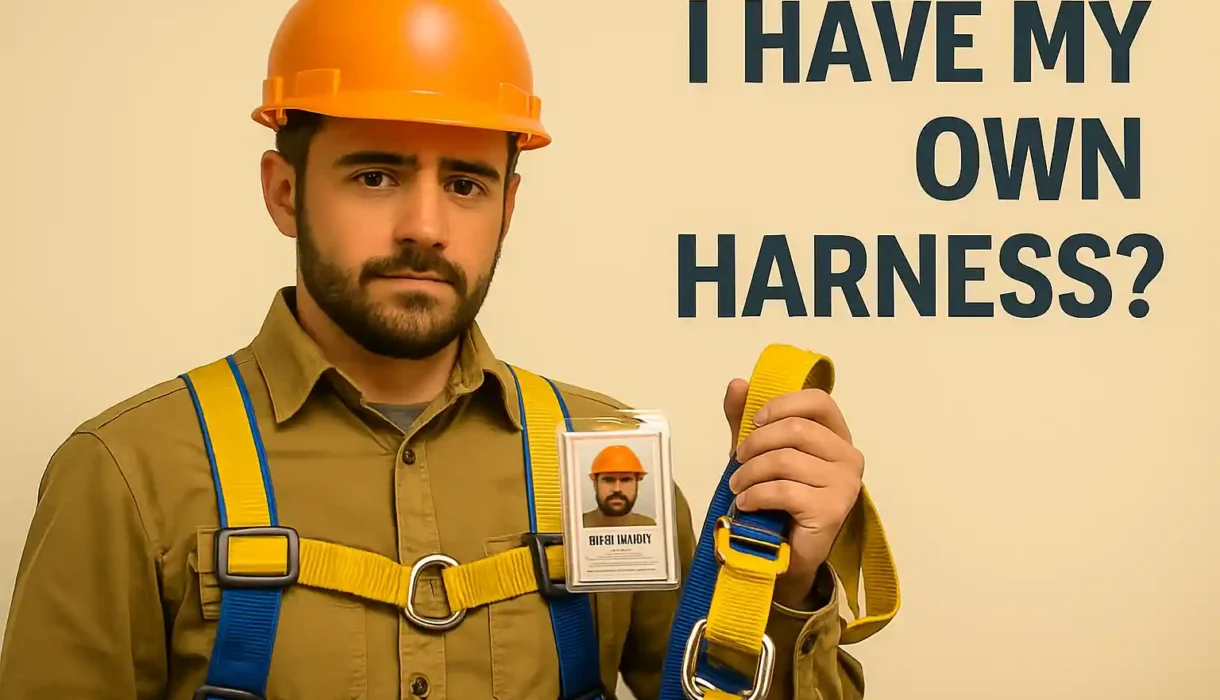
If you’re getting ready to take fall protection training, there’s a good chance one question is sitting in the back of your mind:
“Do I need to bring my own harness?”
Don’t worry—you’re not the only one asking. I get this question all the time. Honestly, I’ve had people show up with brand-new harnesses still in the box, tags and all, because they didn’t want to look unprepared.
I’ve also had workers show up proudly wearing a harness that looked like it had lived through five job sites, a typhoon, and three decades of UV rays. So yeah, people overthink this.
Let’s break it down in a simple, practical, “I’ve-been-there” way so you know exactly what to expect.
See this table:
| Situation | Bring Your Own Harness? | Reason |
|---|---|---|
| Training at a certified training center | No | Centers provide inspected harnesses |
| Employer-sponsored on-site training | Usually Yes | Employer wants you to use their gear |
| Specialized industries (tower climbing, utilities, oil & gas) | Sometimes | They require specific harness types |
| Taking a beginner/basic fall protection course | No | Equipment is included |
| Taking a skills evaluation or recertification | Maybe | Trainer might want to test your actual gear |
| Using a brand-new, unused harness | Optional | You can get it inspected during class |
The Short Answer: Most of the Time, No. You Don’t Need to Bring Anything
Here’s the straight truth:
| Equipment | Provided? | Notes |
|---|---|---|
| Full-body harness | Yes | Properly inspected before class |
| Shock-absorbing lanyard | Yes | Standard for most training |
| SRL (Self-Retracting Lifeline) | Yes | Used for demo or practice |
| Anchor point setups | Yes | Temporary or demo anchors |
| Hard hat | Sometimes | Depends on training center |
| Gloves | Sometimes | Optional |
| Safety glasses | Sometimes | Provided for practice sessions |
| Rescue kits | Yes (demo) | For demonstrations only |
Training centers almost always provide the harness.
And not just harnesses—they’ll usually provide:
- full-body harnesses in different sizes
- lanyards or SRLs
- anchor points
- demo setups
- and sometimes even helmets or gloves
Why? Because they want everyone trained on safe, inspected, and approved equipment. If they let every trainee bring their own random harness, you’d end up with:
- expired harnesses
- cracked D-rings
- frayed stitching
- off-brand gear that isn’t even rated
I’ve seen people bring harnesses from online marketplaces that literally had no labels, no date of manufacture, not even a brand. They look like Halloween costumes. No trainer wants to deal with that.
So for most people: You can walk in empty-handed. They’ll gear you up.
But There Are Times When You Might Need to Bring Your Own Harness
Now let’s talk about the exceptions, because yes, there are a few.
1. If Your Employer Requires It
Some companies want you to train using their equipment.
This usually happens when:
- your job uses a very specific type of gear
- your employer wants to test your own harness for safety
- they’re trying to ensure consistency across the team
A lot of roofing companies do this. So do utilities and tower-climbing crews.
2. If the Training Is Happening at Your Job Site
If the trainer is coming to your workplace instead of you going to a training center, expect to use your employer’s gear. They’ll want you to train exactly how you’ll work.
3. If You’re Doing an Evaluation, Not a Basic Course
Sometimes you aren’t taking a beginner’s class—you’re taking a skills evaluation.
In that case, the trainer might expect you to demonstrate knowledge using your own equipment.
4. If You Work in a Specialized Industry
A few industries use gear that’s not typical, like:
- tower climbing setups
- waist belts for certain utilities
- specialized rescue harnesses
If that’s you, the training center might encourage you to bring your own harness so you can practice with the exact equipment you’ll be using.
But again, for normal construction or general industry training, you’re perfectly fine without bringing anything.
Should You Bring It Anyway? Here Are the Pros and Cons
Even though you don’t need to bring your own harness, some people prefer to. So let’s talk about the upside—and the downside—based on real life.
👍 Pros of Bringing Your Own Harness
1. You become familiar with your own setup
Every harness fits differently. Some ride up. Some have stiff straps. Some are designed for small frames, others for big guys with dad bods.
Training gives you a chance to learn the quirks of your gear.
2. You get free feedback from the instructor
Trainers love checking equipment.
If your harness has issues, they’ll spot it instantly:
- expired labels
- UV damage
- worn stitching
- rusty buckles
- missing serial tags
You’d be surprised how many people didn’t know their harness was already unsafe.
3. You can test the fit properly
A harness that fits you is way safer than one you’re guessing on.
👎 Cons of Bringing Your Own Harness
1. If your harness is unsafe, the trainer won’t let you use it
And trust me—they are strict about this.
2. You might bring gear that isn’t allowed
Like:
- position-only belts
- cheap off-brand harnesses
- Amazon specials with “no label, no problem”—actually a big problem
- gear not rated for fall arrest
3. It can be bulky and annoying to carry
Especially if you’re commuting or taking public transport.
So honestly, unless you really want to bring it, there’s nothing wrong with showing up without one.
What Training Centers Usually Provide (and Why It’s Better)
Most good training providers will give you everything you need—and they’ll inspect it before class. Here’s what they usually hand out:
- Full-body harnesses (cleaned and inspected)
- Shock-absorbing lanyards
- SRLs (self-retracting lifelines)
- Anchor systems
- Demo platforms for working at height
- Installation gear for practice
Instructors prefer this because they know:
- the equipment isn’t expired
- the equipment meets standards
- nobody will be using a frayed harness from 1992
And honestly, there’s nothing worse than stopping a class just to tell someone their harness belongs in a museum.
What NOT to Bring (Just Don’t Do These)
Let me save you from embarrassment and safety issues.
Don’t bring:
- A harness older than your first child
- Anything with missing or unreadable labels
- A harness with duct-taped straps
- Cheap knockoffs with “one size fits all” claims
- Gear that has clearly been sitting in a toolbox for 10 years
- Equipment used in conditions that caused visible wear
One time, I had a guy bring a harness that was so stiff from sun exposure it felt like it was made of cardboard. We wouldn’t even let him try it on.
How to Know If You’re Expected to Bring a Harness
Here’s the easiest way to find out:
1. Check your confirmation email
Training centers usually list what to bring.
2. Look at the course description
Some advanced courses specify “Bring your own PPE.”
3. Ask your safety manager or HR
If the company is paying, they might have rules.
4. If it’s on-site training
Assume you’ll be using employer gear.
5. If nothing is mentioned
You can safely assume equipment will be provided.
Most training centers are prepared for walk-ins wearing just jeans and work boots.
What Happens If You Show Up Without a Harness?
Simple answer: Nothing bad. You’ll be fine.
Training centers expect it. Many trainees show up with no gear at all. The instructor will just hand you a properly sized harness, show you how to wear it, and you’re good to go.
You will NOT:
- be sent home
- have to reschedule
- fail the course
- lose your chance to participate
They want you to complete the training just as much as you do.
If You Already Have a Harness: Should You Bring It for Inspection?
This is a smart move, actually.
If you already own a harness and you’re not sure if it’s still safe, bring it. Most trainers don’t mind taking a quick look. They’ll tell you:
- if it’s expired
- if the stitching is separating
- if UV exposure has damaged it
- if it’s rated for the work you do
- if it’s still acceptable for fall arrest
Think of it as a free safety check.
Do You Need to Buy Your Own Harness After Training?
This comes up a lot. And here’s the real answer:
NO — Your employer is required to provide fall protection PPE.
You shouldn’t have to buy:
- harnesses
- lanyards
- anchors
- SRLs
These are the employer’s responsibility.
But some workers prefer having their own harness because:
- they want a better fit
- they want higher-quality gear
- they don’t want to share sweaty harnesses
- they do side jobs or contract work
If that’s you, buying your own might make sense—but it’s not required.
Final Thoughts: Don’t Stress About the Harness
At the end of the day, here’s the best advice I can give you:
Don’t overthink the harness.
The training center has gear.
The instructor knows what you need.
And you won’t be the first person to walk in empty-handed.
If you want to bring your own harness, awesome—do it. It’s a good way to get it inspected and learn to adjust it properly. But if you don’t own one yet, or you’re not sure if yours is acceptable, you’re still going to be perfectly fine.
Believe me, if your biggest concern before class is whether you need to bring a harness, you’re already doing better than half the people I see show up five minutes late wearing steel-toe boots that still have yesterday’s mud on them.
Show up, pay attention, ask questions, and you’ll walk out confident in how to use a harness—whether it’s yours or theirs.

Mike Pattenson is a construction safety trainer who loves helping workers stay safe on the job. He explains safety in a simple, practical way so crews can easily understand what to do — and why it matters.
Mike Pattenson is a construction safety trainer who loves helping workers stay safe on the job. He explains safety in a simple, practical way so crews can easily understand what to do — and why it matters.
View All Articles