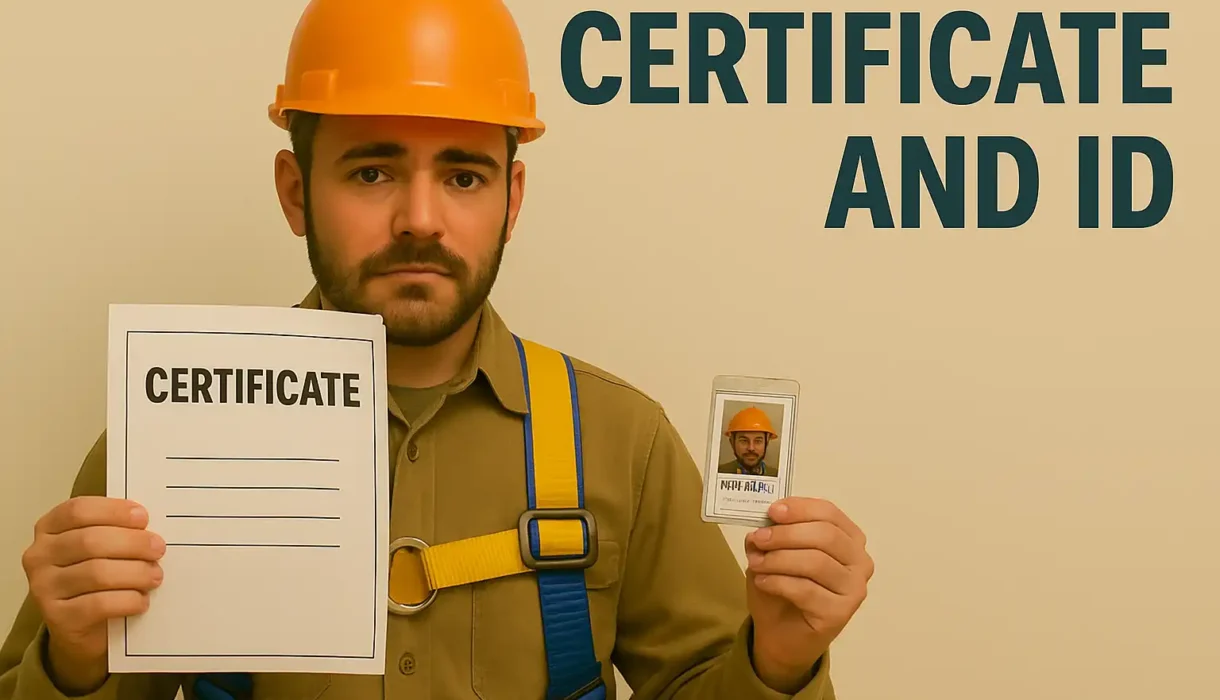
If you just passed your fall protection training and you’re now wondering, “Okay… so what do I actually get? A certificate? An ID card? Both?”—you are definitely not the only one asking that.
Believe me, I’ve trained a lot of workers over the years, and this question is always in the top five. Some folks expect a shiny, laminated card they can stick in their wallet.
Others think OSHA mails you something official. And many workers get confused because different training centers do things differently.
So let’s clear it up in the simplest way possible—no fancy corporate talk, just real jobsite experience.
OSHA Doesn’t Give You Anything (Yep, Nothing)
Before we talk about certificates and ID cards, let’s start with something that surprises a lot of people: OSHA doesn’t give out any cards or certificates.
None. Zero. Zilch.
OSHA doesn’t mail you anything after your training. They don’t have some official wallet card. They don’t give you a badge. What OSHA does require is that your employer keeps proof that you were trained—meaning documentation that your training happened, who taught it, what you were taught, and when.
So if you ever hear someone say, “I have an official OSHA fall protection card,” trust me… that’s not a thing. The only official OSHA cards are for OSHA 10 and OSHA 30, and even those are issued through authorized trainers, not directly from OSHA.
For fall protection training? The proof comes from the training provider or your employer.
| Feature | Certificate of Completion | Wallet ID Card |
|---|---|---|
| Required by OSHA? | Yes (as proof of training) | No |
| Given by Most Providers? | Yes | Sometimes |
| Format | PDF or printed | Plastic, laminated, or printable |
| What It’s Used For | Employer records, audits, investigations | Quick jobsite verification |
| Typical Details Included | Name, date, provider, topics covered | Name, date, provider, sometimes photo |
| Valid for Daily Site Checks? | Sometimes | Yes |
| Reissue Available? | Yes | Yes (if offered by provider) |
The Certificate: The Main Thing Most People Get
Now here’s the part most workers recognize: the certificate of completion.
Almost every training center gives you a certificate because it’s the easiest and clearest proof that you passed the training. You’ll usually get one of these:
Printed Certificate
A regular paper certificate you can hand to your employer or HR. Some places even laminate it or make it look nicer than a high school diploma.
Digital Certificate
A downloadable PDF.
This is actually becoming more common, especially with online courses.
But no matter how it’s delivered, this certificate usually includes:
- Your full name
- Training date
- Name of the course (Fall Protection Training)
- Name of the training provider
- Trainer’s signature or company stamp
- Topics covered
- Sometimes expiration dates (even though OSHA doesn’t set one)
The certificate is what most employers want for their files. It’s the “official” proof they keep in case OSHA ever comes knocking or if something happens on the job.
| Category | OSHA Requirement | Common Training Provider Practice |
|---|---|---|
| Official ID Card | Not required | Sometimes included |
| Certificate | Required as proof of training | Always issued |
| Training Records | Employer must keep | Providers maintain copies as backup |
| Expiration Date | Not mandated | Usually 2–3 years |
| Format | Any documented proof | PDF, printed, ID card |
Do You Get an ID Card Too? Sometimes You Do, Sometimes You Don’t
Now let’s talk about what most workers actually want: the ID card.
That little wallet-sized proof that you can just whip out when a foreman asks, “Let me see your training.”
Here’s the truth: ID cards are optional.
There’s no OSHA rule saying you need one.
Some training providers give them.
Some don’t.
Some charge extra for them.
Some print them only if the employer requests it.
In my experience, smaller training companies and jobsite trainers often skip ID cards because they take more time and cost more to make. But big training centers or companies that want to look more “professional” tend to include them.
These ID cards usually include:
- Your name
- Date of training
- Training provider
- Sometimes a photo
- Sometimes an expiration date
- Course type (“Fall Protection”)
- A “completion number” or card number (not required, just for tracking)
They can be laminated paper, PVC plastic cards, or even printable templates you cut and fold yourself.
| Proof Type | Where It’s Used | Accepted By |
|---|---|---|
| Full Certificate | HR files, audits, investigations | Employers, safety officers |
| Wallet ID Card | Site entry, orientation, spot checks | Foremen, site supervisors |
| Digital Certificate (PDF) | Online submission, onboarding portals | HR, training managers |
| Employer Training Record | OSHA inspections | OSHA, safety officers |
So Which One Do You Actually Need?
If we’re talking OSHA, the certificate is the only thing that matters.
That’s the document your employer needs to keep on file.
But out in the field, on job sites, during safety orientations, or when you move from contractor to contractor, an ID card can be incredibly handy. Foremen love things they can check fast. They don’t have time to read an 8.5 × 11 certificate every morning.
Here’s how it works in real life:
- Certificate = for the records
- ID Card = for quick verification
If you have both, perfect.
If you have only the certificate, no problem—you’re still compliant.
If you have only the card, 90% of the time it’s fine, but some companies might still ask for the full certificate for their files.
Why Some Training Centers Don’t Bother With ID Cards
You might be thinking, “But why not just give both? It seems simple.”
Well… here’s the behind-the-scenes truth:
- PVC cards cost money
- Printing takes time
- Some providers don’t have photo-ID systems
- Some trainers teach in the field, not in an office
- OSHA doesn’t require it anyway
Many training providers keep costs low by sticking to certificates. Some even just email you the PDF and let you handle printing it yourself.
Why Other Providers Do Give ID Cards (Even If They’re Not Required)
On the flip side, a lot of trainers love giving ID cards. Why?
Because it makes workers feel like the training is more “official.”
Workers love it. Employers love it. It creates a sense of professionalism.
Plus, it helps with:
- Faster jobsite verification
- Easier onboarding
- Reducing paperwork
- Improving trust in the training provider
And let’s be honest—if you’ve ever been on a big construction site, you know how chaotic it gets at 6am during onboarding. Having a card makes everyone’s day easier.
Do Online Fall Protection Courses Provide ID Cards?
This is a common question, especially now that many workers prefer online training because it’s quick, cheap, and easy.
Most online fall protection courses offer:
✔ A downloadable certificate
✔ Sometimes a printable wallet card
✖ Rarely a physical card mailed to you
✖ Rarely a photo ID card
If you really want a physical ID card, you may have to:
- Print the template yourself
- Ask your employer
- Pay extra (some websites offer mail-in card services)
What If You Lose Your Certificate or ID Card?
Don’t panic. You’re definitely not the first.
Workers lose these things all the time—left inside lunchboxes, dropped in mud, ruined in the rain, or forgotten in another job site trailer two counties away.
Here’s what you do:
1. Contact the Training Provider
Most training centers keep your records and can re-issue:
- A new certificate
- A new ID card
- A digital version
- Verification for your employer
Some will charge a small fee; others won’t.
2. Ask Your Employer
Your HR department or safety officer should have a copy.
OSHA requires them to keep it, so they should still have your file—even if you lost your copy.
3. Keep Digital Backups
I always tell workers:
- Take a picture of your certificate
- Save it in your phone
- Email a copy to yourself
- Keep it in Google Drive or Dropbox
You don’t want to deal with missing documents on the morning of a shutdown or big project.
Are These Certificates or Cards Valid Forever?
Here’s where workers get confused.
OSHA doesn’t set an official expiration date for fall protection training.
Let me say that again:
OSHA does NOT say your fall protection training expires after 1 year, 2 years, or any number of years.
But OSHA does say you must be retrained when:
- You work with new equipment
- You work in new situations
- You demonstrate unsafe behavior
- There’s an incident or near-miss
- The employer thinks you need a refresher
Even if OSHA doesn’t set dates, most training providers put 2-year or 3-year expiration periods because:
- It encourages regular refreshers
- It keeps skills sharp
- Employers prefer it
- It avoids outdated training
And honestly? I’ve seen workers forget how to properly inspect a harness after just one year. So refreshers are not a bad idea at all.
What Employers Actually Look For on the Job
Different employers have different requirements. But here’s what I’ve seen over and over:
Most employers want:
- A copy of your certificate for their files
Most foremen want:
- Your ID card (fast verification)
Most safety officers want:
- Both (because they want detailed documentation)
In other words, both are helpful but the certificate is the “official” document.
| Employer Type | Certificate Needed? | ID Card Needed? |
|---|---|---|
| Small Contractors | ✔ | Optional |
| Medium Construction Companies | ✔ | ✔ |
| Large Commercial or Industrial Projects | ✔ | ✔ |
| Union Job Sites | ✔ | ✔ |
| Residential Small Jobs | ✔ | Optional |
| Temp Agencies | ✔ | Useful for placement |
So, What Do You Really Get After Training?
Let’s recap it in the simplest way:
✔ Certificate
You almost always get this.
It’s the main proof of training.
It’s required for your employer’s records.
This is the “important” one.
✔ / ✖ ID Card (Wallet Card)
You might get one depending on the training provider.
It’s not required but it makes life easier on the job site.
Great for quick verification.
✖ OSHA Card
Not a thing for fall protection training.
Final Thoughts: Keep Both If You Can
In the real world, here’s the truth:
- The certificate keeps OSHA and your employer happy.
- The ID card keeps the foreman happy on Monday morning.
- Having both keeps you ready for any job site, any inspection, any safety orientation.
If your training provider only gave you the certificate?
You’re fine.
If they gave you both?
Even better.
If you want both but don’t have them yet?
Just contact your provider—they’re used to workers asking.
At the end of the day, the goal is simple: stay compliant, stay safe, and make sure you have proof of training whenever someone asks for it.

Mike Pattenson is a construction safety trainer who loves helping workers stay safe on the job. He explains safety in a simple, practical way so crews can easily understand what to do — and why it matters.
Mike Pattenson is a construction safety trainer who loves helping workers stay safe on the job. He explains safety in a simple, practical way so crews can easily understand what to do — and why it matters.
View All Articles