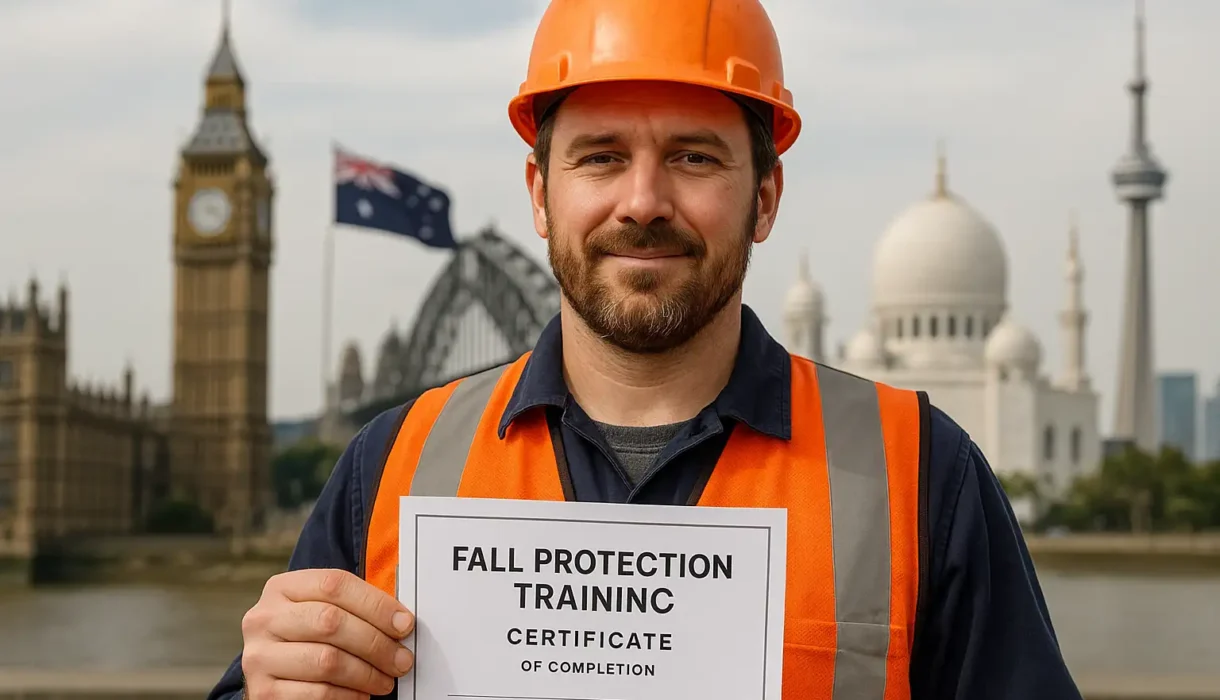
If you’re here, chances are you’re planning to work abroad—or at least you’re thinking about it.
Maybe you have an opportunity waiting in Canada, the UK, Australia, the Middle East, or somewhere else. And now you’re wondering:
“Does my fall protection training count in other countries… or do I need to start all over again?”
I get it. I’ve been in safety training for years, and this question comes up more often than you might think. Workers hate wasting time and money on repeat training, and employers across different countries have different expectations.
So let’s break this down in the simplest, most honest way possible.
First, Let’s Clear One Thing Up: Safety Rules Are Not the Same Everywhere
I wish it were as simple as, “Training is training—once you’re certified, you’re good worldwide.”
But nope.
Every country has its own version of OSHA. For example:
- USA → OSHA standards
- Canada → CSA standards
- UK → HSE regulations
- Australia → WorkSafe standards
- EU countries → EN standards
- Middle East → Mix of OSHA-based and local authority rules
| From Country | To Country | Acceptance Level | Notes / Requirements | Retraining Requirement |
|---|---|---|---|---|
| USA | Canada | Partially Accepted | OSHA training recognized as experience, but CSA-specific training usually required | Every 3 years (CSA) |
| USA | United Kingdom | Not Accepted | Must comply with HSE Working at Height Regulations | 1–3 years depending on risk |
| USA | Australia | Not Accepted | Requires RTO (Registered Training Organization) training | Every 2 years |
| USA | EU Countries | Generally Not Accepted | OSHA does not map directly to EN Standard regulations | 2–3 years (varies) |
| USA | Middle East (UAE, Qatar, Saudi Arabia) | Often Accepted | OSHA-based training preferred but may require local validation | Every 2 years (common) |
| Canada | USA | Partially Accepted | CSA training accepted as experience; OSHA topics may still be required | “As needed” (OSHA) |
| UK | USA | Partially Accepted | HSE training covers basics but OSHA-required items must be met | “As needed” (OSHA) |
| Australia | USA | Partially Accepted | Australian RTO training recognized but OSHA-specific retraining may apply | “As needed” (OSHA) |
| Country | Main Fall Protection Standard | Training Validity Period | Retraining Frequency | Hands-On Training Required? |
|---|---|---|---|---|
| United States (USA) | OSHA 1910 & 1926 Regulations | No fixed validity | “As needed” (after incident, new equipment, or performance issues) | Recommended but not always mandated |
| Canada | CSA Z259 Fall Protection Standards | 3 years (common provincial guideline) | Every 3 years | Yes — practical evaluation required |
| United Kingdom (UK) | HSE Work at Height Regulations | 1–3 years | Based on risk level | Yes — practical training strongly emphasized |
| Australia | Safe Work Australia / RTO Working at Height | 2 years (industry standard) | Every 2 years | Yes — mandatory hands-on component |
| European Union (EU) | EN 361, EN 363, EN 365 (various EN standards) | 2–3 years (varies by EU nation) | Every 2–3 years | Yes — practical components expected |
| Middle East (UAE, Qatar, Saudi Arabia) | OSHA-based standards + Local Authority Rules | 2 years (common employer requirement) | Every 2 years | Varies — many job sites require it |
This means fall protection isn’t taught exactly the same way everywhere. One country might require training every year, another might require retraining “as needed,” and another might require specific equipment training.
So right away, you can see the problem. Employers must follow their country’s regulations—not the rules of the country where you originally took your training.
Read Related Article: Does Fall Protection Training Transfer Between Jobs?
So… Will Your Old Training Count? (The Realistic Answer)
Yes… but also no.
I know that sounds like a vague answer, but stick with me for a second. Based on my experience working with employees moving from one country to another, here’s what usually happens.
When Your Old Training Might Be Accepted
Your certificate can work in your favor if:
✔ The standards between the two countries are similar
For example, OSHA and CSA have a lot of overlap.
✔ Your training is recent (usually within the last year or two)
Employers are more flexible with fresher certificates.
✔ You’re working for a big international company
They sometimes use unified global training programs.
✔ The employer allows “equivalency”
Some employers will say: “We’ll accept this for now, but you still need a short refresher.”
✔ You’re working in a low-risk environment
Warehouses, facilities, and maintenance jobs are often more flexible than big construction projects.
Read Related Article: Is Your Fall Protection Training Valid in Another State?
When Your Old Training Usually Won’t Count
This is where most workers get surprised.
✘ The country has stricter rules than where you trained
Example: Australian working-at-heights laws are extremely strict.
✘ Your certificate doesn’t include hands-on training
Some countries require practical skills checks.
✘ You’re entering a high-risk industry
Oil & gas, tower work, construction, or mining often require local certification.
✘ The training provider from your country isn’t recognized abroad
Some companies only accept providers from an approved list.
✘ Local laws require training based on their own standards
And in many cases, this is non-negotiable.
Read Related Article: Does Fall Protection Training Transfer Between Employers?
Quick Country-to-Country Guide
Let me give you a simple breakdown based on real situations I’ve seen:
USA → Canada (and vice versa)
- OSHA and CSA are similar but not interchangeable.
- Most Canadian employers require training specific to CSA.
- Your OSHA certificate may still help you skip beginner modules.
Verdict: You’ll need Canadian training, but your OSHA training helps.
USA → UK / Europe
- UK’s HSE regulations differ from OSHA.
- European standards vary by country.
- Your US card can be used as “proof of experience,” but not as an official qualification.
Verdict: Expect to retrain in the UK/EU.
USA → Australia / New Zealand
- Very strict height regulations.
- They require RTO (Registered Training Organization)–issued certification.
Verdict: You’ll definitely retrain.
Middle East (UAE, Qatar, Saudi Arabia)
- Many require OSHA-based certification but issued locally or by a recognized training provider.
- Some employers accept foreign certificates temporarily.
Verdict: You may need a bridging course or local validation.
But Don’t Worry—Your Old Training Isn’t Wasted
Here’s something most people forget:
Even if your certificate isn’t formally “accepted,” it still has BIG advantages.
🟦 Advantage #1: You already understand the basics
Anchorage, connectors, harness types, PFAS, lifelines—you’ve seen them before.
🟦 Advantage #2: You’re ahead of other applicants
Employers love hiring workers who already have exposure to safety training.
🟦 Advantage #3: Your retraining abroad will be easier
In some cases, you only need a refresher instead of a full course.
🟦 Advantage #4: Some countries shorten the training for experienced workers
Your old certificate becomes proof that you’re not a total beginner.
🟦 Advantage #5: It shows employers you’re serious about safety
Not everyone bothers to get safety training—so this sets you apart.
Read Related Article: Is Online Fall Protection Training Worth It? But Is It Effective?
What Employers in Other Countries Usually Look For
In my experience, employers check these things before accepting foreign fall protection training:
✔ Was the training hands-on or just online?
Countries like Canada and Australia require practical tests.
✔ Does your certificate cover the equipment they use?
Example: Self-retracting lifelines, rope grabs, double-leg lanyards.
✔ Did a recognized provider issue the certificate?
Some want accredited or government-approved providers.
✔ Is your certificate still valid?
Most countries expect training within the last year or two.
✔ Does the training match their national regulation?
OSHA ≠ CSA ≠ HSE ≠ EN ≠ Worksafe Australia.
If even one item doesn’t match, they may require retraining.
Read Related Article: Is Online Fall Protection Training Worth It? But Is It Effective?
What You Should Do Before Working Abroad
Here’s the part where I put myself in your exact shoes—I’ve helped many workers with this, so I know how stressful it feels.
Before taking the job abroad, do this:
1. Ask the employer directly
Tell them, “I have fall protection training from (country). Do you accept this, or do I need local training?”
2. Send them a copy of your certificate
A scan or photo is enough.
3. Ask if they offer a bridging course
Some employers have short “conversion” courses.
4. Ask if you can take the local course online (if allowed)
Sometimes you can finish half of the training before leaving your country
5. Prepare to retake the training if required
Most workers end up doing this—it’s normal and usually inexpensive.
6. Keep all your certificates in digital form
HR always asks for them.
Read Related Article: How Much Does Fall Protection Training Cost?
My Personal Experience Training Workers Who Transfer Abroad
Let me share a bit from the field.
I’ve trained workers who moved:
- from the Philippines to Saudi Arabia
- from the US to Canada
- from India to Dubai
- from the UK to Australia
- from Mexico to the US
Almost all of them asked the same question you’re asking now.
Here’s what I’ve personally noticed:
1. Employers love workers who already had safety training, even if it’s from another country.
They see you as someone who values safety—not someone they need to “start from zero.”
2. But they STILL require local or updated training.
Even if your fall protection knowledge is solid, they can’t risk violating their own regulations. If something goes wrong, the employer—not you—gets fined.
3. Workers who already had fall protection training learn faster and complete the new training easier.
I’ve seen workers complete refresher training in as little as 1–2 hours because they already knew the basics.
4. Your foreign certificate often serves as proof of experience.
This is especially helpful when applying for higher-paying roles or supervisor positions.
Final Thoughts
Here’s the friendly, honest truth:
Your fall protection training matters—but it usually won’t replace the training required by another country.
Think of it like having a driver’s license. You can drive, you understand the rules… but when you move to another country, they may require you to get a local license. Same idea with fall protection training.
Your old training:
✔ makes you more employable
✔ can shorten your retraining
✔ proves your experience
✔ makes overseas work easier
But the foreign employer still needs you to meet their local safety laws.
If you’re already trained, you’re NOT starting from scratch—you’re simply adapting to the rules of your new workplace.
Mike Pattenson is a construction safety trainer who loves helping workers stay safe on the job. He explains safety in a simple, practical way so crews can easily understand what to do — and why it matters.
Mike Pattenson is a construction safety trainer who loves helping workers stay safe on the job. He explains safety in a simple, practical way so crews can easily understand what to do — and why it matters.
View All Articles