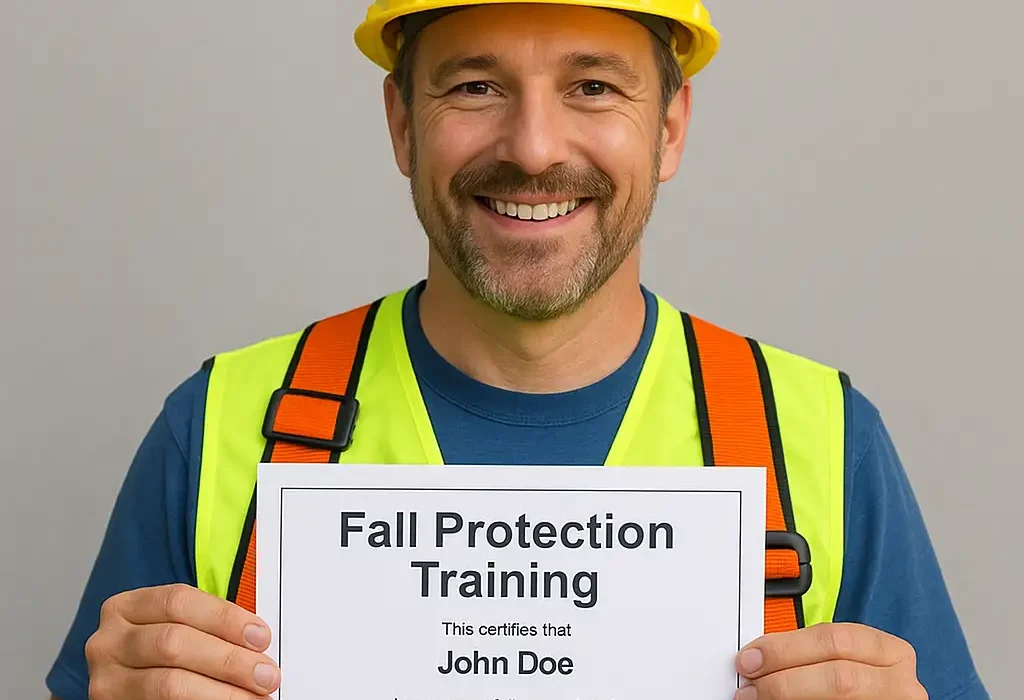
If you’re changing jobs and wondering, “Does my fall protection training transfer to my new employer?”—trust me, you’re not alone.
I’ve been in that exact situation before, showing up to a new job thinking I was all set, only to be told I needed retraining. And at the time, I remember thinking… “What? I literally just took this training!”
So if you’re here searching for clarity before you start your new gig, you’re doing the right thing.
Let me break this down in a friendly, real-world way based on both OSHA rules and my experience in construction and safety training.
The Short Answer: Yes… But Also No (I Know, Not Helpful Yet!)
Here’s the truth: fall protection training can transfer between employers—but not automatically.
You don’t get a “forever” or “universal” OSHA card that works everywhere. OSHA doesn’t issue fall protection licenses. Instead, OSHA requires two things:
- Proper training
- Employer verification
This means your previous training might be accepted if your new employer reviews it and determines it covers everything they need.
But if your new employer has different hazards, uses different equipment, or requires their own customized training, they can make you retrain.
And honestly? Most employers do.
Read Related Article: Is Online Fall Protection Training Worth It? But Is It Effective?
Employer Acceptance Factors
| Factor | Will New Employer Accept It? | Why It Matters |
|---|---|---|
| Certificate Is Still Valid (Recent) | Sometimes | Most employers prefer training done within the last 1–3 years; older certificates are seen as outdated. |
| Includes Hands-On / Practical Training | Often Required | Hands-on training proves you’ve actually used fall protection equipment, not just watched videos or slides. |
| Recognized / Reputable Training Provider | Sometimes | Employers are more likely to accept certificates from known or accredited providers than from unknown online courses. |
| Matches New Job Duties | Must Match | If your new job involves different tasks (e.g., roofs, scaffolds, aerial lifts), the old training may not cover the new hazards. |
| Covers Equipment Used by New Employer | Must Match | New employers need to confirm you’re trained on their specific harnesses, anchors, lanyards, and lifeline systems. |
| Meets Legal / Regulatory Requirements | Required | Training must align with OSHA or state-plan rules; if not, employers risk fines and liability. |
| Fits Employer’s Internal Policy | Varies by Employer | Some companies accept outside training; others require every worker to complete their own in-house program. |
What Transfers vs. What Doesn’t
| What Transfers | What Does NOT Transfer | Explanation |
|---|---|---|
| General Fall Protection Knowledge | Company-Specific Procedures | Basic concepts stay the same, but every employer has unique rules and processes. |
| Hazard Recognition Skills | Site-Specific Training | Workers still need orientation for the new jobsite’s unique hazards. |
| Prior Hands-On Experience | Training on New Equipment | If the employer uses different harnesses, lanyards, or anchors, new training is required. |
| Your Previous Certificate | Employer-Specific Requirements | New employers decide if they accept your certificate or require a new one. |
| Safety Mindset & Work Experience | Rescue Plans / Emergency Procedures | Rescue procedures vary by employer and must be learned fresh every time. |
| Understanding of OSHA Basics | Internal Company Policies | OSHA rules are standard, but companies often add extra requirements you must follow. |
Read Related Article: How Much Does Fall Protection Training Cost?
OSHA’s Real Position
OSHA requires fall protection training under 29 CFR 1926.503 (construction) and 1910 (general industry). But here’s the key point:
👉 Training must be specific to the hazards of the job.
And those hazards change from site to site.
So OSHA basically says:
- If your new employer uses the same type of equipment
- And exposes you to the same hazards
- And your previous training is still current
…then retraining may not be required.
But OSHA also says workers must be retrained whenever:
- There are new hazards
- You use new fall protection systems
- The work environment changes
- A worker demonstrates inadequate knowledge (yes, they can retrain you for unsafe behavior)
- Equipment is upgraded or replaced
So OSHA doesn’t say “your training transfers,” but they also don’t say it can’t. They simply require that training matches the job.
Read Related Article: Fall Protection Training vs. Working at Heights: The Difference?
When Your Fall Protection Training Usually Transfers
Let me speak from experience here.
If I moved from one construction company to another—same type of work, same tasks, same equipment—most employers accepted my previous training. They’d still do an orientation, but they didn’t make me retake the entire course.
Training tends to transfer more smoothly when:
✔ Your certificate is recent
Most employers prefer within 1–2 years.
✔ The job tasks are similar
For example:
- Construction → Construction
- Roofing → Roofing
- Tower climbing → Tower climbing
✔ The equipment matches
If you used:
- Full-body harness
- Standard 6-ft lanyard
- SRLs
- Guardrails
- Scaffolding fall protection
…and the new job uses the same, they often accept previous training.
✔ The training provider is reputable
Employers trust recognized trainers or known online training companies.
When Your Training Does NOT Transfer (This Happens a Lot)
Here’s where reality kicks in—and why so many workers end up doing training again.
❌ 1. The site uses different equipment
If your old job only used fixed ladders, but the new job uses articulating booms or expects you to tie off at 6 ft, retraining is required.
❌ 2. Your certificate is old
Some employers want training every year—even though OSHA doesn’t require annual recertification.
❌ 3. Your old employer didn’t cover enough topics
Some companies focus on basic awareness, while others require hands-on practice.
❌ 4. The new employer has stricter safety rules
Some companies simply want “their own training” done so everyone follows the same system.
❌ 5. You’re entering a higher-risk environment
Moving from warehouse work to high-rise work?
Your old certificate likely won’t cut it.
❌ 6. Your old training was online-only and your new employer requires hands-on
Some employers don’t accept online-only training for fall protection, especially in construction.
Read Related Article: When is Fall Protection Training Required? (7 Situations)
Why Employers Often Require New Training (Even If You Just Did One Yesterday)
This is the part that used to frustrate me the most. But now that I’ve spent years in safety training, it actually makes sense.
✔ Every jobsite is different
Even the same type of work may have different anchor points, different roof slopes, different access ladders, and different rescue procedures.
✔ Employers are legally responsible
OSHA doesn’t care if you were trained somewhere else.
They hold your current employer responsible for making sure you’re trained.
✔ They need to verify your knowledge
Certificates can be bought online, faked, outdated, or incomplete.
✔ They want consistency
A company wants every worker following the same safety rules.
✔ Some employers had bad experiences
I’ve seen workers show a certificate then not know how to wear a harness correctly.
So yes—sometimes your employer will retrain you even if your certificate is brand new. It’s not personal. It’s protection for both of you.
Read More About This Topic: Does OSHA Require Fall Protection Training Annually?
From My Experience: When Employers Said “Show Me What You Know”
At a few companies, instead of making me retake the whole course, they did something smart:
- Reviewed my certificate
- Asked about my previous tasks
- Had me demonstrate wearing the harness
- Asked me to identify anchor points
- Checked if I knew how to inspect equipment
If I passed their internal checklist, they accepted my training.
Other companies didn’t even look at my certificate—they just said, “You’ll join the fall protection class this afternoon.”
It truly varies.
Read Related Article: Who Can Give Fall Protection Training? (And Who Cannot)
How to Make Your Training More Transferable
If you want the best chance of your training being accepted, do these:
1. Keep your certificate clean, digital, and easily accessible
Your phone should always have a copy.
2. Ask your previous trainer for training records
Some employers need a list of topics covered.
3. Stick with reputable OSHA-compliant courses
Especially if you move jobs often.
4. Stay updated
Refreshers every 1–2 years make you look competent and responsible.
5. Document experience
If you’ve used:
- SRLs
- Leading-edge systems
- Guardrails
- Aerial lifts
- Harnesses
- Vertical or horizontal lifelines
…it helps the new employer decide faster.
What to Do If Your New Employer Doesn’t Accept Your Certificate
If you end up in this situation, don’t stress. It’s extremely common.
Here’s how I’d handle it:
✔ Stay calm and ask why
Often it’s because of:
- New hazards
- Older training
- Requirements of the project
✔ Ask if you can do a shorter refresher instead of the full course
Some companies allow this.
✔ Request training on only the new hazards
Example: “If I’ve already taken basic fall protection, can you just train me on roof-specific hazards?”
✔ Remember: training is always paid by the employer
You’re not losing money.
Does Online Fall Protection Training Transfer?
Online training can transfer, but only if the new employer accepts it.
Some companies want:
- Hands-on practice
- Demonstrations
- Rescue training
For construction jobs especially, online training alone is sometimes not enough.
But for warehouses, manufacturing, telecommunications, utilities, maintenance—online courses are often accepted.
Final Thoughts
Here’s the friendly, honest truth:
👉 Sometimes it does, sometimes it doesn’t.
👉 It depends on your new employer, the equipment used, and the hazards of the job.
From experience, about half the employers I’ve worked with accepted my previous training—and the other half didn’t.
But one thing I’ve learned over the years is this:
Repeated training is never a waste of time.
Every class teaches you something new, and fall protection is one area where the stakes are literally life and death.
Whether your certificate transfers or not, staying trained, informed, and updated is the best investment you can make in yourself and your safety.

Mike Pattenson is a construction safety trainer who loves helping workers stay safe on the job. He explains safety in a simple, practical way so crews can easily understand what to do — and why it matters.
Mike Pattenson is a construction safety trainer who loves helping workers stay safe on the job. He explains safety in a simple, practical way so crews can easily understand what to do — and why it matters.
View All Articles