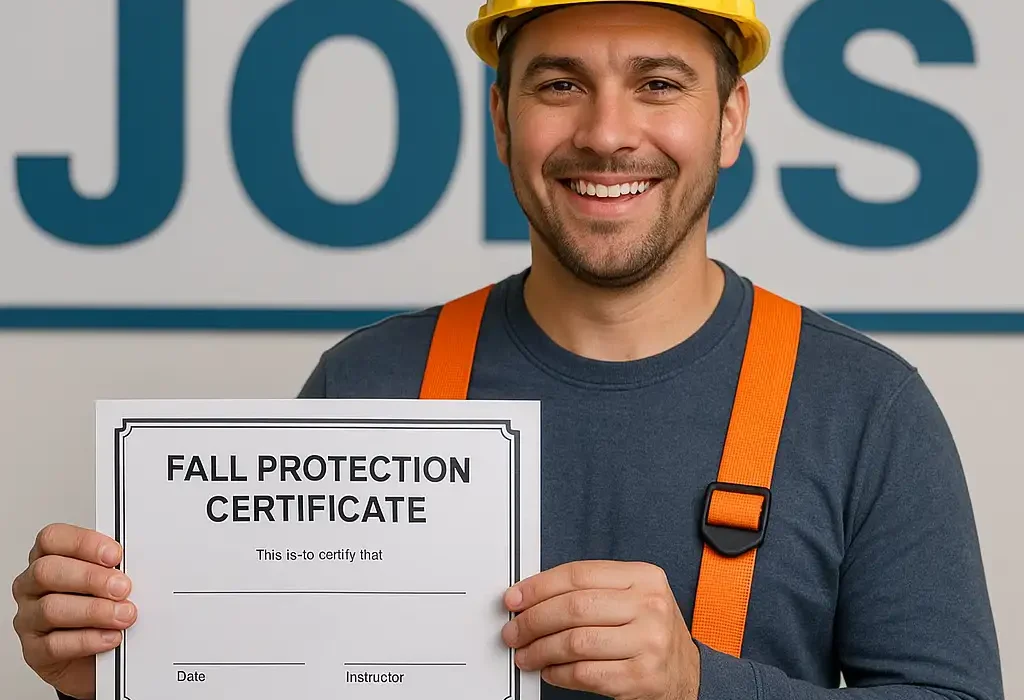
If you’re reading this, chances are you’re switching jobs—or thinking about it—and wondering: “Does my fall protection training transfer to my new employer?”
Good question. And honestly, you’re not alone. I used to ask the exact same thing back when I was moving from one contractor to another. I remember holding my old certificate like it was a golden ticket—thinking it could save me time, stress, and another awkward safety class.
But here’s the thing: fall protection training doesn’t always transfer the way we hope it will. And depending on your new employer, it may or may not be accepted.
Let’s break this down together, in plain English, so you’ll know exactly what to expect.
A Quick Answer (The One We All Want): Yes… but also no. Let me explain.
Here’s the simplest way I can say it:
- Your training skills transfer.
- Your training certificate might not.
OSHA doesn’t actually handle certificates or “official cards.” OSHA only requires that your employer—meaning your current or new employer—ensures you are properly trained for the work you’re doing.
So even if you’ve taken excellent fall protection training before, your new employer has the right (and the legal responsibility) to decide whether it meets their requirements.
I’ve seen old certificates accepted.
I’ve also seen them rejected.
It really depends on the situation—and I’ll show you exactly when and why.
Please refer to the table…
| Factor | Transfers to New Job? | Notes |
|---|---|---|
| Knowledge of Fall Hazards | Yes | General fall protection concepts remain the same across workplaces. |
| Hands-On Skills | Sometimes | Depends on whether the new job uses different harnesses, lanyards, or anchorage systems. |
| Previous Certificate | Sometimes | New employers decide whether to accept your old certificate based on their requirements. |
| Employer-Specific Rules | No | Each company has its own policies that must be followed, even if you’re already trained. |
| Training on Company Equipment | No / Depends | If new equipment is used, employers must provide additional training. |
Read Related Article: Is Your Fall Protection Training Valid in Another State?
Why Training Doesn’t Automatically Transfer Between Jobs
| Reason | Explanation | Impact on Worker |
|---|---|---|
| Different Equipment Used | New employer may use different harness types, SRLs, lanyards, anchors, or rescue systems that require specialized training. | Worker must learn proper setup, inspection, and usage of new equipment. |
| Company-Specific Policies | Each company has unique procedures, rescue plans, and enforcement rules—even if the regulations are the same. | Retraining required to ensure compliance with the new employer’s policies. |
| Different Job Tasks | A worker may go from ladder work to roof work, scaffolds, aerial lifts, or tower climbing, which require different training modules. | Tasks with higher risk levels require additional or advanced training. |
| State or Local Requirements | Some states or regions have stricter fall protection rules than federal OSHA, or require specific training providers. | A worker may need state-specific or location-specific retraining. |
| Training Provider May Not Be Recognized | Not all employers accept certificates from online-only or unknown training providers. | Worker may need training from an employer-approved or accredited provider. |
| Certificate May Be Expired or Outdated | Employers don’t accept certificates older than 1–3 years due to changes in equipment and standards. | Refresher training required before starting work. |
| OSHA Requires Job-Specific Training | OSHA states workers must be trained for the exact hazards present at their workplace—not just general fall protection. | Even trained workers must undergo site-specific training at every new employer. |
Read Related Article: When is Fall Protection Training Required? (7 Situations)
I’ll tell you from experience: every jobsite is different.
Even if you feel confident because you’ve been in the industry for years, your new workplace may have:
- Different fall hazards
- Different ladders, scaffolds, lifts, or anchor points
- Different heights and exposure levels
- Different equipment (like a specific type of SRL or harness brand)
- Different safety rules and procedures
As a safety trainer, I’ve certified workers in construction, telecom, warehousing, manufacturing, and even solar installations. And in all those years, I’ve never seen two jobsites that are exactly the same.
Here’s an example:
A worker moves from a warehouse job to a roofing company. Yes, he’s trained in fall hazards—but the type of fall protection he’ll be using on a roof is dramatically different.
So while his old skills are helpful, the new employer can’t rely on previous training alone.
And legally? The employer must ensure you’re competent for their specific hazards. That’s why training doesn’t auto-transfer like a driver’s license.
Read Related Article: Is Online Fall Protection Training Worth It? But Is It Effective?
When Your Old Training Might Be Accepted
Okay, now the good news: there are plenty of situations where your old fall protection training will fly just fine.
You’re more likely to be accepted if:
1. The job hazards are similar.
Example:
- You move from one commercial construction company to another.
- You’re still working with the same type of harnesses, anchor points, and tasks.
2. Your certificate is recent.
If you completed training within the last 1–3 years, many employers are willing to accept it.
3. Your training provider is reputable.
If you trained with a company known in the industry (especially one that follows OSHA 29 CFR 1926.503 or 1910 standards), employers are more willing to trust the competency.
4. You can show detailed proof of what you learned.
Some workers bring:
- A certificate
- A training card
- A syllabus
- The trainer’s name and contact
- A course outline
The more documentation you provide, the more credible your past training becomes.
Read related Article: How Much Does Fall Protection Training Cost?
5. The new employer has a flexible “verification” policy.
Some employers simply run a quick evaluation or refresher to confirm you understand the basics.
I used to do this myself:
When someone presented an old certificate, I didn’t automatically reject it. I’d ask them a few practical questions, observe how they put on a harness, and check how comfortable they were with identifying hazards.
If they clearly understood the essentials, I’d accept the training and maybe just give them a short orientation on new equipment.
When You’ll Definitely Need New Training
Now, let’s talk about the situations where your old certificate probably won’t be enough—and where retraining is pretty much guaranteed.
1. You’re switching industries.
Examples:
- Warehouse → Roofing
- Construction → Telecom
- Manufacturing → Tower climbing
Each industry has specialized fall protection systems.
Read Related Article: Fall Protection Training vs. Working at Heights: The Difference?
2. You’ll be using equipment you’ve never used before.
Such as:
- Vertical lifelines
- DBI-SALA-style SRLs
- Beam clamps
- Leading-edge SRLs
- Advanced rescue equipment
New gear = new training.
3. Your previous training is old or outdated.
If your last training was:
- More than 3 years ago (common refresh cycle)
- Before major equipment updates
- Before new OSHA interpretations
…then retraining is almost always required.
4. Your certificate lacks detail.
Some certificates only show a name and date, with no topics listed.
Most employers won’t accept those.
5. Your new company has stricter safety policies.
Some employers require their own training no matter what—especially big corporations.
Read More About This Topic: Does OSHA Require Fall Protection Training Annually?
So What Happens When You Show Your Old Certificate to the New Employer?
Let me walk you through what usually happens.
Scenario 1: Employer Accepts It
They’ll keep a copy, maybe give you a short refresher, and then you’re good to go.
Scenario 2: Employer Partially Accepts It
They’ll say something like:
“This is good, but we’ll add a site-specific training session.”
This is actually very common.
Scenario 3: Employer Rejects It
They may require:
- A full retraining session
- A 1–2 hour refresher
- A practical skills demonstration
Don’t take this personally—this isn’t about not trusting you. It’s about protecting their workers, meeting OSHA requirements, and reducing their liability.
Read Related Article: Is Fall Protection Training an All-Day Thing? (Shorter or Longer?)
Tips to Make Your Training More Transferable Next Time
Here’s something most workers don’t realize: you can make it easier for your training to be accepted just by being organized.
1. Keep your certificates safe.
Digital copy + printed copy = best combo.
2. Ask for the course syllabus.
It shows exactly what you learned.
3. Request a wallet card if available.
These are easier to show than a full certificate.
4. Keep your trainer’s name or provider’s info.
A new employer might call them for verification.
5. Stay updated every 1–2 years.
Many employers love seeing recent training.
What OSHA Actually Says
OSHA doesn’t provide training cards.
OSHA doesn’t certify workers.
OSHA doesn’t approve training schools.
What OSHA does require under 29 CFR 1926.503 & 1910.30 is:
- Employers must train workers exposed to fall hazards.
- Employers must evaluate and certify that training was completed.
- Retraining is required when:
- You show unsafe behavior
- You forget something
- Jobsite conditions change
- New equipment is introduced
- There’s a near miss or accident
So no, OSHA won’t say “your training transfers.”
But they will say “your employer must ensure you’re trained.”
That’s the key difference.
Should You Just Take the New Training Anyway?
Honestly?
Yes—most of the time it’s worth it.
Here’s why:
- It refreshes your memory.
- You learn your new employer’s procedures.
- You get familiar with new equipment.
- You stay OSHA compliant.
- You protect yourself and your paycheck.
- Training is usually free because employers must pay for it.
Even as a trainer, I retake fall protection courses from time to time—because knowledge fades, and equipment evolves.
Final Thoughts
So, does fall protection training transfer between jobs?
Your knowledge does. Your certificate might.
Every employer wants to make sure you’re safe, and sometimes that means retraining. Don’t think of it as a hassle—think of it as reinforcement. A stronger shield. Another layer of protection.
At the end of the day, whether the certificate transfers or not, the goal is the same:
Go home safe. Every single day.

Mike Pattenson is a construction safety trainer who loves helping workers stay safe on the job. He explains safety in a simple, practical way so crews can easily understand what to do — and why it matters.
Mike Pattenson is a construction safety trainer who loves helping workers stay safe on the job. He explains safety in a simple, practical way so crews can easily understand what to do — and why it matters.
View All Articles