If you work around heights long enough, you start hearing the same questions over and over again.
One of the big ones?
“Does OSHA really require a competent person for fall protection, or is that just something safety guys keep repeating?”
I get it—OSHA’s wording can feel like a riddle sometimes. And when you’re on a busy jobsite, the last thing you want to do is flip through regulations trying to decode what a “competent person” even means.
So let’s break this down the way we would on site—straightforward, simple, and with real-world examples.
The Short Answer: Yes… Most of the Time
This part always confuses people.
OSHA says training should be done by a competent person or qualified person—and sometimes both.
A “qualified person” is someone with deep, technical knowledge—engineers, certified trainers, people with credentials.
A “competent person” is someone who can recognize hazards and take action.
For most regular fall protection training on a jobsite, a competent person is acceptable.
For more technical training—like designing anchor systems, advanced rigging, or high-risk tasks—a qualified person is needed.
If you’re unsure which one applies, here’s a simple rule:
If workers’ lives rely on the system, a competent person oversees it. If the system itself needs to be engineered or designed, a qualified person handles it.
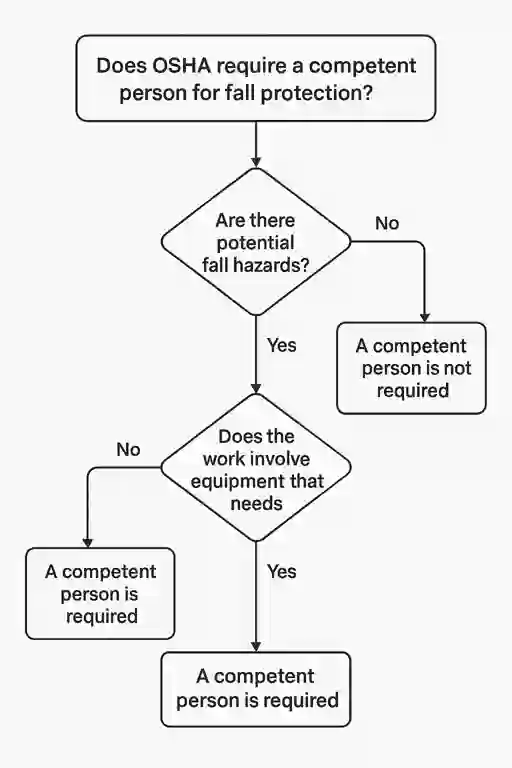
Here’s how to know if you need one:
How Employers Must Officially Designate a Competent Person
Choosing your Competent Person isn’t just picking someone at random—it’s picking the one person who can actually spot trouble and isn’t scared to speak up.
OSHA wants someone who knows their stuff and can shut things down if things get unsafe. As the employer, it’s your job to officially say, “Yep, this is our Competent Person.”
Here’s the simple way to do that.
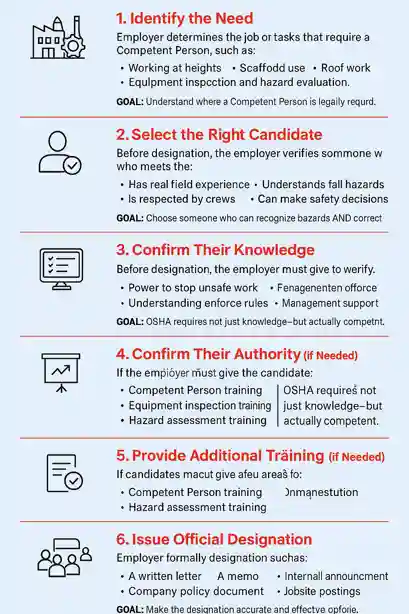
What OSHA Actually Means by “Competent Person” (Explained So It Makes Sense)
OSHA’s definition is:
“A person who is capable of identifying existing and predictable hazards and has authorization to take corrective measures.”
But let me translate that into normal, jobsite language:
A competent person is someone who has:
- The eyes to see the problem – Noticed a frayed lanyard? Spotted an anchor in the wrong place? Sees someone wearing a harness wrong? They catch it.
- The brains to understand the hazard – They actually know why something is unsafe, not just that it “looks wrong.”
- The guts and authority to stop the work – They can shut things down, no permission needed.
Some folks think it’s just whoever has the most experience.
Some think it has to be the safety officer.
Some think a two-hour online course makes them one.
Nope.
A competent person is someone the employer specifically designates, who has enough knowledge, experience, and authority to manage fall protection hazards right then and there.
So… Who Can Actually Be a Competent Person?
Here’s the truth:
OSHA doesn’t give you a list of job titles.
It could be:
- A foreman
- A supervisor
- A site safety officer
- The most experienced worker on the crew
- A trained and trusted journeyman
I’ve even seen small companies designate a lead carpenter who simply had years of experience and took the role seriously.
What matters is:
✔ They know fall hazards
✔ They know equipment
✔ They can recognize when someone is using gear improperly
✔ They know what an acceptable anchor point is
✔ They can take immediate action
✔ And the employer has officially said, “Yes, this is our competent person.”
In other words, you can’t just point to someone randomly and say, “Yep, that’s him.”
They actually need knowledge and authority.
Do You Need a Competent Person on Every Single Jobsite?
A lot of folks assume OSHA wants a competent person standing next to every worker who’s near an edge. That’s not the case.
Here’s when OSHA clearly expects one to be involved:
1. Pre-job hazard assessments
Before anyone climbs anything, the competent person should identify risks.
2. Equipment inspections
This is big. Harnesses, SRLs, lanyards, anchors, guardrails—something always needs inspection.
3. When workers are using fall protection equipment
Someone must ensure it’s set up correctly.
4. When conditions change
Rain, wind, new openings in floors, new scaffolds, new roof installs—any of that requires re-assessment.
5. When training is conducted
OSHA expects training to be done by someone competent (or qualified, depending on the situation).
So do you need one every minute?
Not necessarily.
But do you need one overseeing the work, checking the hazards, inspecting equipment, and making safety calls?
Absolutely.
If fall protection is involved, so is a competent person.
When OSHA Requires a Competent Person (Specific Activities)
| Activity | Competent Person Required? | Notes |
|---|---|---|
| Fall Protection Equipment Inspection | ✔ Yes | Must inspect before each shift |
| Fall Hazard Assessment | ✔ Yes | Required whenever work conditions change |
| Scaffold Work | ✔ Required | OSHA has explicit scaffold CP rules |
| Roofing Work | ✔ Expected | Not always explicitly stated, but implied |
| Training Oversight | ✔ Yes | CP or Qualified person required |
| Anchor Point Approval | ✔ Yes | Must determine suitability |
| Controlled Decking Zone | ✔ Required | Steel erection requirement |
| Ladder Use | ✖ Not always | But hazard assessment still needed |
| Small or “quick jobs” | ✔ Yes | Hazard evaluation still mandatory |
Duties of a Competent Person (What They Actually Do on Site)
| Competent Person Responsibility | Description |
|---|---|
| Identify fall hazards | Detect existing or predictable dangers |
| Inspect equipment | Harnesses, lanyards, SRLs, anchors, etc. |
| Approve anchor points | Decide if the location is safe and strong enough |
| Stop unsafe work | Has authority to shut down operations immediately |
| Correct hazards | Fix problems on the spot |
| Monitor weather changes | Wind, rain, surfaces, visibility |
| Ensure proper PPE use | Makes sure workers connect properly |
| Oversee rescue planning | Ensures there is a plan before work starts |
So Who Should Your Competent Person Be?
If you’re an employer or supervisor trying to choose one, here’s what you look for:
| Quality | Description | Why It Matters | Examples / Indicators |
|---|---|---|---|
| Real Jobsite Experience | Hands-on experience working at heights, using equipment, and dealing with hazards—not just classroom knowledge. | Competent Persons must identify hazards that are not obvious to untrained workers. | Has installed anchors, inspected harnesses, supervised crews at heights. |
| Strong Hazard Awareness | Notices unsafe conditions quickly; able to spot small details others miss. | Many fall hazards are subtle (improper anchor points, worn lanyards, unprotected edges). | Points out hazards during walkthroughs before others notice them. |
| Willing to Speak Up | Confident enough to stop work, correct mistakes, or challenge unsafe decisions—even if unpopular. | OSHA requires Competent Persons to stop work when they see danger. | Tells workers to re-tie off, stops a lift, or rejects unsafe equipment. |
| Respected by Workers | Someone the crew listens to and takes seriously. | Instructions are useless if workers don’t follow them. | Workers often ask this person for help or clarification. |
| Takes Responsibility | Understands the weight of the role and accepts accountability for safety decisions. | Competent Persons make decisions that affect lives. | Tracks inspections, documents corrections, follows up consistently. |
| Trained (But Not Just Certified) | Has completed fall protection training from a qualified source. | Training gives knowledge—but authority + experience create competence. | Holds a certificate but also knows how to apply it on the job. |
| Authority to Correct Hazards | Has permission from management to stop work and fix hazards immediately. | OSHA requires both knowledge AND authority—not just one. | Supervisor, foreman, lead worker with decision-making power. |
OSHA doesn’t hand you a magic certificate saying “You’re the competent person now.”
It’s up to the employer to decide who fits the role.
OSHA just tells you what the role requires.
If the person can:
- Identify hazards
- Make immediate corrections
- Stop unsafe work
- Ensure fall protection is set up right
…then they fit OSHA’s definition.
If they can’t—or aren’t given authority—then they’re not a competent person, no matter what training they took.
The Part Most Workers Don’t Realize They’re Missing
Here’s the thing most folks never consider:
A competent person isn’t just the one who checks things off a list.
They are also the one responsible for:
1. Inspections
Before each shift and every time conditions change.
2. Correcting hazards immediately
No waiting, no asking for permission.
3. Stopping unsafe work
This is the big one.
A regular worker can yell, “Hey, that doesn’t look safe!”
But a competent person can say, “Stop work. Everyone come down. Fix this now.”
That authority is EVERYTHING.
It’s why OSHA insists on the role.
Is a Competent Person Really Required—Or Just Recommended?
Let me put it this way:
OSHA rarely uses words they don’t mean.
When OSHA says a competent person is required, that’s not a suggestion.
Here are situations where OSHA explicitly requires one:
- Scaffold inspections
- Excavations and trenches
- Fall protection systems setup
- Controlled decking zones
- Equipment inspections
- Training oversight
- Roofing activities
And honestly, even in the few areas where they don’t explicitly say the words, a competent person is still needed to recognize hazards.
If nobody on your jobsite has the authority to stop unsafe work…
If nobody knows how to inspect equipment…
If nobody knows what anchor points are safe…
You don’t just have a missing role—you have a serious OSHA problem and a real safety problem.
The Biggest Mistake Companies Make
| Mistake | What Happens | Risk Level |
|---|---|---|
| No one officially designated | Workers assume someone else is in charge | High |
| Thinking a supervisor automatically qualifies | Knowledge may be lacking | High |
| No authority given to the CP | CP cannot correct hazards immediately | Very High |
| No regular inspections | Equipment failure goes unnoticed | Critical |
| Using workers with no real training | Incorrect decisions made | High |
| Assuming training alone makes someone competent | Lacks experience or authority | Medium |
The most dangerous mistake I see:
Not officially assigning a competent person.
Either:
- Everyone assumes it’s the supervisor
- Or they think the “safety guy” just automatically is one
- Or nobody knows who’s actually in charge
That creates a jobsite where:
- Hazards go unnoticed
- Equipment goes uninspected
- Workers “make do”
- Anchor points are guessed
- People use the wrong harness or lanyard setup
- No one has the authority to stop bad decisions
And that’s when falls happen.
I’ve seen companies get fined for “lack of a competent person” even when the person technically existed—just not officially.
Make it official. Put a name to it.
Final Thoughts: Clearing Up the Confusion
Here’s the bottom line:
Yes, OSHA requires a competent person for fall protection—very often.
Here’s what you now know:
- A competent person is someone with real knowledge AND authority.
- They don’t need a specific job title—just the right experience and power to act.
- They’re needed on almost every job that involves a fall hazard.
- Even small jobs need one overseeing the risks.
- They are responsible for inspections, hazard correction, and stopping unsafe work.
- Employers must officially designate them.
And honestly?
Having a competent person isn’t just about OSHA.
It’s about keeping people alive.
Falls remain one of the top causes of injuries on job sites.
The competent person is the one who stands between a worker and a life-changing fall.
Mike Pattenson is a construction safety trainer who loves helping workers stay safe on the job. He explains safety in a simple, practical way so crews can easily understand what to do — and why it matters.
Mike Pattenson is a construction safety trainer who loves helping workers stay safe on the job. He explains safety in a simple, practical way so crews can easily understand what to do — and why it matters.
View All Articles