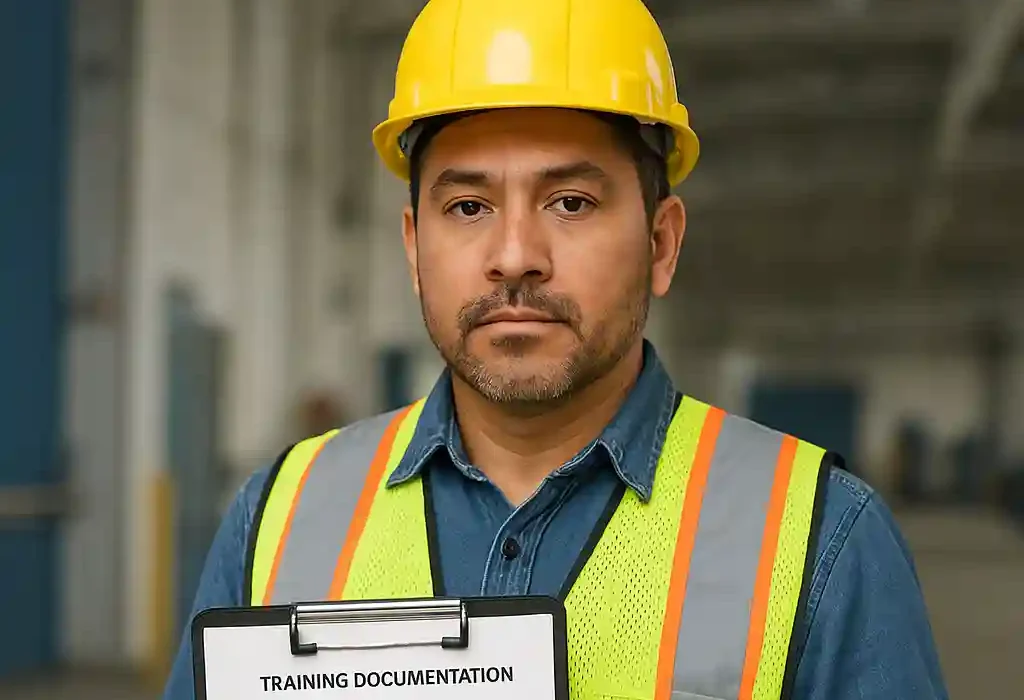
If there’s one thing I’ve learned from being around safety programs for a long time, it’s this: training is only half the battle—documentation is what protects you when things go wrong.
You can train workers thoroughly, walk them through equipment, coach them on tie-off points, and even supervise their practice. But if an OSHA inspector shows up tomorrow asking for proof, and the documents aren’t there… it’s as if the training never happened.
The good news? Keeping complete fall protection training documentation isn’t complicated once you know exactly what you need. And that’s what we’ll walk through here—clearly, simply, and from the perspective of someone who’s seen what happens when documentation is done right and when it’s done poorly.
Let’s break this down step-by-step.
Why Fall Protection Documentation Matters More Than Most People Realize
Most companies don’t get cited because workers weren’t trained—they get cited because they can’t prove workers were trained.
OSHA 1926.503 and 1910.30 make it clear: Employers must train workers exposed to fall hazards and must document that training.
Training protects people. Documentation protects the company.
Without the paperwork, an investigator won’t assume you trained your team. They’ll simply note the absence of records—and that alone is enough for a citation.
That’s why the most well-run safety programs don’t leave documentation to chance. They treat it like part of the training process, not an afterthought.
Read related article: Lost Your Fall Protection Certificate? Here’s What to Do Next
What Fall Protection Training Documentation Includes
| Record Category | Specific Data to Capture | Required / Recommended | Source / Standard | How You Use It |
|---|---|---|---|---|
| Training Certification Record | Employee name or ID, date(s) of training, signature of trainer or employer | Required for construction fall protection training records | OSHA 29 CFR 1926.503(b)(1)–(2) | Core proof that a specific worker completed fall protection training |
| Training Topics Covered | Nature of fall hazards, correct procedures, use/operation of guardrails, safety nets, PFAS, role in safety-monitoring, etc. | Required that training covers listed items; documenting topics is best practice | OSHA 29 CFR 1926.503(a)(2) | Shows that content matched OSHA requirements and site hazards |
| Attendance & Sign-In Sheet | Names of attendees, date, instructor, type of training, signatures | Common requirement in institutional fall-protection programs | University / EHS fall protection manuals | Backup evidence that workers were physically present in the session |
| Trainer Details / Credentials | Trainer name, role, experience or credentials related to fall protection | Recommended; often requested during audits | Safety training guidance & violation analyses | Demonstrates that training was provided by a knowledgeable person |
| Written Test / Quiz Record | Copy of test or answer sheet, score, pass/fail status, date | Recommended way to show understanding and skill | Fall-protection training guides & programs | Proof that workers understood regulations, hazards and safe use of equipment |
| Practical Evaluation Checklist | Harness inspection, proper donning, anchorage selection, tie-off, safe use during tasks | Required that workers “demonstrate” ability; documenting it is best practice | OSHA 1910.30 & 1926.503 interpretive guidance | Shows each worker can actually use fall protection systems correctly |
| Certificates or Cards | Worker name, course title, date, provider, expiry or refresher due date (if used) | Often required to be kept on site or by the worker; strongly recommended | National safety centres & provincial / state guidance | Quick proof of training when workers move between sites or employers |
| Retraining / Refresher Record | Reason for retraining (new equipment, new hazards, poor performance, incident), date, topics | Required when circumstances trigger retraining | OSHA 1910.30(c) & 1926.503(c) | Shows you responded correctly when conditions changed or skills lapsed |
| Equipment Inspection & Rescue Plan Records | Inspection logs for harnesses/anchors, written rescue plan, rescue drills | Recommended part of a managed fall-protection program | Fall-protection program guides & OSHA-oriented training articles | Supports overall compliance and ties worker training to actual equipment and rescue procedures |
| Record Retention & Access | Where records are stored, retention period, who can access, how records are provided during audits | Records must be available for review on request; retention period often set by internal policy | Institutional fall-protection manuals & documentation guidance | Keeps your documentation system audit-ready and consistent across projects |
| Documentation Item | Description | Why It Matters |
|---|---|---|
| Trainee Information Sheet | Worker name, job title, employer, project | Identifies who was trained |
| Training Date & Trainer Info | Date, trainer name, qualifications, signatures | Verifies legitimate training |
| Topics Covered | List of fall protection topics included | Shows training matched hazards |
| Training Methods | Classroom, hands-on, evaluation | Proves training was applied, not just theory |
| Written Test Results | Test copy or score | Shows knowledge was assessed |
| Practical Evaluation Checklist | Harness inspection, anchoring, tie-off demo | Confirms worker can perform tasks |
| Attendance Sheet | Names and signatures of participants | Secondary verification |
| Certificate of Completion | Issued after training (optional) | Proof for job transfers or audits |
Let’s go one by one so nothing gets missed. These items create a complete, OSHA-ready documentation package.
Read related article: Not Fall Protection Certified? Here’s What OSHA Can Fine You
1. Trainee Information Sheet
Every worker should have an individual training record that includes:
- Full name
- Job title
- Employer (especially when contractors are involved)
- Worksite or project
- Employee ID (if available)
Why this matters:
If an auditor sees “15 workers trained,” they’ll still ask, “Who exactly?” This sheet removes the guesswork.
Read related article: Are Your Fall Protection Training Records OSHA-Ready?
2. Training Date and Details About the Instructor
Every record should clearly show:
- Date of the training
- Name of the trainer
- Qualifications or experience (even a short description is enough)
- Signature of the trainer
If OSHA questions whether the person delivering the training was competent to do so, this information helps resolve that quickly.
3. Training Topics Covered (Course Outline)
This is where you prove the training wasn’t generic.
Your topic list should include items such as:
- Types of fall hazards present
- Proper use of PFAS (Personal Fall Arrest Systems)
- Anchor points
- Harness inspection and adjustment
- Using lanyards and connectors
- Ladder safety
- Scaffold safety
- Warning line systems
- Fall clearance
- Rescue planning
Why it matters: OSHA expects your training content to match the hazards workers face. A clear outline shows you covered the right material.
Read related article: How Often Do You Need Fall Protection Training?
4. Training Method Used
OSHA requires that workers not only receive training but also demonstrate understanding.
Your documentation should show:
- Classroom or online instruction
- Hands-on equipment demonstrations
- Practical evaluation
- Written test
This proves the training wasn’t just a slide deck—it was applied.
Read related article: Who Can Give Fall Protection Training? (And Who Cannot)
5. Written Test or Quiz Results
Some companies skip this because they think it’s unnecessary. But keeping:
- A copy of the test, or
- A record of each worker’s score
…is one of the easiest ways to show OSHA that workers understood the material.
Written tests don’t have to be complicated. Even a simple 10-question quiz goes a long way.
Read related article: Fall Protection: Whose Responsibility Is It—Employer or Worker?
6. Practical Evaluation Checklist
Fall protection training must include a hands-on demonstration. This is where many employers fall short.
A good practical checklist includes:
- Inspecting the harness
- Correctly putting it on
- Adjusting straps
- Selecting a proper anchor
- Connecting properly
- Demonstrating fall clearance awareness
- Using equipment safely during simulated work tasks
The checklist should be signed:
- By the worker (acknowledging the evaluation)
- By the trainer (verifying competence at the time of training)
This document carries significant weight in an audit.
Read related article: Qualified vs. Competent Person in Fall Protection
7. Attendance Sheet With Signatures
Even when individual sheets exist, OSHA still loves seeing a group attendance sheet. It acts as a secondary verification.
Your attendance sheet should include:
- Worker name
- Signature
- Time of training
- Trainer signature
Make sure the signatures are clear. Auditors do not appreciate scribbles.
8. Certificate of Completion (Optional—but highly recommended)
OSHA doesn’t require certificates. But every experienced safety professional keeps them for several reasons:
- Workers can present them when transferring job sites.
- Supervisors can verify training quickly.
- It adds a professional layer of documentation.
Think of certificates as the “front cover” of your record system.
How Long Should You Keep Fall Protection Training Records?
| Record Type | Recommended Retention Duration | Reason |
|---|---|---|
| Fall Protection Training Records | Duration of employment + 5 years | Supports audits and investigations |
| Practical Evaluations | Same as above | Demonstrates competence over time |
| Refresher or Retraining Records | 5+ years | Needed when workers fail evaluations or new equipment is introduced |
This is one of the most misunderstood topics.
OSHA doesn’t give a specific retention timeline for fall protection training. But here’s what works best and aligns with industry standard practice:
Keep all fall protection training records for the entire duration of employment + 5 years.
Here’s why:
- OSHA can investigate incidents long after they happen.
- Recurrent training (often every 1–2 years) requires a trackable history.
- It protects you during liability claims.
Additionally, retraining must be documented whenever:
- New fall protection gear is introduced
- New hazards or job tasks appear
- A worker has a near miss, incident, or is observed using equipment improperly
If OSHA asks, “Why did this worker get retrained?”
Your documentation should answer that question immediately.
Common Documentation Mistakes (I See These Constantly)
| Mistake | Impact |
|---|---|
| Missing signatures | Invalidates the entire record |
| Only keeping certificates | Insufficient documentation |
| No practical evaluation record | Training appears incomplete |
| Using generic training logs | Doesn’t match OSHA requirements |
| Scattered or inconsistent records | Causes audit delays and citations |
You can have great training and still get cited because the paperwork was incomplete. Some of the most avoidable mistakes include:
1. Missing signatures
A worker without a signature might as well be untrained in the eyes of an inspector.
2. Only keeping the certificate
Certificates are nice—but they’re not enough by themselves. OSHA wants everything behind it.
3. No practical evaluation included
This is one of the most common gaps.
4. Using a generic “safety training” log
Fall protection deserves its own dedicated record.
5. Inconsistent recordkeeping
Training records spread across:
- HR
- Safety department
- Jobsite trailer
- Manager’s car
…is a guaranteed audit headache.
A Simple Way to Organize Your Fall Protection Records
You don’t need expensive software to create a solid documentation system. Here’s a structure that works for most companies:
Option 1: Physical Binder System
Create a binder with sections:
- Training roster
- Individual worker records
- Copies of certificates
- Written tests
- Practical evaluation sheets
- Topic outline
- Trainer qualifications
This system works surprisingly well in small to mid-size companies.
Option 2: Digital Folder System
Use Google Drive, Dropbox, or Microsoft OneDrive.
Recommended folder structure:
- Fall Protection Training
- Year
- Individual Worker Files
- Attendance Sheets
- Practical Evaluations
- Test Results
- Certificates
- Trainer Info
- Year
Digital systems are easier to back up and share.
Whichever system you choose, the biggest key is consistency.
What OSHA Looks for During an Inspection
During a typical audit, OSHA will ask for:
- Your training program
- Records showing each worker was trained
- Practical evaluation documentation
- Evidence the training matches the hazards
- Refresher or retraining documentation
Inspectors will often select random employees and ask:
- “When were you trained?”
- “Do you have proof?”
- “Can you show me how you inspect your harness?”
The documentation you keep directly supports these interviews.
I’ve seen situations where strong documentation prevented fines—even when minor issues were present in the field—because the company clearly invested in training.
Final Thoughts
Fall protection training is essential, but the documentation behind it is what keeps a company protected, organized, and ready for audits. You don’t need a massive system or expensive software—just a clear, consistent way to track who was trained, on what, when, and how.
When your documentation is complete, your job becomes easier:
- Audits run smoother
- Workers are better prepared
- Supervisors can verify training instantly
- You avoid unnecessary violations
Build your documentation process now, not after an incident—because in safety, the paperwork is part of the protection.

Mike Pattenson is a construction safety trainer who loves helping workers stay safe on the job. He explains safety in a simple, practical way so crews can easily understand what to do — and why it matters.
Mike Pattenson is a construction safety trainer who loves helping workers stay safe on the job. He explains safety in a simple, practical way so crews can easily understand what to do — and why it matters.
View All Articles