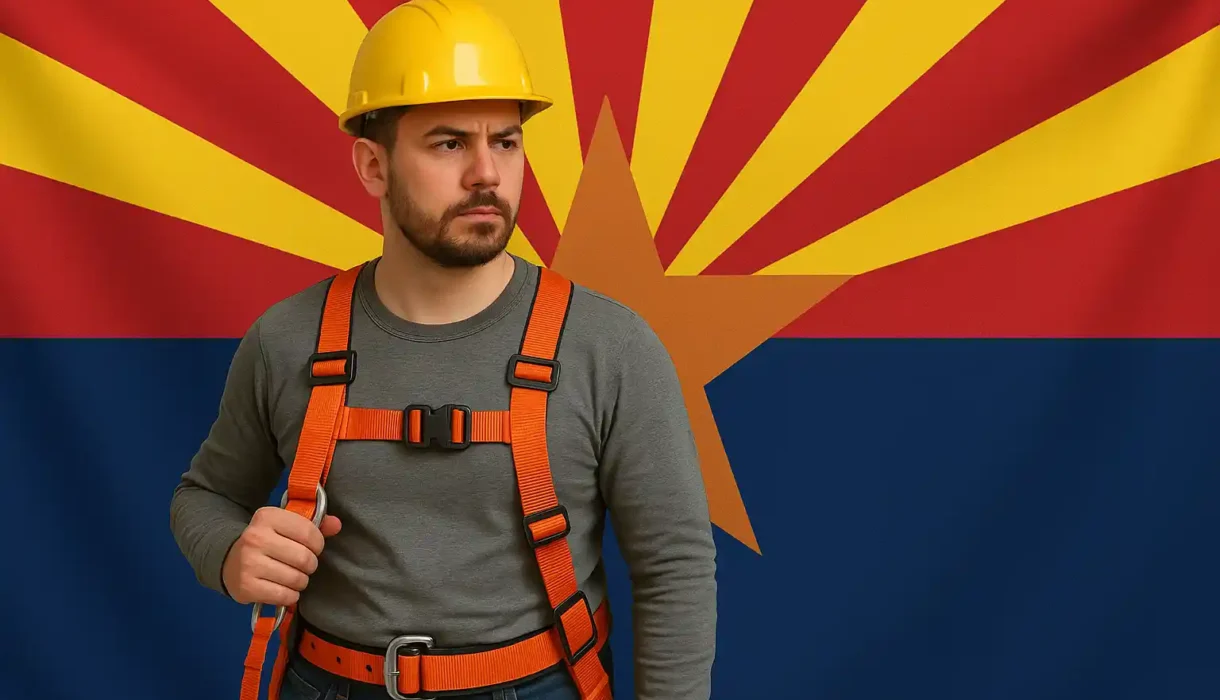
If you’ve ever worked on a roof in the middle of a hot Arizona afternoon, you already know—fall protection isn’t something you take lightly.
Between the blistering sun, metal rooftops that heat up like a frying pan, and strong desert winds, it only takes one small mistake for things to go bad fast.
I’ve walked enough Arizona job sites—roofing crews in Phoenix, solar installers in Tucson, construction workers in Flagstaff—to see just how quickly a normal workday can turn dangerous.
That’s why fall protection training in Arizona matters. Not just because OSHA says so, but because people get hurt when they skip it, rush it, or “wing it.”
In this guide, I’ll walk you through everything. Let’s get into it.
Does Arizona Have Its Own Fall Protection Rules?
This is one of the most common questions I hear from crews and supervisors across the state.
Short answer: No. Arizona follows federal OSHA standards.
Unlike states such as California or Washington, Arizona does not have a separate, stricter fall protection program. So whether you’re in Phoenix, Yuma, or Prescott, the rules you follow are the same as OSHA’s federal fall protection standards:
- Construction: Fall protection required at 6 feet
- General industry: Fall protection required at 4 feet
- Scaffolds: Fall protection required at 10 feet
- Aerial lifts: Always required
- Wherever a fall hazard exists: Even below 4–6 feet if a serious hazard is present
You’d be surprised how many Arizona workers think the height requirement is higher because “we’re used to working on roofs all the time.” But OSHA doesn’t care how comfortable you are on a roof—if there’s a hazard, protection is required.
Who Needs Fall Protection Training in Arizona?
Here’s the simple truth: if your feet leave the ground, you probably need training.
Some of the workers who absolutely need it include:
- Roofers
- Solar panel installers (one of the biggest sectors in AZ)
- General contractors
- Steel workers
- Scaffold workers
- Window installers
- HVAC techs climbing onto rooftops
- Telecom tower workers
- Warehouse workers using elevated work platforms
- Anyone using ladders, harnesses, lifelines, or SRLs
Even if you’re “just getting on the roof to check something,” OSHA expects you to be trained.
And trust me—Arizona roofs are not forgiving. Tile roofs, metal roofs, solar arrays, parapet walls, stucco scaffolding… every job site has its own traps waiting for you.
Where Can You Take Fall Protection Training?
| Company / Provider | Address / Contact Info | Notes / What They Offer |
|---|---|---|
| CERTEX USA | Headquarters: 7310 N 16th Street, Suite 300, Phoenix, AZ 85020 Phone: 602-271-0476 Phoenix Branch: 1721 W Culver Street, Phoenix, AZ 85007 (CERTEX USA) | Offers “Safety at Heights / Fall Protection” courses in Arizona — Authorized Person, Competent Person, on-site trainings among others. (CERTEX USA) |
| ETC Compliance | Phoenix, AZ (training campus) Phone: 602-923-9673 (e-t-c.com) | Provides fall protection training & certification in Phoenix (and reportedly Tucson). Course duration: 8 a.m.–4 p.m.; price from about US$265 per attendee. (e-t-c.com) |
| CoreSafety | Phoenix, AZ (serves Arizona) — offers onsite or facility-based training (coresafety.com) | Offers OSHA & safety-training services, including onsite instructor-led training in Phoenix. Useful if you want flexibility or have crews. (coresafety.com) |
| OSHA Training Services Inc. | Tucson, AZ Provides on-site OSHA/Fall Protection & other safety trainings for Tucson and surrounding areas. (OSHA Training) | Offers “OSHA Fall Protection / Fall Prevention Training” along with other OSHA-related courses. Useful for southern Arizona teams. (OSHA Training) |
What Each Provider Offers / What to Expect
CERTEX USA
- Offers a full range of fall-protection & rigging training: Authorized Person, Competent Person for Safety at Heights, Equipment Inspection, lift training (forklift/aerial lift/scissor lift), and even train-the-trainer courses.
- They provide both classroom-based and on-site training.
ETC Compliance
- Their “Fall Protection: AZ – Phoenix” course is aimed at individuals with exposure to fall hazards.
- They allow students to bring their own fall protection equipment (harness, lanyard, etc.) to class.
- They also mention possible scheduling in Tucson depending on availability.
CoreSafety
- Offers OSHA-compliant safety training, including fall protection, with flexibility: either at their facility or onsite at your location.
- Training can be in English or Spanish — a plus for crews with mixed language background.
OSHA Training Services Inc. (Tucson-based)
- Provides fall protection / fall prevention training, among many OSHA-related courses.
- Can deliver training on-site in Tucson or surrounding areas — good if you have remote or regional crews.
What’s Not Always Clear — What You Should Ask / Confirm
- Dates & Availability — many providers don’t post full schedules; you often need to call or email for next open class.
- On-site vs. Classroom — if you manage a crew, on-site training (crew-level) can be more efficient. Confirm with the provider.
- Equipment — some courses expect trainees to bring their own fall-protection gear (harness, lanyard, etc.), especially in provider like ETC.
- Certification Type — whether it’s “Authorized Person,” “Competent Person,” “Inspection,” or “Lift-training add-on.” Match with what your project requires.
- Language & Crew Size — especially relevant in AZ where crews may be diverse; provider like CoreSafety shows bilingual training options.
What You Should Do Next
Since you’re doing research (maybe for a workplace setup or recommendation), here’s what I recommend:
- Reach out directly to these providers (CERTEX USA; ETC Compliance; CoreSafety; OSHA Training Services Inc.) and ask for:
- Next available fall-protection course dates
- On-site vs. classroom options (and cost differences)
- What the course covers (Authorized vs. Competent vs. Inspection)
- Certificate type & validity
- Compare costs vs. what you and your crews need — e.g. if you just need basic harness training vs. full competent-person certification or yearly refreshers.
- Ask about language options or group discounts — especially useful if you have a mixed crew or many workers.
- If you want — I can pull up 8–12 more providers (covering Phoenix, Tucson, Flagstaff, Yuma, etc.), which gives broader options across Arizona.
How Much Does The Training Cost?
Prices vary depending on the city, provider, and type of course. Here’s what you can expect based on common rates across the state:
Authorized Person Training
$75–$175
Good for workers and basic certification.
Competent Person Training
$250–$550
More technical, more documentation, more hands-on.
Aerial Lift or Scissor Lift Add-On
$75–$150
On-Site Training for Entire Crews
$500–$1,500 per group
This is what most construction companies in Arizona prefer because it’s cheaper per head.
Why Costs Vary in Arizona
- Providers in Phoenix are generally cheaper because of competition.
- Providers in Flagstaff, Winslow, Yuma, and rural areas cost more due to travel.
- Solar installers often request specialized training packages.
- Competent person courses cost more due to higher instructor qualifications.
Final Thoughts
Getting fall protection training in Arizona doesn’t have to be complicated. The courses are affordable, they don’t take long, and they could save your life or one of your crew members. Whether you’re working on a roof in Phoenix, installing solar panels in Tucson, or doing commercial construction in Mesa, the hazards are the same—and so are the training requirements.
If you know what to expect, the entire certification process becomes quick and painless. And once you’re trained, you’re not just compliant—you’re confident.
Need Fall Protection Training in Arizona? Tell us what you need—we’ll help you find the right course and get a quick quote.
Mike Pattenson is a construction safety trainer who loves helping workers stay safe on the job. He explains safety in a simple, practical way so crews can easily understand what to do — and why it matters.
Mike Pattenson is a construction safety trainer who loves helping workers stay safe on the job. He explains safety in a simple, practical way so crews can easily understand what to do — and why it matters.
View All Articles