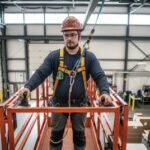
If you’re working in Georgia—whether you’re on a roof in Savannah, climbing a telecom tower outside Macon, or walking a warehouse mezzanine in Atlanta—there’s one rule that never changes:
If you can fall, OSHA expects you to know how not to.
And because Georgia follows federal OSHA (there’s no state-run OSHA plan here), the rules are pretty straightforward… but the way different Georgia industries deal with fall protection varies a lot. I’ve worked with enough Georgia crews—construction guys, warehouse teams, HVAC techs, solar installers—to know that fall hazards show up in more places than people think.
So let’s break down, in plain language, what fall protection training in Georgia actually looks like: the OSHA requirements, who needs the training, how much it costs, and what your options are for getting certified.
OSHA Fall Protection Requirements in Georgia
Georgia doesn’t make its own fall protection rules. Everything here is straight from federal OSHA, mainly:
- 1926 Subpart M — Construction fall protection
- 1910 Subpart D — General industry walking-working surfaces
I know those numbers look intimidating, but here’s the simple version:
OSHA’s “Fall Protection Height Rules”
If you’re in Georgia:
- Construction: You need fall protection at 6 feet
- General industry: You need fall protection at 4 feet
- Any height: If there’s dangerous equipment below you (like moving machinery)
This is the part people misunderstand all the time.
I’ve had warehouse workers tell me:
“Fall protection? That’s for roofers.”
Nope. If you’re in a warehouse and you step onto a platform or mezzanine that’s 4 ft off the ground—boom, you’ve activated OSHA’s fall protection rule. That’s why warehouse employees get cited in Georgia all the time, especially around Atlanta’s distribution centers.
You Need Training ANY Time You Use Fall Protection
OSHA doesn’t just want you to wear a harness—they want you to understand it.
Fall protection training must teach you:
- How to recognize fall hazards
- How to choose the right equipment
- How to use a harness correctly (this is where most people mess up)
- How to connect to a proper anchor point
- How to inspect your gear
- What to do during and after a fall
And here’s the kicker:
You must be retrained if:
- You switch to a new type of fall protection
- There are new hazards on the job
- You show unsafe behavior
- Your employer thinks you didn’t understand it the first time
(OSHA’s wording is softer than mine, but that’s the reality.)
Do You Need This Training?
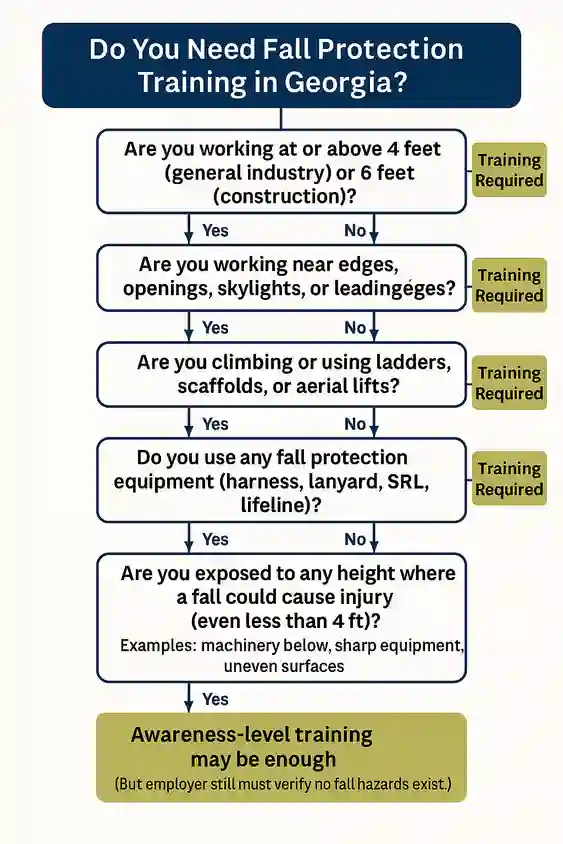
Who Actually Needs Fall Protection Training in Georgia?
Let me tell you something I’ve learned after years of working with Georgia employers:
A lot of workers need fall protection training and don’t even realize it.
Here’s who truly needs it:
| Job / Trade | Why They Need Training | Typical Hazards in Georgia | Common Equipment Used |
|---|---|---|---|
| Roofers | Work at 6 ft+ on residential and commercial roofs | Steep residential roofs, skylights, roof edges, weak decking | Harness, lanyard, SRL, roof anchors |
| Carpenters & Framers | Constant exposure to leading edges and framing platforms | Floor openings, exposed edges, unguarded balconies | Harness, positioning lanyard, temporary anchors |
| Ironworkers / Steel Erectors | Work on beams and structural steel at height | Open steel, wet/slippery beams, unprotected perimeters | Harness, SRL, beam clamps, beam straps |
| Solar Installers | Rooftop installs with constant movement | Sloped roofs, loose shingles, fragile surfaces | Harness, roof anchors, lifelines |
| HVAC Technicians | Rooftop maintenance at any height | Roof edges, skylights, ladders | Harness, anchor straps, restraint systems |
| Warehouse Workers | 4-ft OSHA rule for general industry | Mezzanines, elevated platforms, order pickers | Harness, order-picker lanyards, restraint systems |
| Maintenance & Facility Workers | Routine access to elevated surfaces | Catwalks, overhead platforms, cooling towers | Harness, SRL, anchor points |
| Telecom Tower Workers | Extreme-height climbing | Ladders, tower anchors, wind exposure | Tower harness, vertical lifelines, cable grabs |
| Window Washers | Suspended or elevated work at multi-story buildings | Ledges, slippery conditions | Harness, lifeline systems |
| Electricians | Work on elevated platforms, ladders, lifts | Mezzanines, cable trays, ladder falls | Harness, lanyards, lift-approved SRLs |
| Painters | Often work on ladders or scaffolds | Edges, overreaching, unstable surfaces | Harness, scaffold gear, SRLs |
| General Laborers | Assist on construction sites with fall hazards | Floors under construction, temporary edges | Harness, temporary anchors |
| Scaffold Workers | Working above 10 ft per OSHA scaffolding rules | Unstable planks, incomplete guardrails | Harness, scaffold tags, lifelines |
| Industrial / Manufacturing Workers | Elevated equipment platforms and catwalks | Conveyor systems, elevated walkways |
Construction Trades
If you work in construction and your feet ever leave ground level, you need this training. That means:
- Roofers
- Carpenters
- Framers
- Ironworkers
- Concrete workers
- Scaffold users
- Rebar installers
- General laborers
Construction is the most obvious group, but not the only one.
Warehouse & General Industry Workers
Warehouse operations in Georgia—especially in big hubs like Atlanta, McDonough, and Savannah—have tons of at-height tasks:
- Mezzanines
- Walkways
- Overhead platforms
- Order picker forklifts
- Elevated conveyor systems
Remember: 4 feet is enough to trigger OSHA’s requirement.
If your people climb anything higher than the top of a lunchbox, they need fall protection training.
Maintenance & Facility Workers
This category surprises people the most.
Georgia facilities often have maintenance teams checking:
- Rooftop HVAC units
- Exhaust fans
- Cooling towers
- Skylights
- Electrical systems
Any time maintenance climbs onto a roof or platform, OSHA expects fall protection training to already be done.
Special Trades
These are the big ones:
Telecom tower workers
Georgia tower climbers absolutely need advanced training—no exceptions.
Solar installers
Georgia’s solar industry is growing fast, especially in rural counties.
Solar crews do a ton of steep-roof work—high risk, must be trained.
Window cleaners
Even at two stories high, OSHA expects training.
HVAC installers
One of the most commonly cited trades for fall protection.
Supervisors & Safety Leads
If you’re a foreman, site supervisor, or “competent person,” OSHA expects you to know more than the workers. You’re responsible for making sure your crew anchors properly, uses the right gear, and understands the job’s fall hazards.
Types of Fall Protection Training in Georgia
| Training Type | What It Covers | Who Should Take It | Duration | Certificate Included? |
|---|---|---|---|---|
| Awareness Training | Basic OSHA rules, types of fall hazards, overview of fall protection systems | New hires, office personnel, workers who do NOT wear harnesses | 1–2 hours (online or classroom) | Usually Yes, but not valid for at-height work |
| Authorized User Training | Hazard identification, proper harness use, anchor selection, lanyards/SRLs, equipment inspection, hands-on practice | Workers who use fall protection (construction, roofing, warehouse, maintenance) | 4–8 hours | Yes, wallet card or certificate |
| Competent Person Training | OSHA requirements, fall protection planning, anchor approval, in-depth equipment inspection, supervision responsibilities | Supervisors, foremen, safety managers, crew leads | 1–2 full days | Yes, CP certificate |
| Rescue Training | Rescue planning, self-rescue vs. assisted rescue, suspension trauma, rescue equipment use | Telecom, tower workers, confined space workers, high-risk trades | 1–2 days | Yes, varies by provider |
| Refresher / Retraining | Review of equipment, changes in job tasks, behavior correction, updated OSHA rules | Any worker who has changes in role, equipment, or failed prior evaluation | 1–4 hours | Yes |
| Jobsite-Specific / On-Site Training | Customized training for your facility: roof work, platforms, catwalks, warehouses, solar installs, etc. | Companies with groups, custom hazards, or special systems | Half-day to full day | Yes, with site-specific notes |
| Equipment Inspector Training | How to inspect harnesses, SRLs, lifelines; when to remove from service; documentation | Competent Persons, safety staff, toolroom inspectors | 4–8 hours | Yes |
What Good Fall Protection Training Should Look Like
Not all training is created equal.
I’ve seen “training” done in Georgia that was basically:
“Here’s a harness. Put it on. Good luck.”
That’s not training—that’s a lawsuit waiting to happen.
A proper course in Georgia should include:
1. Classroom Learning
This covers:
- OSHA regulations (in plain language)
- When fall protection is required
- What the 4-ft and 6-ft rules mean
- Identifying fall hazards
- Different types of systems:
- PFAS (Personal Fall Arrest Systems)
- Positioning systems
- Restraint systems
- Guardrails
- Safety nets
2. Hands-On Training (Extremely Important)
This is where workers get the most value.
Good hands-on sessions include:
- Putting on harnesses the right way
- Adjusting straps correctly
- Choosing anchor points
- Connecting lanyards or SRLs
- Inspecting equipment for damage
- Understanding shock absorbers
- Knowing when gear must be removed from service
Workers should get real practice—not just “look at this picture and sign your name.”
3. Competent Person Training
This is for supervisors or anyone responsible for at-height operations.
Competent Person training teaches you:
- How to inspect anchors
- How to oversee workers
- How to write basic fall protection plans
- How to recognize unsafe conditions immediately
- How to select the right equipment for the job
You’ll find a lot of Georgia companies sending safety managers to these classes, especially from:
- Construction firms
- Warehouses
- Manufacturing plants
- Telecom companies
- Utility operations
How Much Does Fall Protection Training Cost in Georgia?
Prices in Georgia are pretty consistent with the rest of the Southeast.
Here’s what you can expect, based on what I’ve seen over the years:
| Training Type | Price Range | Format | What’s Included | Best For |
|---|---|---|---|---|
| Online Awareness Training | $30 – $100 | Online, self-paced | Basic fall protection overview, OSHA basics, quizzes | New hires, low-risk workers, refresher knowledge (not enough for workers using harnesses) |
| Authorized User Training (In-Person) | $150 – $300 per person | Classroom + hands-on | Hazard identification, harness fitting, lifeline/lanyard use, anchor points, equipment inspection, certificate | Construction workers, warehouse workers, maintenance crews |
| Competent Person Training | $450 – $800+ per person | Classroom + advanced hands-on | Fall protection planning, anchor selection, system inspection, supervision responsibilities, OSHA 1910/1926 deep dive | Supervisors, foremen, safety coordinators, site leads |
| Rescue Training / Specialized Courses | $500 – $1,000+ | In-person, hands-on | Self-rescue, assisted rescue, suspension trauma, specialized equipment | Tower workers, telecommunication, industrial facilities |
| On-Site Company Training (Private Group) | $1,200 – $3,000+ per day | At your jobsite or workplace | Customized training based on your site’s hazards, hands-on harness and equipment inspection, documentation | Companies training 8–20 workers at once; warehouses, plants, construction crews |
| Refresher / Retraining Sessions | $80 – $200 | Online or onsite | Review of hazards, equipment updates, behavioral corrections | Workers returning to at-height duties or switching equipment types |
| Free OSHA Consultation (Georgia Tech) | $0 | On-site assessment | Hazard identification, recommendations, compliance improvement (not certification training) | Small/medium businesses wanting hazard evaluation and OSHA compliance help |
Online Training
Good for awareness, not for high-risk jobs.
- $30–$100 per person
- Quick and convenient
- Not enough for workers who actually wear harnesses
OSHA requires hands-on training for anyone using a fall arrest system, so online-only won’t cut it.
In-Person Authorized User Training
Your typical half-day or full-day “worker” level course.
- $150–$300 per person
- Includes hands-on harness training
- Certificate or wallet card is given
- Good for:
- Warehouse staff
- Construction workers
- Maintenance teams
- Solar crews
This is the most common type of fall protection course in Georgia.
Competent Person Training (Advanced)
This is for supervisors, leads, and safety professionals.
- $450–$800+ per person
- Usually a 1–2 day class
- More detailed, deeper dive into OSHA rules
- Includes administrative responsibilities
Most serious construction companies in Georgia require at least one Competent Person on every site.
On-Site Group Training
This is when the trainer comes to your facility or jobsite.
- $1,200–$3,000 per day
- Good for groups of 10–20
- Tailored to your actual workplace hazards
- Saves travel time for your crew
I personally recommend this for warehouses, factories, and large construction teams—it’s customized, cheaper per person, and more realistic.
Free OSHA Consultation Services (Georgia Tech)
A lot of employers don’t know this, but Georgia Tech runs a free OSHA consultation program for small and medium-sized businesses.
It’s:
- Free
- Confidential
- Very helpful for identifying fall hazards
- Good for improving compliance
They don’t provide full formal “fall protection training,” but they can tell you exactly what you’re missing and help you fix it.
Where to Get Fall Protection Training in Georgia
Georgia actually has a solid number of reputable training providers. Here are some of the better-known ones:
| Provider | Contact / Address / Phone / Email | Notes |
|---|---|---|
| Georgia Tech OSHA Training Institute Education Center (OTIEC) | Phone: 404-385-3090 (select option 5 for training info) | Offers OSHA 3115 Fall Protection course + many other safety/OSHA classes. |
| AGC Georgia (Associated General Contractors of Georgia) | Address: 1940 The Exchange, Atlanta, GA 30339 Office phone: 678-298-4100 (for general office) or 678-298-4112 (for private class scheduling / contact: Cindy Parham) | Offers “Fall Protection – Competent Person Training,” plus other construction safety courses. |
| Applied Technical Services (ATS) – Marietta, GA | Phone: 1-888-287-5227 | Offers fall protection certification and “competent person”-level training (including rope-access, anchor systems, etc.) |
| OSHA Training Services Inc. – Georgia / Alpharetta Area | (As listed online) offers on-site OSHA / fall protection training courses. | Provides OSHA Fall Protection / Fall Prevention training, scaffold training, general industry & construction safety courses. |
How to Choose the Right Training Provider in Georgia
If you’re picking a trainer for your crew, here’s what you should look for (trust me, this matters):
✔ Must include hands-on harness practice
A “slide deck class” isn’t good enough.
✔ Must cover OSHA 1910 and 1926 rules
Especially the height requirements.
✔ Must teach hazard recognition
Workers need to know what NOT to anchor to (this is where most mistakes happen).
✔ Must issue a wallet card or certificate
You’ll need documentation if OSHA ever visits.
✔ Should understand Georgia industries
Solar, roofing, warehouses, telecom… every trade has different needs.
✔ Should offer on-site customization
Your hazards aren’t the same as another company’s hazards.
Final Thoughts
Fall protection training in Georgia is not complicated—but it is extremely important. Whether you’re building homes in Augusta, climbing a tower in Valdosta, or checking a rooftop HVAC unit in Columbus, fall hazards are everywhere.
What keeps workers safe isn’t the harness—it’s the knowledge behind how to use it.
If you invest in proper training:
- Your team works safer
- Your supervisors stay confident
- Your projects stay compliant
- OSHA stays off your back
- And most importantly… your people go home at the end of the day
Georgia might follow federal OSHA, but the responsibility falls on every employer and worker to make sure they understand fall protection the right way.
Mike Pattenson is a construction safety trainer who loves helping workers stay safe on the job. He explains safety in a simple, practical way so crews can easily understand what to do — and why it matters.
Mike Pattenson is a construction safety trainer who loves helping workers stay safe on the job. He explains safety in a simple, practical way so crews can easily understand what to do — and why it matters.
View All Articles