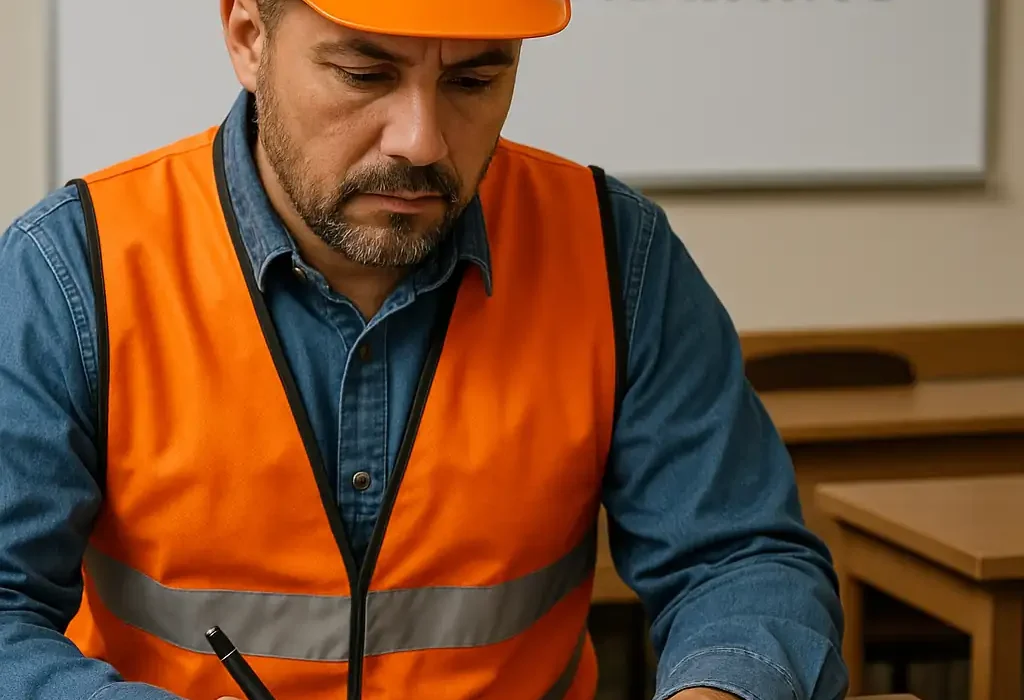
These are the real fall protection training questions workers ask, the same ones I’ve heard again and again on training days, safety meetings, and actual jobsites. And every answer is explained in a clear, practical way—no jargon, no complicated technical talk.
Let’s break down the questions that matter most when it comes to staying safe at heights.
| # | Category | Question | Answer |
|---|---|---|---|
| 1 | OSHA Rules | At what height is fall protection required in construction? | At 6 feet or more above a lower level. |
| 2 | OSHA Rules | At what height is fall protection required in general industry? | At 4 feet. |
| 3 | OSHA Rules | Is fall protection required when working over dangerous equipment? | Yes, regardless of height. |
| 4 | OSHA Rules | Who is responsible for providing fall protection equipment? | The employer. |
| 5 | OSHA Rules | Does OSHA require fall protection training? | Yes — workers exposed to fall hazards must be trained. |
| 6 | OSHA Rules | When is retraining required? | When equipment changes, job conditions change, or unsafe behavior is observed. |
| 7 | OSHA Rules | Can a worker refuse unsafe work if fall protection is missing? | Yes — workers may refuse unsafe work. |
| 8 | OSHA Rules | Do all job sites need a fall protection plan? | Required when conventional methods cannot be used. |
| 9 | OSHA Rules | Do ladder tasks require fall protection? | Not under 24 ft unless additional hazards exist. |
| 10 | OSHA Rules | Are safety nets a valid form of fall protection? | Yes — OSHA recognizes them as a passive system. |
| 11 | Equipment Basics | What are the three parts of a PFAS? | Anchor, Body Harness, Connecting Device. |
| 12 | Equipment Basics | What is the ABCD of fall protection? | Anchor, Body Support, Connectors, Descent/Rescue. |
| 13 | Equipment Basics | What is considered a passive system? | Guardrails and covers. |
| 14 | Equipment Basics | What is a travel restraint system? | Prevents a worker from reaching an edge. |
| 15 | Equipment Basics | What is a deceleration device? | Reduces force on the body during a fall. |
| 16 | Harness Use | How high should the D-ring sit on your back? | Between the shoulder blades. |
| 17 | Harness Use | Can a harness be shared? | Yes, but must be adjusted and inspected. |
| 18 | Harness Use | Can you wear a harness over bulky clothing? | Yes, if properly tightened. |
| 19 | Harness Use | What happens if a leg strap is loose? | Can cause serious injury during a fall. |
| 20 | Harness Use | Can harnesses expire? | Yes — many last 5–10 years. |
| 21 | Anchors | What is the required anchor strength for PFAS? | 5,000 lb per worker. |
| 22 | Anchors | Can rebar be used as an anchor? | Only if approved. |
| 23 | Anchors | Can you tie off to a scaffold guardrail? | No — not designed for fall arrest forces. |
| 24 | Anchors | What is a horizontal lifeline? | A line between anchors that allows mobility. |
| 25 | Anchors | What is the risk of swing fall? | Worker may swing into structures. |
| 26 | Lanyards & SRLs | How much free fall is allowed with a lanyard? | Maximum 6 feet. |
| 27 | Lanyards & SRLs | What fall clearance is needed? | About 18.5 feet total. |
| 28 | Lanyards & SRLs | Can you use a lanyard on a scissor lift? | No — use an SRL when required. |
| 29 | Lanyards & SRLs | What is an SRL? | A self-retracting lifeline that limits free fall. |
| 30 | Lanyards & SRLs | Can you connect two lanyards together? | No — prohibited and unsafe. |
| 31 | Inspection | How often should fall equipment be inspected? | Before each use and annually by a competent person. |
| 32 | Inspection | What if stitching is frayed? | Remove equipment from service. |
| 33 | Inspection | What do you check on metal components? | Cracks, corrosion, sharp edges. |
| 34 | Inspection | Can equipment be reused after arresting a fall? | No — must be removed from service. |
| 35 | Inspection | Can labels be missing? | No — no label = remove from service. |
| 36 | Rescue | What is suspension trauma? | A dangerous condition from hanging in a harness. |
| 37 | Rescue | How fast should rescue occur? | Immediately; within 5–10 minutes is ideal. |
| 38 | Rescue | What should a rescue plan include? | Rescuers, equipment, steps, emergency contacts. |
| 39 | Rescue | Do workers need rescue training? | Yes — OSHA requires awareness. |
| 40 | Rescue | Does every PFAS require a rescue plan? | Yes — all fall arrest must include rescue. |
| 41 | Scaffolds | When is fall protection required? | At 10 feet or higher. |
| 42 | Scaffolds | What is required on suspended scaffolds? | PFAS + guardrails. |
| 43 | Scaffolds | Can you climb cross braces? | No — use proper access. |
| 44 | Scaffolds | Should scaffolds be fully decked? | Yes — minimal gaps. |
| 45 | Scaffolds | Can you move a scaffold with someone on it? | No — prohibited. |
| 46 | Ladders | Is fall protection required on portable ladders? | Not usually, unless hazards exist. |
| 47 | Ladders | How far must a ladder extend above landing? | 3 feet. |
| 48 | Ladders | Can ladders be placed on unstable objects? | No — must be stable and level. |
| 49 | Ladders | What is the 4-to-1 ladder rule? | For every 4 ft height, base 1 ft out. |
| 50 | Roof Work | Can workers walk backward near edges? | No — maintain visual awareness and tie off. |
Read related article: Are Your Fall Protection Training Records OSHA-Ready?
What the Fall Protection Test Usually Includes
| Test Component | What It Includes | Skills Needed |
|---|---|---|
| Written Exam | MCQs, True/False, Scenarios | Knowledge of rules, equipment, hazards |
| Practical Exam | Harness donning, inspection, anchors | Hands-on skills & correct application |
| Test Section | Passing Requirements | Failing Causes |
|---|---|---|
| Written Exam | 70–80% correct (varies) | Too many rule-based mistakes |
| Practical Exam | Proper harness use, anchor choice | Loose straps, unsafe anchor, failed inspection |
Read related article: 7 Types of Fall Protection Training You Can Take
Most fall protection training programs combine two exam types:
1. A written test
This includes:
- multiple choice questions
- true/false items
- scenario-based questions
- equipment identification
- questions based on OSHA fall protection standards
2. A hands-on practical test
Where you may be asked to:
- properly inspect your harness
- adjust it correctly
- demonstrate connector use
- choose the correct anchor point
- explain fall clearance
- identify damaged or unsafe equipment
Knowing what to expect eliminates most of the pressure—even before you start studying.
| Area | Written Test | Practical Test |
|---|---|---|
| Purpose | Knowledge check | Skills check |
| Format | MCQ, T/F, scenarios | Hands-on tasks |
| Focus | Understanding rules | Applying them in real life |
| Common Failure | Misinterpreting questions | Incorrect harness fitting |
Read related article: Lost Your Fall Protection Certificate? Here’s What to Do Next
The Key Topics Fall Protection Tests Always Cover
Every training provider has their own style, but almost all written exams revolve around the same core knowledge. Below is a breakdown of the concepts you should fully understand before test day.
| Topic | Importance Level | What to Focus On |
|---|---|---|
| OSHA Height Rules | High | 6ft/4ft rules, employer responsibilities |
| Harness Fit | High | Chest strap, leg straps, D-ring position |
| Anchor Strength | High | 5,000 lbs rating, safe vs unsafe anchors |
| Lanyards & SRLs | Medium | Free fall limits, fall clearance |
| Rescue Requirements | Medium | Suspension trauma, rescue timing |
Read related article: Is Fall Protection Training an All-Day Thing? (Shorter or Longer?)
1. OSHA Rules You’ll Be Tested On
The test will almost always cover:
- When fall protection is required
- The height requirements for different industries
- The difference between employer and worker responsibilities
- Retraining triggers
- General fall protection principles
Here’s the simplified breakdown you need to remember:
- Construction: Fall protection required at 6 ft
- General industry: Fall protection required at 4 ft
- Working over dangerous equipment: Fall protection required at any height
- Anchors: Must support 5,000 lbs per worker
If you understand these four lines, you already know a third of the written exam.
Read related article: Is Fall Protection Training Required for All Jobs?
2. Harness Knowledge You’ll See on the Test
| Equipment | What You Must Identify | Test Expectation |
|---|---|---|
| Harness | D-ring, leg straps, buckles | Know each part & its purpose |
| Lanyard | Shock absorber, hooks | Identify safe vs damaged |
| SRL | Lifeline, housing | Know proper uses |
| Anchor | Fixed points, rated anchors | Distinguish safe from unsafe |
You will absolutely be asked questions about:
Harness fit
A properly worn harness should be:
- snug
- chest strap at mid-chest
- leg straps tight but not painful
- D-ring centered between shoulder blades
Many test questions simply check whether you understand what a safe fit looks like.
Donning a harness
The practical exam almost always requires demonstrating proper harness wear.
When harnesses must be removed from service
You’ll be tested on identifying:
- frayed stitching
- cuts or tears
- chemical damage
- broken hardware
- missing labels
If a label is missing, the harness fails—not negotiable.
Read related article: Does OSHA Require Fall Protection Training Annually?
3. Lanyards, SRLs, and Connectors
Expect questions about:
- maximum free-fall distance
- total fall clearance
- when to use an SRL vs a lanyard
- why connecting two lanyards together is unsafe
- shock absorbers and deceleration distance
Here are the numbers trainees must know:
- Shock-absorbing lanyard free fall: up to 6 ft
- Typical total fall distance: around 18.5 ft
- SRL free fall: usually 24 inches or less
If you’re working somewhere with limited fall clearance, this becomes critical.
4. Anchor Points & Fall Clearance
These two areas often confuse trainees, so test questions usually cover them in multiple forms.
You’ll need to know:
- what makes a strong anchor
- what cannot be used as an anchor
- how swing fall works
- how to calculate fall clearance
- how to identify structural vs non-structural anchor points
Safe anchors must:
- support 5,000 lbs per attached worker
- be designed or approved for fall protection
Unsafe anchors include:
- guardrails
- light fixtures
- plumbing pipes
- ladders
- scaffolds (unless engineered for it)
A few test questions may describe jobsite scenarios and ask:
“Which anchor option is safe?”
This is where your understanding matters more than memorization.
5. Equipment Inspection & Maintenance
A large part of fall protection training focuses on equipment inspection. Expect several test questions related to:
When inspections are required
- before each use
- periodically by a competent person
- after any fall arrest event
What to check
- stitching
- webbing
- buckles
- snap hooks
- labels
- signs of deformation
- rust or corrosion
What to do with failed equipment
Only one correct answer exists:
Remove it from service immediately.
6. Scaffolds, Ladders, and Lifts
You will likely see scenario questions about:
- when fall protection is required on scaffolds
- tie-off rules for scissor lifts
- safe ladder setup
- guardrails vs personal fall arrest systems
- working near edges
Key points:
- Scaffolds: fall protection required at 10 ft
- Suspended scaffolds: require both guardrails and a PFAS
- Portable ladders: fall protection not usually required but safety rules still apply
- Aerial lifts: tie-off required on boom lifts
These appear on tests often because they reflect real life jobsite hazards.
7. Rescue Procedures
Many trainees underestimate how much of the test involves rescue planning.
Expect questions about:
- suspension trauma
- rescue timelines
- the purpose of a rescue plan
- what must happen after a fall
Key points to remember:
- rescue should happen immediately
- suspension trauma can become dangerous within minutes
- every fall arrest setup requires a rescue plan
This is an area where knowing the “why” helps you get the questions right.
Using Q&A to Prepare for the Test
This is where test-style questions become incredibly valuable. A great Q&A set helps you:
- learn definitions
- practice identifying safe vs unsafe choices
- understand real-job scenarios
- remember essential numbers
- spot common equipment mistakes
- visualize what the written test will feel like
Every question becomes easier once you understand the principles behind it.
Tips for Passing the Test With Confidence
Here are simple, proven ways to make your test day easier:
• Don’t rely on memorization alone
Fall protection is mostly logic. Once you understand how the systems work, the right answer becomes obvious.
• Focus on the essentials
Height requirements, harness fit, anchors, and fall clearance account for a big part of the exam.
• Think in terms of safety, not rules
The safest answer is often the correct one.
• Pay attention during hands-on practice
Most practical test failures come from rushing, not from lack of knowledge.
• Use real-world examples to visualize questions
If a scenario involves choosing an anchor, imagine yourself on a jobsite selecting the safest option.
Final Thoughts: You Don’t Need to Be Nervous—You Just Need Clarity
Fall protection training can feel intimidating at first, but the test is simply a check to ensure you know how to protect yourself and others. Once you understand the fundamentals—harness fit, proper anchors, fall clearance, inspections, and how the equipment works—everything starts to make sense.
Every question you learn today becomes a safer decision you make tomorrow.
If you prepare with solid Q&As, understand the concepts, and stay calm during the practical test, you’ll walk into the exam—and onto the jobsite—with confidence.

Mike Pattenson is a construction safety trainer who loves helping workers stay safe on the job. He explains safety in a simple, practical way so crews can easily understand what to do — and why it matters.
Mike Pattenson is a construction safety trainer who loves helping workers stay safe on the job. He explains safety in a simple, practical way so crews can easily understand what to do — and why it matters.
View All Articles