Let’s be honest — scissor lift fall protection is one of those topics that always starts an argument on the jobsite. Ask ten guys whether you need a harness on a scissor lift and you’ll get ten different answers.
Some will swear up and down that it’s required. Others will tell you they’ve never worn one in their entire career and they’re still alive. Then OSHA walks in, and suddenly everybody is “not sure.”
So let’s clear this up the simple way — no legal jargon, no stiff safety lecture, just straight talk from someone who’s seen this play out hundreds of times.
The Short Answer (Everyone Gets This Wrong)
Here’s the real deal:
On a scissor lift, OSHA does not automatically require you to wear a harness.
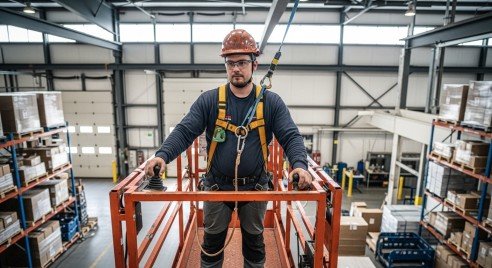
If the guardrails are installed, intact, and used properly, the guardrails themselves are considered the fall protection system.
That’s the part most workers don’t realize.
A scissor lift isn’t treated the same way as a boom lift. Boom lifts require harnesses — always, no exceptions. But scissor lifts fall under the scaffolding rules, not the aerial lift rules. That’s why the guardrails matter so much.
But before you start celebrating and tossing the harness in the gang box, read this whole thing. Because there are times when a harness is required — and I’ve seen too many operators get written up (or almost seriously injured) because they didn’t understand the details.
| Equipment Type | OSHA Standard | Primary Fall Protection | Harness Required? | Notes / Key Rules (Plain English) |
|---|---|---|---|---|
| Scissor lift (construction) | 29 CFR 1926.451 (Scaffolds) | Guardrail system around platform | Not automatically required | If all guardrails (top/mid/chain or gate) are in place and used correctly, they count as your fall protection. Harness may be required if guardrails are missing/damaged, the manufacturer says so, or site policy demands it. |
| Scissor lift (general industry) | 29 CFR 1910.29 / 1910.23 (Fall protection & walking-working surfaces) | Guardrail system around platform | Not automatically required | Similar idea in general industry settings (warehouses, maintenance): guardrails are normally enough if they meet height and strength requirements and are used properly. |
| Boom lift / articulating lift (construction) | 29 CFR 1926.453 (Aerial lifts) | Personal fall arrest or restraint system | Yes – always | Operators must wear a harness and be tied off to the approved anchor point in the basket at all times. Guardrails do not replace the harness requirement on boom-style lifts. |
| Boom lift / articulating lift (general industry) | 29 CFR 1910.67 (Vehicle-mounted elevating & rotating work platforms) | Personal fall arrest or restraint system | Yes – always | Same story in general industry: body harness + lanyard attached to the manufacturer-approved anchor point in the platform is required whenever the lift is in use. |
| Mobile scaffold (non–self-propelled) | 29 CFR 1926.451 (Scaffolds) | Guardrails and/or PFAS depending on height & configuration | Depends on setup | When guardrails meet scaffold requirements, they usually count as fall protection. If guardrails are not practical or are missing in certain areas, personal fall arrest may be needed. |
Here’s How to Know If You Need Fall Protection When Operating Scissor Lift
OSHA Rules in Plain, No-Nonsense English
I’m going to break this down the way I explain it when I’m training new operators — very simple, very practical, and very real.
1. Scissor lifts fall under the OSHA scaffold standard (1926.451).
Not the aerial lift standard.
So the rules for guardrails matter much more than harness rules.
2. Guardrails = Fall Protection
If every rail is where it’s supposed to be — top rail, mid rail, and the gate or chain — OSHA says you’re already protected from falling.
3. You don’t need a harness unless something is wrong with the lift or the situation.
Missing gate?
Bent top rail?
Damaged mid rail?
Working right beside a ledge?
Windy outdoor job?
Manufacturer says tie off?
Then yes, you need the harness.
OSHA’s rule is basically this:
“Guardrails protect you… until they can’t.”
So When Does OSHA Require a Harness on a Scissor Lift?
Here are the real-world situations I’ve seen again and again:
1. If the guardrails are missing or damaged
Let’s say the gate is missing, or someone removed the mid rail to load materials.
That’s an automatic harness requirement.
2. When the manufacturer says so
Every scissor lift has a manual, and believe it or not, OSHA follows the manual.
If Genie, Skyjack, or JLG says “wear a harness,” then OSHA says “wear a harness.”
3. When you’re working on a sketchy surface
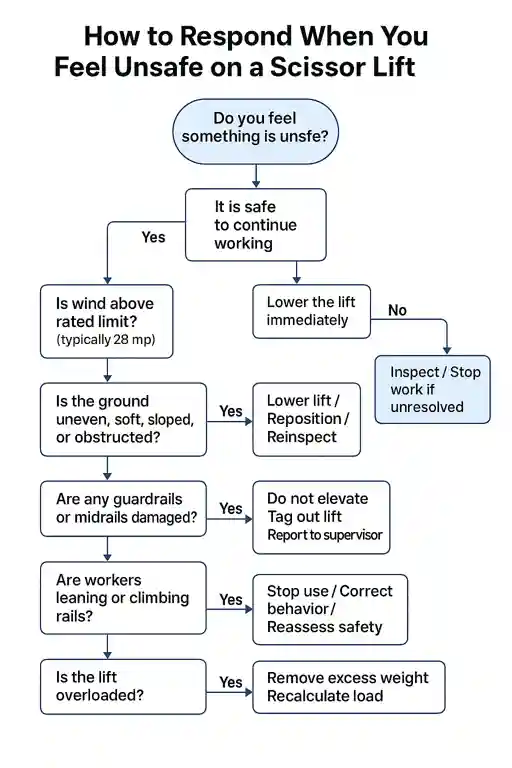
Uneven ground, soft flooring, ramps, slopes — all of these increase tip-over risk.
A sudden tilt can throw you off balance.
4. When you’re right next to a fall hazard outside the lift
Think of elevator shafts, loading docks, mezzanines, pits, edges, stair openings.
If the lift tips or jerks, you’re not just falling to the platform floor — you’re falling off the whole building.
5. When site policy says it’s mandatory
OSHA doesn’t mind if a company adds extra rules.
Some sites require 100% tie-off, no matter what.
If they do, that’s the rule.
6. If you’re the type who leans out too much
I say this with love — we all know that one guy who stretches just a bit too far.
If that’s you, tie off.
Please.
When You DON’T Need a Harness on a Scissor Lift
Let’s keep this simple.
You don’t need a harness when:
- All guardrails are in place
- The gate/chain is closed
- The lift is designed for guardrails-only fall protection
- You’re indoors in a stable environment
- You’re on flat, solid ground
- No unusual hazards are present
- You’re following manufacturer instructions
In other words: standard, normal, everyday scissor lift use.
This is why so many operators never wore harnesses in warehouses — and they were still perfectly within OSHA rules.
Why People Get Confused (And Argue About This Constantly)
The confusion comes from three things:
1. Boom lifts ALWAYS require a harness
Scissor lifts DO NOT.
Different rules, different equipment.
2. Some companies add their own policies
And workers mistakenly think it’s OSHA.
3. Every trainer explains it differently
Some are overly strict.
Some are too lax.
Some don’t explain it at all — they just say “always tie off” so they don’t have to answer questions.
And then there’s the classic line:
“I’ve been doing this for 20 years and I never wore a harness.”
Yeah — until OSHA catches you at the wrong jobsite with a missing rail.
A Little Real-World Story (This Is Why I Take This Seriously)
I once trained a group of maintenance guys in a warehouse.
One guy — let’s call him “Big Joe” — kept saying:
“Why would I ever need a harness? This thing’s safe.”
So we get into the lift, everything’s normal.
Then as we’re moving across the shop, one of the wheels rolls over a thick power cord.
The lift jerks sideways.
Joe loses his balance, slams against the top rail, and he’s halfway over the side before he catches himself.
He turns to me and goes:
“Okay, I get it now.”
That’s the moment that changed his mind — not OSHA rules, not a lecture.
Just one little jerk of the lift.
That’s why I always tell people:
You don’t need a harness… until the one time you actually do
Why Guardrails Are Enough — Until They Aren’t
Guardrails work great most of the time.
But guardrails can’t protect you from:
- Your own body weight shifting
- A wheel hitting something
- A sudden stop
- A coworker bumping the lift
- Wind gusts (outdoor work!)
- Slopes
- Rollovers
- Overreaching
Scissor lifts aren’t dangerous when they’re used properly.
They’re dangerous when workers get too comfortable.
And the truth is, most accidents happen from overreaching and sudden movement, not from faulty equipment.
The Manufacturer Rules (Most People Forget This Part)
OSHA has a rule that many people don’t know:
You MUST follow the manufacturer’s instructions.
So if the manual says:
- Wear a harness
- Tie off to the designated anchor
- Keep the gate closed
- Don’t climb the rails
- Don’t overload the platform
Then that’s the law.
Not a suggestion.
I always tell operators:
“OSHA doesn’t care what your supervisor said — they care what the manual says.”
Common Scissor Lift Mistakes That Can Get You in Trouble
Let me list the ones I see the most:
- Standing on a bucket inside the lift
- Sitting on the rails
- Climbing the rails
- Leaving the gate open “just a little”
- Overloading the platform
- Leaning out to reach something
- Moving the lift while fully extended
- Parking next to a drop-off
- Using it outdoors in high wind
- Removing a rail to load materials
Every one of these can get you written up — or injured.
Simple Rule of Thumb (That Never Fails)
If you’re ever unsure whether you need a harness, here’s my advice after years of training operators:
If you’re asking the question… the safest answer is to wear the harness.
It’s easier to put it on than to regret not wearing it.
FAQ: The Stuff Everyone Always Asks
Do boom lifts and scissor lifts follow the same OSHA rule?
No. Boom lifts = harness always.
Scissor lifts = guardrails usually enough.
Can I tie off to something outside the scissor lift?
Never. That can pull you out during movement.
Can I climb the rails or stand on anything inside the basket?
Nope. Instant OSHA violation.
Is it okay to leave the gate open for a second?
No — the gate is part of your fall protection system.
Can I use a ladder inside a scissor lift?
Big no. OSHA hates that.
What if the lift is in perfect condition — do I need a harness?
Not unless something else about the situation makes it unsafe.
Final Thoughts (From Someone Who Has Been Around These Machines a Long Time)
Most scissor lift accidents are preventable.
Almost all of them come from doing something “just for a second” or trying to reach “just a little further.”
OSHA’s rules might seem annoying sometimes, but they’re not there to punish you — they’re there because too many workers got hurt doing things the wrong way.
At the end of the day, here’s the simplest way I can put it:
Guardrails are your fall protection on a scissor lift.
If the guardrails are solid, you’re usually covered.
But if anything feels off — the lift, the surface, the weather, the situation, or your gut — throw the harness on.
It takes 20 seconds, and it might save you from a lifetime of regret.
Stay safe up there.
Mike Pattenson is a construction safety trainer who loves helping workers stay safe on the job. He explains safety in a simple, practical way so crews can easily understand what to do — and why it matters.
Mike Pattenson is a construction safety trainer who loves helping workers stay safe on the job. He explains safety in a simple, practical way so crews can easily understand what to do — and why it matters.
View All Articles