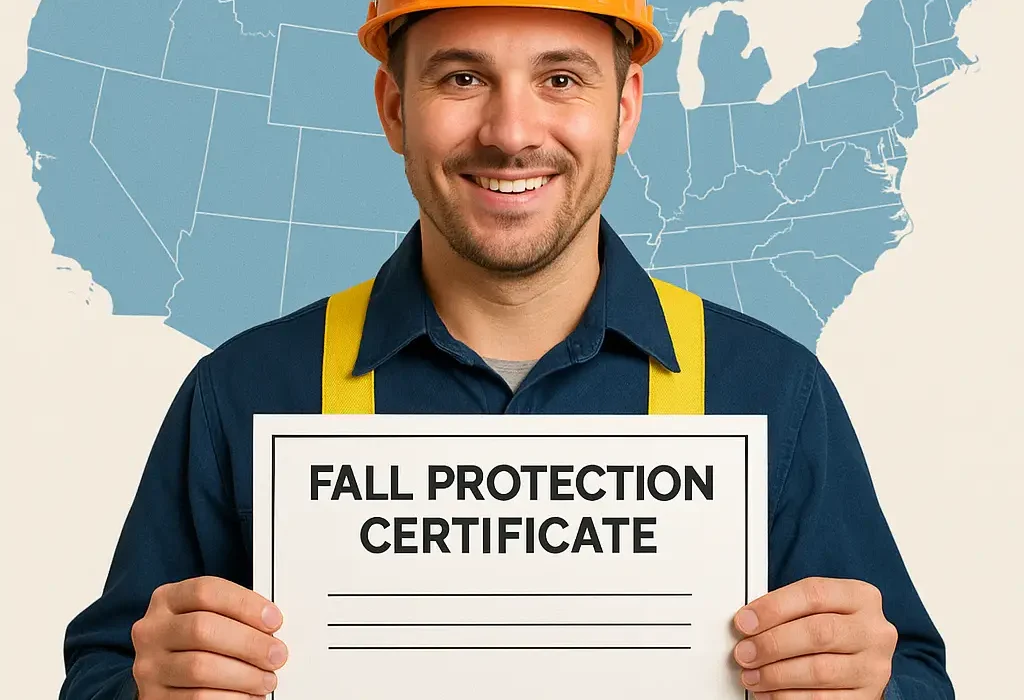
If you’re like me, you probably took your fall protection training seriously—you sat through the lessons, went through the hands-on part, passed the quizzes, and finally got that shiny certificate.
And now… you’re heading to a new job in a different state and you’re wondering:
“Is my fall protection training still valid?”
I get it. Moving to a new job is already stressful. Having to worry about whether your certification still counts in another state is the last thing you want to deal with.
So let me walk you through this.
The Short Answer: Mostly Yes… But Not Always
Your fall protection training generally does transfer from one state to another, because fall protection rules in the U.S. are based on OSHA, which is federal. That means the core training is the same whether you learned it in Texas, Florida, New York, or anywhere else.
But—and there’s always a “but”—the employer in your new state gets the final say. Not the state. Not OSHA. The employer.
Some employers will look at your certificate and say, “Great, you’re good to go.”
Others may require a refresher or even full retraining depending on:
- How old your training is
- What type of work you’ll do
- What fall protection systems the company uses
- Whether the state adds extra rules on top of OSHA
Let me break everything down the way I explain it to workers during training.
Read Related Article: Is Online Fall Protection Training Worth It? But Is It Effective?
Employer Acceptance Checklist
| Requirement | Will New Employer Accept It? | What This Means for You |
|---|---|---|
| Certificate Still Valid (Not Expired) | Often Yes | Most employers prefer training within the last 1–3 years. Older certificates may not be accepted. |
| Recognized Training Provider | Sometimes | If your training came from a reputable or known provider, employers are more likely to accept it. |
| Matches New Job Tasks | Must Match | If your new job includes different work (e.g., roofs instead of ladders), the employer may require extra training. |
| Covers Equipment Used on New Job | Must Match | You may need retraining if the new employer uses different harnesses, anchors, or systems than your previous job. |
| Includes Hands-On / Practical Component | Preferred | Many employers prefer or require proof that you’ve actually practiced using fall protection equipment, not just taken an online course. |
| Meets State or Local Requirements | Required in Some States | State-plan states (like California or Washington) may require state-specific training, even if you were already trained elsewhere. |
| Employer’s Own Policy Allows Outside Training | Varies by Employer | Some companies accept previous training, others require all workers to go through their in-house program. |
Read Related Article: Does Fall Protection Training Transfer Between Employers?
Understanding How Fall Protection Training Actually Works
Fall protection training is governed by OSHA—specifically 29 CFR 1926 Subpart M for construction and 1910 for general industry. These are federal standards. This is why most of the U.S. follows the same rules.
However, about half the states operate under federal OSHA, and the other half have state OSHA plans. These states can add extra requirements.
Think of it like cooking:
- OSHA sets the main recipe.
- Some states add a bit of extra seasoning.
This is usually where transfer issues come up.
States With Their Own OSHA Plans (Stricter Rules)
Here are the states where I’ve personally seen more questions and retraining situations:
- California (Cal/OSHA)
- Washington (DOSH)
- Oregon (OR-OSHA)
- Michigan (MIOSHA)
- Minnesota
- Kentucky
- Hawaii
- New Mexico
- Virginia
- North Carolina
- South Carolina
- Maryland
- Tennessee
| State Example | Stricter Than Federal OSHA? | Special Rules Affecting Training Validity |
|---|---|---|
| California (Cal/OSHA) | Yes | Requires stricter fall protection standards; may require Cal/OSHA-specific certification. |
| Washington (DOSH) | Yes | Requires state-specific height limits and PPE rules; outside training may not be fully accepted. |
| Oregon (OR-OSHA) | Yes | Has unique fall protection requirements for construction and roofing; may need Oregon-specific training. |
| New York | Moderate | High-rise and scaffold laws are stricter; employers often require additional training. |
| Nevada | Moderate | State-plan requirements may differ for casinos, construction, and entertainment venues. |
| Texas | No | Follows federal OSHA; out-of-state training is more likely to be accepted by employers. |
| Florida | No | No additional state-specific fall protection requirements, but employers may still require site-specific training. |
These states sometimes require additional training, especially California and Washington, which are the strictest.
If you trained in one of these states and move to another—or vice versa—your employer may want you to take supplemental training so everything lines up with their rules.
Realated Article: How Much Does Fall Protection Training Cost?
From My Experience: When Training Does Transfer Smoothly
I’ve worked with many workers who moved from one state to another, and most of the time, employers accept valid OSHA-aligned training with no issues, especially when:
✔ Your training is less than 2 years old
Most employers prefer recent training, even though OSHA doesn’t specify an expiration date.
✔ You had hands-on practice
If your course included equipment inspection, harness fitting, anchor selection, and rescue basics, employers see you as properly trained.
✔ You trained through a reputable provider
Training schools that follow OSHA guidelines and provide a legitimate certificate usually transfer without problems.
✔ Your new employer uses similar equipment
If the job uses standard harnesses, lanyards, SRLs, and anchor points, your training applies directly.
Where Problems Usually Start
Now, let’s flip the coin and look at situations where fall protection training doesn’t transfer well. I’ve seen these issues many times:
1. Your Certificate Is Too Old
OSHA requires retraining “as needed,” but employers typically look for training that’s:
- within the last 1–2 years for general industry
- within 1 year for construction (common practice)
If your certificate is from the dinosaurs era (just kidding… but anything older than 3 years), most employers will send you for retraining.
Read Related Article: Fall Protection Training vs. Working at Heights: The Difference?
2. Your Previous Job Used Different Fall Protection Systems
Example:
You’ve only used positioning lanyards, but your new job uses self-retracting lifelines (SRLs) and mobile anchor systems.
Different gear = different training.
This isn’t questioning your knowledge—it’s about ensuring you’re trained on the exact equipment you’ll be using so you stay safe.
3. Your First Training Was Online-Only
Here’s the truth:
Online training alone is not enough for OSHA. Employers know this.
If your past provider only gave video modules with no hands-on portion, your new employer might not accept it.
Hands-on = essential.
4. You’re Moving to a State With a Stricter OSHA Plan
California is the most common example.
I’ve seen many workers with completely valid training, but Cal/OSHA requires additional topics.
WA and OR can be sticklers, too.
5. The Employer Just Wants Their Own Training
Let me be honest—some employers simply want you to take their training even if yours is valid.
Not because yours is bad… but because:
- They have company-specific policies
- Their equipment setup is unique
- Their insurance requires it
- They want everyone trained “the same way”
It’s frustrating, but common.
Read Related Article: When is Fall Protection Training Required? (7 Situations)
What Employers Actually Look For
When I review certificates or talk to workers moving from out of state, these are the things I check:
✔ Training date
Recent? Good.
Too old? Needs refresher.
✔ Provider credibility
Legit? Or a shady $10 online-only course?
✔ Content covered
Did you learn inspection, harness fitting, SRLs, rescues, PFAS, anchor selection?
✔ Hands-on proof
Did someone physically watch you strap in and inspect equipment?
✔ Did you pass?
Some certificates actually list your quiz score.
If your certificate ticks these boxes, you’re likely good.
What Happens If Your Training Isn’t Accepted?
Don’t worry. It’s not the end of the world.
Based on what I’ve seen, employers usually ask for one of the following:
1. A simple refresher
This is usually the case if your knowledge is still solid but they want you updated.
2. A site-specific training
This takes 15–45 minutes.
Covers the equipment you’ll be using at that specific job.
3. Full retraining
This rarely happens unless:
- Your training is too old
- It wasn’t hands-on
- It’s from a non-reputable provider
- You’re moving to a state with stricter rules
Even if you repeat the course, most of your knowledge carries over—you’ll just get updated and aligned with the new employer’s system.
Read More About This Topic: Does OSHA Require Fall Protection Training Annually?
How to Make Your Training More “Portable” in the Future
If you want to avoid headaches every time you switch employers or states, here’s what I advise:
✔ Choose OSHA-aligned training
Look for providers who follow 29 CFR 1926 and 1910.
✔ Get hands-on practice
This makes your certificate far more legitimate.
✔ Keep your certificate and training records
Take photos. Keep digital copies. Never rely on just one printed sheet.
✔ Take refresher training every 1–2 years
Even if OSHA doesn’t force it, employers prefer it.
✔ Get equipment-specific orientation
Whenever you use a new system—SRLs, leading-edge lifelines, vertical lifelines, etc.
Doing these things will make you “transfer-ready” almost anywhere in the country.
FAQs
Is fall protection training valid nationwide?
Yes—if it follows OSHA guidelines. But employers may still require extra steps.
Can a new employer reject my certification?
Absolutely. Employers have the final say.
How long is fall protection training valid?
There’s no fixed OSHA expiration, but 1–2 years is common.
Does online-only training count in all states?
No. OSHA requires practical, hands-on training.
Read Related Article: Is Fall Protection Training an All-Day Thing? (Shorter or Longer?)
Final Thoughts
Speaking as someone who teaches and evaluates fall protection training, I can tell you this:
Most training transfers state to state with no problem.
But your employer, your equipment, and your new state’s rules ultimately determine whether you’re “good to go.”
If you’re moving to a new job or relocating, don’t stress—just bring your certificate, stay honest about your past training, and be open to refreshers. Training isn’t just about compliance… it’s about staying alive in high-risk work.

Mike Pattenson is a construction safety trainer who loves helping workers stay safe on the job. He explains safety in a simple, practical way so crews can easily understand what to do — and why it matters.
Mike Pattenson is a construction safety trainer who loves helping workers stay safe on the job. He explains safety in a simple, practical way so crews can easily understand what to do — and why it matters.
View All Articles