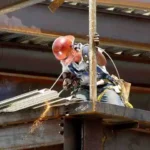
If you’re confused about the difference between a qualified person and a competent person in fall protection—don’t worry, you’re not alone.
Even people in construction, maintenance, and safety ask this all the time:
“Do I need a qualified person or a competent person for this job?”
“Aren’t they basically the same?”
“Is my supervisor automatically considered competent?”
As someone who’s been working with OSHA standards for years, let me break this down for you in the clearest, friendliest way possible—without the jargon overload.
Quick Answer (For People Who Just Want It Straight)
Here’s the difference in one simple line:
A qualified person designs the fall protection system.
A competent person makes sure workers actually use it safely.
Easy, right?
Now let’s go deeper so you can apply this correctly on your jobsite.
Read Article: How Often Do You Need Fall Protection Training?
When Do You Need a Competent Person vs. a Qualified Person?
| Situation / Task | Competent Person Needed? | Qualified Person Needed? | Why / Explanation |
|---|---|---|---|
| Daily fall-protection equipment inspections | ✔️ Yes | ❌ No | Requires hazard recognition and authority to remove defective gear, not engineering calculations. |
| Training workers on how to use fall-protection equipment | ✔️ Yes | ❌ Usually No | OSHA allows a Competent Person with adequate knowledge to train; engineering-level expertise not required. |
| Stopping unsafe work or correcting hazards on the spot | ✔️ Yes | ❌ No | Only a Competent Person has employer-granted authority to take immediate corrective action. |
| Approving or rejecting anchor points before use | ✔️ Yes | ❌ Sometimes | Competent Person evaluates safe use; Qualified Person only needed if structural adequacy must be engineered. |
| Designing a horizontal lifeline (HLL) | ❌ No | ✔️ Yes | Requires engineering calculations (tension, sag, load, anchor strength). Must be designed by a Qualified Person. |
| Designing or modifying personal fall arrest systems (PFAS) | ❌ No | ✔️ Yes | Involves structural load analysis and specification of components. |
| Calculating fall clearance distances | ❌ No | ✔️ Yes | Requires advanced understanding of system dynamics and shock-absorber behavior. |
| Investigating a fall incident | ✔️ Yes | ❌ Sometimes | Competent Person leads investigation; Qualified Person is needed only if system failure analysis is required. |
| Setting up site-specific fall-protection procedures | ✔️ Yes | ❌ Sometimes | Competent Person develops and enforces procedures; engineering needed only if designing new systems. |
| Certifying structural anchor points (e.g., rooftop anchors) | ❌ No | ✔️ Yes | OSHA requires a Qualified Person to verify structural capacity. |
| Supervising workers using fall-protection systems | ✔️ Yes | ❌ No | Competent Person ensures systems are used correctly and hazards are controlled. |
| Reviewing manufacturer instructions and determining compatibility | ✔️ Yes | ❌ Usually No | Competent Person can evaluate equipment compatibility unless a custom system needs engineering review. |
| Developing rescue plans | ✔️ Sometimes | ✔️ Sometimes | Competent Person handles procedural planning; Qualified Person needed when rigging or load calculations are involved. |
What a Competent Person Can Do vs. What a Qualified Person Can Do
| Task / Responsibility | Competent Person Allowed? | Qualified Person Allowed? | Notes / Explanation |
|---|---|---|---|
| Conduct daily inspections of fall-protection equipment | ✔️ Yes | ✔️ Yes | Both can inspect, but Competent Person is the one primarily responsible for daily checks. |
| Identify fall hazards on the jobsite | ✔️ Yes | ✔️ Yes | Hazard recognition is required for both roles, but only Competent Person has authority to act immediately. |
| Stop unsafe work immediately | ✔️ Yes | ❌ No | Only Competent Person has employer-authorized authority to enforce corrections on the spot. |
| Train workers on fall-protection use | ✔️ Yes | ✔️ Sometimes | Competent Person typically trains; Qualified Person may train for advanced systems. |
| Approve anchor points for daily use | ✔️ Yes | ✔️ Sometimes | Competent Person verifies safe use; Qualified Person is needed if engineering approval is required. |
| Calculate fall clearance distances | ❌ No | ✔️ Yes | This requires engineering-level understanding of PFAS, lifelines, and shock-absorbers. |
| Design fall-protection systems (e.g., HLL, anchors) | ❌ No | ✔️ Yes | Only a Qualified Person can design or modify engineered systems. |
| Certify structural anchor points | ❌ No | ✔️ Yes | Structural load verification must be done by a Qualified Person. |
| Modify or approve custom fall-protection setups | ❌ No | ✔️ Yes | Must be engineered or reviewed by a Qualified Person to ensure compliance and load capacity. |
| Perform incident investigations | ✔️ Yes | ✔️ Sometimes | Competent Person leads investigation; Qualified Person steps in when engineering failure analysis is needed. |
| Develop site-specific fall-protection procedures | ✔️ Yes | ✔️ Sometimes | Competent Person usually writes procedures; Qualified Person required if procedures rely on engineered systems. |
| Review equipment compatibility (harness-lanyard connectors, etc.) | ✔️ Yes | ✔️ Yes | Both can confirm compatibility unless it involves custom/non-standard setups. |
Legal Authority — Competent Person vs. Qualified Person
| Type of Authority | Competent Person | Qualified Person | Explanation |
|---|---|---|---|
| Stop Work Authority | ✔️ Yes | ❌ No | Only a Competent Person is given employer authority to immediately stop unsafe work and correct hazards. |
| Authority to Take Corrective Action | ✔️ Yes | ❌ No | A Competent Person can order fixes, remove unsafe equipment, or restrict workers from unsafe areas on the spot. |
| Authority to Design Fall Protection Systems | ❌ No | ✔️ Yes | Only a Qualified Person can design or modify engineered systems such as horizontal lifelines or anchors. |
| Authority to Approve Structural Anchor Points | ❌ No | ✔️ Yes | Structural adequacy requires engineering calculations — only a Qualified Person meets that requirement. |
| Authority to Approve Daily Anchor-Point Use | ✔️ Yes | ✔️ Sometimes | Competent Person verifies safe and proper use; Qualified Person is needed only when engineering sign-off is required. |
| Authority to Train Workers | ✔️ Yes | ✔️ Sometimes | A Competent Person typically trains; a Qualified Person trains when advanced or engineered systems are involved. |
| Authority to Perform Engineering Calculations | ❌ No | ✔️ Yes | Qualified Persons have the technical background to calculate loads, fall clearance, and system forces. |
| Authority to Certify Equipment or Systems | ❌ No | ✔️ Yes | Certifications involving strength, design, or system performance require a Qualified Person. |
| Authority to Conduct Incident Investigations | ✔️ Yes | ✔️ Sometimes | Competent Person investigates worker behavior/equipment issues; Qualified Person investigates engineering/system failures. |
| Authority to Enforce OSHA Compliance on Site | ✔️ Yes | ❌ No | Competent Person ensures day-to-day compliance; Qualified Person ensures design compliance. |
OSHA Definitions — Official Wording vs. Plain English
| OSHA Term | OSHA Regulation | Official OSHA Definition | Plain-English Explanation |
|---|---|---|---|
| Competent Person | 1926.32(f) | “One who is capable of identifying existing and predictable hazards… and has authorization to take prompt corrective measures to eliminate them.” | The on-site safety enforcer. Recognizes hazards, stops unsafe work, fixes issues immediately, and keeps workers using equipment properly. |
| Qualified Person | 1926.32(m) | “One who, by possession of a recognized degree, certificate, or professional standing, or by extensive knowledge, training, and experience, has successfully demonstrated the ability to solve or resolve problems related to the work.” | The system designer/engineer. Creates or approves fall-protection systems, calculates loads, designs anchors or lifelines, and handles technical compliance. |
| Fall Protection (Construction) | 1926 Subpart M | Covers guardrails, PFAS, anchors, lifelines, training, inspections, and role responsibilities. | Main OSHA rule for construction fall protection. Explains what systems are allowed, how they must be used, and who is qualified to design or supervise them. |
| Walking-Working Surfaces (General Industry) | 1910 Subpart D | Covers elevated work areas, platforms, ladders, and fall hazards in non-construction settings. | Applies to warehouses, factories, maintenance, and everyday elevated work. Defines when fall protection is required and what systems can be used. |
What Is a Qualified Person? (Think: Engineer-Level Expert)
OSHA’s definition can feel a bit heavy, so here’s the simple version:
A qualified person is someone with a high level of technical knowledge—usually backed by a degree, professional certification, or specialized training—who can design, analyze, and approve fall protection systems.
This person understands the science behind fall protection: forces, load ratings, anchorage strength, structural requirements, and system behavior.
What a Qualified Person Typically Handles
- Designing anchor points
- Approving engineered lifeline systems
- Calculating fall clearance
- Reviewing structural components
- Writing or signing off on fall protection plans
- Deciding what equipment is acceptable for complex jobs
Examples of a Qualified Person
- A safety engineer
- A civil or structural engineer
- A CSP (Certified Safety Professional)
- A PE (Professional Engineer)
- A manufacturer-trained fall protection technician
If you’re working on something that involves design decisions, custom anchor points, or a unique fall hazard—you need a qualified person involved.
Read Related Article: Who Can Give Fall Protection Training? (And Who Cannot)
What Is a Competent Person? (Think: Hands-On Jobsite Safety Boss)
This is where most people get confused.
A competent person is NOT required to be an engineer. But they DO need something just as important:
👉 The knowledge + the authority to identify hazards AND stop work immediately.
That last part is key.
A competent person isn’t just “trained”—they must have authority from the employer to enforce safety.
What a Competent Person Typically Does
- Performs daily fall protection inspections
- Watches over workers doing elevated work
- Ensures harnesses, lanyards, and SRLs are used correctly
- Trains new workers in fall protection basics
- Stops unsafe behavior on the spot
- Investigates near misses or incidents
- Adjusts jobsite procedures when conditions change
Examples of a Competent Person
- Foreman
- Site supervisor
- Lead worker who has completed competent person training
- Safety officer on site
You’ll find competent people in the field—on the roof, on the scaffold, near the edge—making sure your crew is safe.
Read Related Article: Fall Protection: Whose Responsibility Is It—Employer or Worker?
Qualified vs. Competent Person (Side-by-Side Comparison)
| Feature | Qualified Person | Competent Person |
|---|---|---|
| Primary Role | Designs fall protection systems | Supervises and enforces safe use |
| Knowledge Level | Engineering/technical expertise | Practical jobsite experience |
| Authority | Approves technical systems | Stops work & corrects hazards |
| Training | Advanced technical training | OSHA-compliant competent person training |
| Typical Job Titles | Engineer, CSP, PE | Supervisor, foreman, lead |
| Daily Tasks | Planning, analyzing, designing | Inspecting, training, enforcing |
| Must Be on Site? | No | Yes, especially during fall hazards |
When you look at it this way, both roles are equally important—just in different ways.
When Do You Need a Qualified Person?
You’ll need a qualified person when:
- Designing custom anchor points
- Creating engineered horizontal lifelines
- Working with non-standard fall protection systems
- Evaluating building structure load capacity
- Determining if anchor points meet OSHA strength requirements
- Drafting a detailed fall protection plan
If the job involves math, calculations, or engineering, call in the qualified person.
When Do You Need a Competent Person?
You need a competent person every time workers are exposed to a fall hazard.
They are required on:
- Roofing jobs
- Scaffolding work
- Steel erection
- Aerial lift operations
- Maintenance at elevation
- Warehouse mezzanine work
- Construction sites
They’re the eyes and ears on the ground—constantly checking for:
- Loose guardrails
- Damaged harnesses
- Workers not tying off
- Incorrect anchor usage
- Environmental hazards
- Unsafe behavior
If anything looks sketchy, the competent person is the one who steps in.
Read More About This Topic: Does OSHA Require Fall Protection Training Annually?
Do You Need a Competent Person or a Qualified Person?
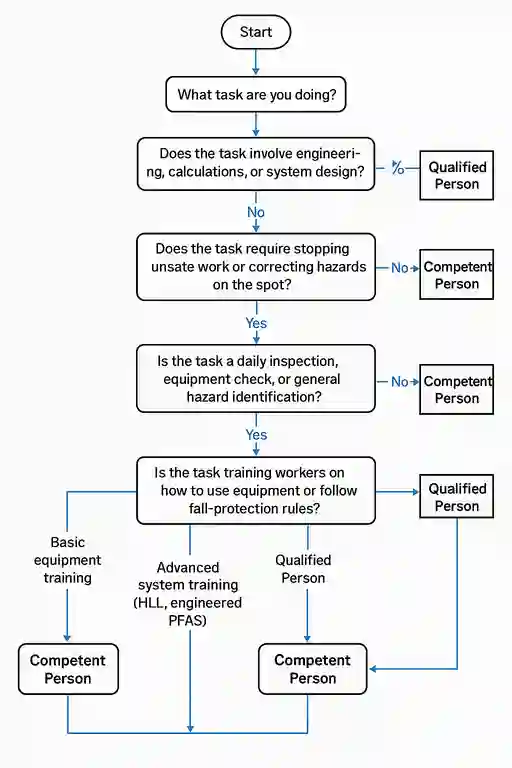
Can One Person Be Both Qualified AND Competent?
Yes—they can.
But only if the person actually meets both sets of requirements.
For example:
A safety engineer (qualified person) who also has years of field experience and authority on site can function as both.
But here’s something I see often (and it’s wrong):
A foreman with zero engineering background calling themselves a “qualified person.”
Nope. OSHA won’t accept that.
Being “qualified” requires proof of technical capability, not just a title.
Common Mistakes Companies Make (That Lead to OSHA Violations)
I’ve seen these more times than I can count:
❌ Assuming a supervisor is automatically a competent person.
Not true. They must be trained AND given authority.
❌ Letting non-engineers approve anchor points.
Anchor points must withstand 5,000 lbs, and only a qualified person can determine that.
❌ Having no documentation.
OSHA will always ask: “Who is your competent person?”
❌ Assigning roles without training.
A title alone doesn’t make someone competent or qualified.
Read More About This Topic: Does OSHA Require Fall Protection Training Annually?
How to Choose the Right Person for Your Jobsite
Choosing a Qualified Person
Ask:
- Do they understand engineering principles?
- Can they perform calculations?
- Are they certified or trained for system design?
- Do they have experience with fall protection systems?
Choosing a Competent Person
Ask:
- Do they have authority to stop work?
- Can they recognize real fall hazards?
- Do workers respect them enough to listen?
- Are they trained to inspect equipment and supervise?
Final Thoughts
At the end of the day, both roles matter—a lot—when it comes to keeping everyone safe on the job.
A qualified person is the technical expert who makes sure the fall protection system is designed the right way.
A competent person is the on-site leader who watches over the team and makes sure those systems are actually used the way they’re supposed to.
When you understand the difference between the two, you’re not just checking an OSHA box—you’re protecting real people and helping everyone go home safely at the end of the day.

Mike Pattenson is a construction safety trainer who loves helping workers stay safe on the job. He explains safety in a simple, practical way so crews can easily understand what to do — and why it matters.
Mike Pattenson is a construction safety trainer who loves helping workers stay safe on the job. He explains safety in a simple, practical way so crews can easily understand what to do — and why it matters.
View All Articles