Let me be honest with you right from the start:
If I had a dollar for every time someone asked me, “Do I really need fall protection in this lift?” — I could probably retire early.
Aerial lifts confuse a lot of people because the rules aren’t the same for every type of lift. Boom lifts and scissor lifts get lumped together like they’re the same thing, but OSHA looks at them very differently. And honestly, once you work with these machines long enough, you understand why.
So today, I’m breaking everything down in plain, simple English — no legal jargon, no stiff corporate tone — just real talk from someone who’s actually been up in these things.
Let’s get into it.
The Short Answer: YES, You Need Fall Protection… Depending on the Lift
Here’s the quick version most people wish OSHA would say:
- Boom lift (any articulating or telescopic lift) → Harness required 100% of the time. No debate.
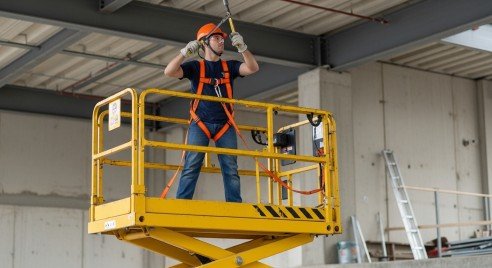
- Scissor lift → Harness usually NOT required as long as you stay inside the guardrails.
That’s it. That’s the big secret. But of course, OSHA doesn’t write their standards like that. They make you decode 1926.453 like it’s an escape-room puzzle.
So let me break down the actual rule in English you can understand.
OSHA Rules for Aerial Lift Fall Protection
| OSHA Reference | What OSHA Says (Summary) | Plain-English Translation | What the Operator Must Do |
|---|---|---|---|
| 29 CFR 1926.453(b)(2)(v) | A body belt with lanyard shall be attached to the boom or basket when working from an aerial lift. | If you’re in a boom-type aerial lift, you must be tied off to the approved point in the basket or boom. | Wear a full-body harness with lanyard/SRL and clip to the designated anchor point every time you’re in a boom lift. |
| 29 CFR 1926.453(b)(2)(iii) | Employees shall stand firmly on the floor of the basket; shall not sit or climb on the edge or use planks, ladders, etc., to gain greater working height. | No standing on rails, no ladders in the basket, no “boosting” your height with boxes or junk. | Keep both feet on the deck, stay inside the guardrails, and move the lift instead of climbing. |
| 29 CFR 1926.451(g)(1) (Scaffolds – applies to scissor lifts as mobile scaffolds) | Each employee on a scaffold more than 10 ft above a lower level shall be protected from falling by guardrails or a personal fall arrest system. | On scissor lifts, the guardrails themselves count as fall protection as long as they’re complete and you stay inside them. | Make sure all rails are in place, don’t remove midrails or top rails, and don’t lean out or climb the rails. Harness usually not required unless conditions are unsafe or company policy says so. |
| 29 CFR 1926.502(d) (Criteria for personal fall arrest systems) | Sets strength, design, and performance requirements for PFAS (max arresting force, anchor strength, free-fall limits, etc.). | Your harness, lanyard, and anchor point must be strong enough and used correctly, or OSHA doesn’t consider you “protected.” | Use ANSI-rated gear, inspect it before use, avoid long free-fall distance, and only tie to approved anchors on the lift. |
| 29 CFR 1910.67(c)(2)(v) (General industry – vehicle-mounted elevating platforms) | A body belt shall be worn and a lanyard attached to the boom or basket when working from an aerial lift. | Same idea in general industry: in an aerial lift, you’re expected to be tied off. | In warehouse/plant/general industry use, follow the same rule: harness + lanyard + approved anchor point. |
Boom Lift vs. Scissor Lift – Fall Protection Requirements
| Lift Type | Is a Harness Required? | Primary OSHA Logic / Category | Notes for Operators (Plain Talk) |
|---|---|---|---|
| Boom Lift (articulating or telescopic) | YES – always required | Covered under aerial lift rules (1926.453). Platform can swing/jerk → ejection risk. | Wear a full-body harness and clip to the approved anchor point every time the boom is in use. No exceptions. |
| Truck-Mounted or Vehicle-Mounted Aerial Lift | YES – always required | Same as other boom-type lifts – treated as aerial lifts under OSHA. | If it has a boom and you ride in the basket, treat it like any boom lift: harness on, tied off. |
| Scissor Lift | Usually NO (guardrails count) | Treated like a mobile scaffold. Guardrails are accepted fall protection if complete. | If all rails are in place and you stay inside them, OSHA doesn’t require a harness. Don’t climb or lean out. |
| Scissor Lift with Missing/Damaged Rails | YES – or don’t use it | If guardrails aren’t doing their job, fall protection is no longer adequate. | Either tag it out of service or use a harness and proper anchor until it’s fixed (depending on company policy). |
| Scissor Lift on Uneven Ground / Awkward Reach Work | Recommended / often required by company policy | Higher tip-over and fall risk due to instability or overreaching. | If you’re stretching, leaning, or working on sketchy surfaces, throw on the harness even if OSHA isn’t explicit. |
| Boom or Scissor Lift under Stricter Company Policy | YES, if employer says so | Employers are allowed to be stricter than OSHA, not looser. | Some sites say: “In any lift, you wear a harness.” In that case, OSHA or not, you follow site rules. |
OSHA’s Rule for Boom Lifts
OSHA says that if you’re in an aerial lift, you must use a personal fall arrest system.
That’s OSHA’s fancy way of saying:
👉 Wear a full-body harness and tie your lanyard to the approved anchor point.
Not the rail.
Not a pipe.
Not your coworker’s belt loop.
The actual anchor point inside the platform.
Why is OSHA strict here?
Because boom lifts can throw you. Literally.
Boom lifts have what we call the catapult effect. If the base hits a hole, the boom jerks, or the basket stops suddenly, you can get launched right out like a watermelon from a slingshot. And trust me, I’ve seen people get tossed hard — not pretty.
That’s why OSHA doesn’t play around with boom lifts.
If you’re in one, you’re wearing a harness. End of story.
OSHA’s Rule for Scissor Lifts — Also Translated Into English
Now let’s talk scissor lifts.
People get surprised when I tell them OSHA doesn’t actually require a harness in a scissor lift.
As long as:
- The guardrails are installed
- Nothing is missing or damaged
- You stay inside the rails
…then the guardrails themselves count as fall protection.
See, scissor lifts are classified as mobile scaffolds, not aerial lifts. That’s why the rules don’t match boom lifts. A scissor lift only goes straight up and down. It doesn’t swing or articulate, so you’re not at risk of being flung out.
But — and this is a BIG “but” — the second you start leaning way out, climbing the rails, or doing something that would make OSHA raise an eyebrow, that’s when fall protection becomes necessary.
If your center of gravity is over the guardrail?
Yeah, now you’ve created your own fall hazard.
When in doubt, I tell people:
If you’re doing something risky, put the harness on.
Boom Lifts: The “Harness Every Time” Category
Let me spend a moment on boom lifts because this is where operators get hurt the most.
What OSHA expects (in real terms):
- Wear a full-body harness
- Use a lanyard or SRL
- Tie off to the manufacturer-approved anchor point
- Keep your feet on the platform floor
- Close the gate or chain behind you
If you skip any of this, OSHA can hit you with a citation, but honestly, the bigger risk is that you’ll bounce out when the lift jerks.
Why OSHA cares so much
Boom lifts can:
- Jolt when they’re driven over uneven ground
- Swing the platform unexpectedly
- Rebound if the controls snap back
- Shift weight when someone moves fast
Think of a boom lift like a giant seesaw. You’re not just standing on a platform — you’re at the end of a mechanical arm. That arm moves, and you move with it.
A story I always share
I once watched a guy drive a boom lift over a small pothole — nothing crazy. But because the boom was extended way out, the basket whipped up and down like a diving board. He wasn’t tied off. He nearly went airborne.
That moment is why I never argue with OSHA’s rule on this one.
Scissor Lifts: The “Guardrails Are Enough” Category
Now, scissor lifts. These guys are the more predictable cousins of boom lifts.
When a harness is NOT required:
- Guardrails are in place
- You stay inside the platform
- You’re not leaning out or standing on rails
- You’re not climbing on boxes, ladders, or tools inside the lift
Scissor lifts are basically big mobile baskets that go straight up. That’s why OSHA considers the guardrails enough protection.
When a harness might be required anyway:
Even though OSHA doesn’t require it, plenty of companies do.
Here’s when a harness becomes a smart idea:
- You’re working on uneven ground
- You’re facing strong wind
- You need to reach far outside the lift
- You’re doing HVAC installs with awkward angles
- Your jobsite policy is stricter than OSHA
- The rails are damaged or missing
I’ve also seen situations where the lift is raised on a slight slope, and the operator starts to drift. That’s when I tell them, “Put the harness on. Don’t argue.”
Real-life example
One day, I watched a painter stretch so far over the rail of a scissor lift that his whole torso was hanging outside the lift. No harness. No nothing.
All it took was one bad step, and he would’ve flipped over like a wet towel.
That’s why I always say:
Just because OSHA doesn’t require it doesn’t mean you shouldn’t wear it.
Company Policy vs. OSHA Minimum Requirements (Aerial Lift Fall Protection)
| Topic | OSHA Minimum Requirement | Typical Company Policy (Stricter) | What This Means for the Operator |
|---|---|---|---|
| Boom Lift Fall Protection | Harness required 100% of the time with lanyard attached to approved anchor. | Same — sometimes requires SRL only instead of a 6 ft lanyard. | No debate. If you’re in a boom lift, you’re tying off. Some sites may limit what type of lanyard you can use. |
| Scissor Lift Fall Protection | Harness not required if guardrails are complete and you stay inside them. | Many companies require a harness in ALL lifts, even scissor lifts. | Even if OSHA doesn’t require a harness, your employer absolutely can — and you must follow the company rule. |
| Anchor Points | Must be manufacturer-approved. No clipping to rails, midrails, or random metal parts. | Zero tolerance for non-approved tie-off points. Some companies physically mark anchor points. | Always clip to the rated D-ring anchor in the basket — not the rails. If unsure, ask, don’t guess. |
| Leaning/Climbing on Rails | Prohibited. OSHA says feet must stay on the floor of the platform. | Treated as a disciplinary violation in many companies. | Even one time caught standing on rails = retraining or removal from lift duties. |
| Equipment Inspection | Required before each use. Harness, lanyard, lift must be checked. | Some companies require a signed inspection sheet for each shift. | You might have to document your inspection, not just do it mentally. |
| Weather Conditions | OSHA offers general guidance but no strict wind-speed rule for lifts. | Many companies set a specific wind limit, usually 20–28 mph. | If the site says “shut it down at 20 mph,” then that’s the rule — even if OSHA doesn’t specify it. |
| Training Requirements | Operator must be trained, evaluated, and authorized. | Companies may require annual refresher, not just “as needed.” | Even if you’re experienced, you may need to repeat training more often. |
| Use of Lanyards/SRLs | Must limit free fall to 6 ft and meet arresting force requirements. | Some sites require self-retracting lifelines (SRLs) only. | If the rule says SRL, then leave the shock lanyard in the toolbox. |
| Working Alone in a Lift | OSHA doesn’t forbid it. | Many companies require a spotter or ground person anytime a lift is in use. | You can’t just hop in and go — you may need someone watching the base. |
| Tag-Out/Unsafe Equipment | Equipment that is damaged or unsafe must be removed from service. | Zero-tolerance: any issue = immediate tag-out. | Companies may ban “minor repairs on the spot” — if it’s questionable, it’s tagged. |
Common Mistakes People Make (And OSHA Would Fail Them Immediately)
You want to know what gets people cited faster than speeding in a school zone?
These:
1. Clipping to the rails
Every training class I’ve ever taught has at least one person who says,
“Why can’t I just clip to the rail? It’s easier.”
Because the rail is not rated for fall arrest.
If you fall, the rail will go with you — or break — and now both of you are falling.
2. Using a lanyard that’s too long
If your lanyard is so long that you could fall more than 6 feet, OSHA will nail you for excessive free fall distance.
Shorter is safer.
3. Not adjusting the harness correctly
Loose leg straps are the silent killers of fall protection.
If you ever want motivation to tighten your straps properly, look up what happens in a fall with loose straps.
(Trust me, you’ll tighten them every time after that.)
4. Climbing the guardrails
If I had a nickel for every person I’ve seen stand on the rails like they’re in the Olympics, I wouldn’t need a job today.
Rails are not ladders.
They’re fall protection.
Don’t climb the equipment that’s supposed to protect you.
5. Not tying off BEFORE elevating
This is a big one.
Tie off before the lift starts going up.
Who Actually Needs Fall Protection on an Aerial Lift?
A lot of folks think fall protection is only for rookies. Nope. OSHA doesn’t care if you’ve been doing this for 20 years.
Here’s who must follow the rule:
- Aerial lift operators
- Anyone riding in the lift
- Maintenance workers doing elevated repairs
- Anyone using a boom lift (no exceptions)
- Scissor lift operators, if jobsite or conditions require
Some companies even require harnesses in all lifts, no questions asked. They’d rather be safe than deal with an incident report.
Final Thoughts: OSHA Isn’t Trying to Make Your Life Hard — They’re Trying to Keep You Alive
Look, I get it.
Sometimes safety rules feel like they’re written by people who’ve never been on a job site.
But the aerial lift fall protection rule actually makes sense once you understand the risks:
- Boom lifts can throw you.
- Scissor lifts rely on rails — unless you do something risky.
- Harnesses aren’t there to annoy you; they’re there to keep you from becoming a safety statistic.
At the end of the day, fall protection isn’t complicated.
You just need to respect the machine, the height, and your own safety. And if you’re ever unsure?
Do what I always tell my guys:
“When in doubt, wear the harness.”

Mike Pattenson is a construction safety trainer who loves helping workers stay safe on the job. He explains safety in a simple, practical way so crews can easily understand what to do — and why it matters.
Mike Pattenson is a construction safety trainer who loves helping workers stay safe on the job. He explains safety in a simple, practical way so crews can easily understand what to do — and why it matters.
View All Articles