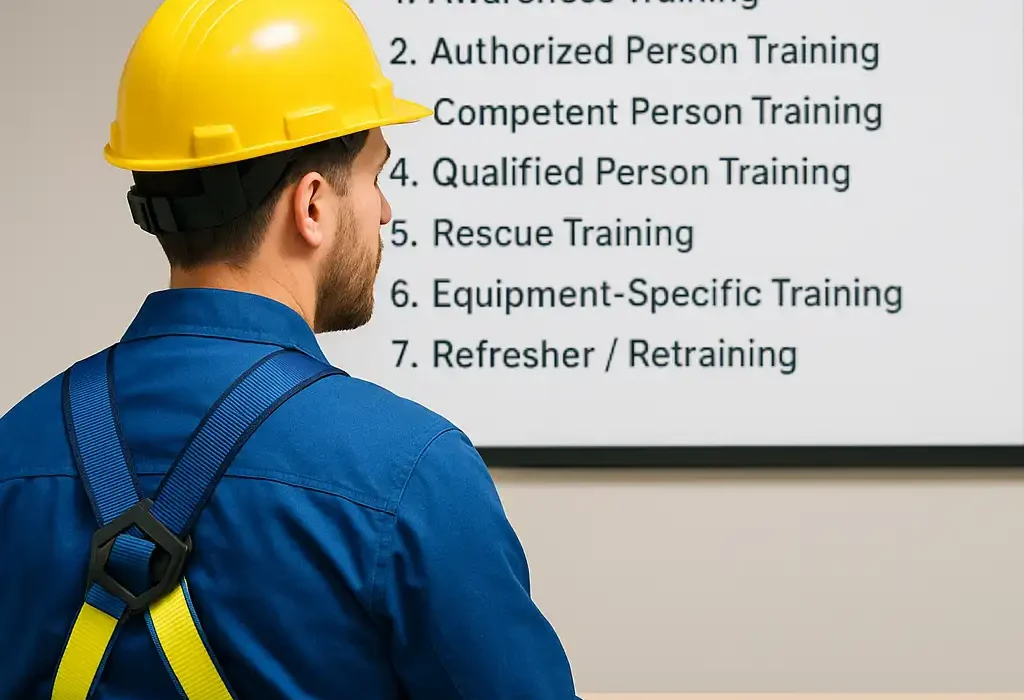
If you’ve ever searched “types of fall protection training,” you’ve probably seen terms like authorized person, competent person, or rescue training and thought, Which one do I actually need?
You’re not alone — I’ve trained thousands of workers and supervisors, and almost everyone asks the same thing. Fall protection isn’t one-size-fits-all; different jobs and responsibilities require different levels of training.
So let me break this into 7 types.
| Training Type | Target Audience | Key Skills / Topics Covered | When Needed / Trigger |
|---|---|---|---|
| 1. Awareness Training | Workers near hazards but not using gear | Recognizing hazards, safe behavior around edges, understanding fall risk | When exposed to fall hazards but not using fall protection equipment |
| 2. Authorized Person Training | Workers who wear harnesses or tie off | Harness fitting, equipment inspection, anchor selection, fall clearance | Required when you use any fall protection gear |
| 3. Competent Person Training | Supervisors, leads, foremen, safety officers | Hazard identification, equipment inspections, correcting unsafe practices, overseeing workers | Needed when supervising workers at heights or enforcing safety |
| 4. Qualified Person Training | Engineers, safety professionals, system designers | Designing fall protection systems, load calculations, anchor engineering | Required when designing, modifying, or approving fall protection systems |
| 5. Rescue Training | High-risk workers, tower crews, emergency responders | Suspension trauma prevention, self-rescue, assisted rescue, descent devices | Needed when workers must rescue a fallen employee or cannot rely on 911 |
| 6. Equipment-Specific Training | Workers using specialized fall protection systems | Horizontal lifelines, leading-edge SRLs, fixed ladders, rooftop anchors, rope access systems | Required when using new, complex, or specialized fall protection equipment |
| 7. Refresher / Retraining | All workers, supervisors, and system users | Reviewing key principles, correcting unsafe practices, updating skills for new equipment, reinforcing proper procedures |
Required when: – Job roles change – New equipment is introduced – A worker shows unsafe behavior – After incidents or near-misses – When knowledge has faded (recommended every 1–2 years) |
Read related article: Lost Your Fall Protection Certificate? Here’s What to Do Next
Why Fall Protection Training Isn’t All the Same
Safety training tends to confuse people because we often assume that “training is training.” But OSHA views fall protection differently. They want you to be trained for the exact hazards you face, nothing more, nothing less.
For example:
- A worker climbing a roof needs a different skillset than someone inspecting a ladder.
- A site supervisor needs deeper knowledge than an entry-level helper.
- An engineer designing an anchor point needs more advanced training than the crew using it.
Over the years, I’ve seen workers get the wrong class — and they end up confused, overwhelmed, or not trained enough. That’s why knowing the types of fall protection training is incredibly important.
Let’s start with the most basic level and work our way up.
Read related article: How to Become Certified in Fall Protection? (A Guide)
1. Fall Protection Awareness Training
(For people who work around fall hazards)
Think of Awareness Training as Fall Protection 101.
This training is meant for people who might be near fall hazards but aren’t necessarily using harnesses or specialized gear.
What Awareness Training Covers
- What a fall hazard is
- How to recognize unsafe conditions
- What your responsibilities are
- When and where fall protection is required
- The basics of safe behavior around heights
Who This Training Is For
- Office or admin employees visiting job sites
- Maintenance workers who occasionally work near edges
- Helpers, interns, or new workers who don’t yet perform high-risk tasks
- Anyone exposed to fall hazards but not using equipment
Why It Matters
I’ve met people who say, “I don’t work at heights, so I don’t need training.”
Then two minutes later, I catch them walking under a guy on a ladder or stepping too close to a skylight.
Awareness Training teaches people how not to get hurt by accident.
Read related article: How to Pass the Written & Practical Fall Protection Tests?
2. Authorized Person Training
(The most common type — this is probably what YOU need)**
If you’re wondering what class you should take, there’s a 90% chance it’s this one.
The “Authorized Person” is the worker who actually uses fall protection equipment — the harnesses, lanyards, anchors, SRLs, and so on.
What Authorized Person Training Covers
- How to fit and wear a harness correctly
- How to inspect your harness, lanyard, and anchor points
- When and where to tie off
- How to calculate fall clearance
- How to identify unsafe anchor points
- What types of systems you may use (PFAS, SRLs, nets, rails, etc.)
- Common mistakes that cause real accidents
Who Needs It
- Roofers
- Construction workers
- Tower workers
- Installers
- Maintenance crews
- Ironworkers
- Anyone who ties off or wears a harness
Why It Matters
In my experience, Authorized Person Training is the training that saves the most lives. Most fall accidents happen because someone:
- Didn’t know their gear was worn out
- Used the wrong anchor
- Had a loose harness
- Forgot to calculate fall distance
This training is hands-on, practical, and absolutely essential if you work at heights.
Read related article: Are Your Fall Protection Training Records OSHA-Ready?
3. Competent Person Training
(For supervisors, foremen, and anyone who enforces safety)**
The Competent Person is the “eyes and ears” of safety on a job site. If you’re a supervisor, lead person, foreman, or designated safety representative, OSHA expects you to have a deeper understanding.
What Competent Person Training Covers
- How to identify fall hazards before workers begin
- How to inspect fall protection equipment
- How to correct unsafe behavior
- How to stop workers from using unsafe systems
- How to write or review fall protection plans
- Proper anchor selection
- Elements of rescue planning
- Accident investigation basics
Who Needs This Training
- Site supervisors
- Crew leads
- Foremen
- Safety officers
- Construction managers
- Anyone with authority to stop work
My Personal Insight
This is one of the most misunderstood levels of training. Many supervisors think their job is just to “remind workers to put on their harnesses.”
But OSHA says a Competent Person must be someone who:
- Can recognize a hazard AND
- Has the authority to correct it
If you’re expected to stop workers from doing something unsafe, you need Competent Person training — plain and simple.
Read related article: 50 Common Fall Protection Training Questions & Answers
4. Qualified Person Training
(Highly technical — usually for engineers or experts)**
Most workers will never need this. The Qualified Person is the individual who actually designs fall protection systems.
What Qualified Person Training Covers
- Engineering principles of anchor points
- Calculating forces, loading, and clearances
- Structural analysis
- Designing horizontal lifelines
- Reviewing and approving fall protection plans
- Advanced system troubleshooting
Who Needs It
- Engineers
- Safety professionals
- People designing or modifying fall protection systems
- Consultants or advanced safety trainers
Why It’s Important
This level of training prevents catastrophic failures — such as anchors ripping off rooftops or lifelines being incorrectly tensioned.
If your job doesn’t involve design or engineering, you probably don’t need this training.
5. Fall Rescue Training
(The most forgotten but arguably the most important)**
Using fall protection equipment is one thing. Knowing what to do after someone falls is another.
You’d be surprised how many companies skip this — and it’s dangerous.
What Rescue Training Covers
- Suspension trauma awareness
- How to perform a self-rescue
- Assisted rescue techniques
- How to use rescue kits and descent devices
- How to lower or retrieve a fallen worker
- How fast you need to rescue someone (hint: it’s quick!)
Who Needs It
- Tower climbers
- High-rise workers
- Confined space teams
- Construction crews in remote locations
- Supervisors responsible for emergency response
- Anyone working where calling 911 is NOT fast enough
My Personal Insight
I’ve seen rescue scenarios where workers froze because they had no idea what to do. Fall protection is only half the system. The rescue plan is the other half.
If you work in high-hazard environments, rescue training is not optional — it’s essential.
6. Equipment-Specific Training
(When your job requires specialized systems)**
Not all fall protection systems are the same. Sometimes workers need training for unique equipment.
Examples of Equipment-Specific Training
- Leading-edge self-retracting lifelines
- Rooftop anchor systems
- Permanent horizontal lifelines
- Fixed ladder safety systems
- Scaffolding fall protection
- Man-lifts and aerial lifts
- Rope access systems
- Descent and rescue devices
- Body belts vs. full-body harnesses
- Passive systems (guardrails, nets, covers)
Why This Matters
I’ve seen workers use general fall protection training but still fail to use specialized equipment correctly because the training didn’t cover that device.
Any time equipment is new, complicated, or high-risk, a separate session is needed.
7. Refresher Training
When Do You Need Refresher or Retraining?
Even if you’ve been trained before, OSHA requires retraining when:
- You forget the proper use
- You use equipment incorrectly
- You start using new equipment
- Your job changes
- A near-miss or accident happens
- A change in workplace conditions introduces new hazards
How Often Should You Be Retrained?
There’s no fixed timeline — OSHA uses the phrase “as needed.”
But best practice (based on what I’ve seen across the industry):
- Every 1–2 years for most workers
- Every year for high-hazard jobs
- Immediately after equipment or job changes
If you can’t remember the last time you took training, that’s a sign it’s time for a refresher.
Quick Guide: Which Training Do YOU Need?
Here’s the easiest way to figure it out:
| What Describes You? | Training You Need |
|---|---|
| If you wear a harness | Authorized Person Training |
| If you supervise workers | Competent Person Training |
| If you design systems | Qualified Person Training |
| If you’re near hazards but not using gear | Awareness Training |
| If you work in high-risk environments | Rescue Training |
| If your equipment is specialized | Equipment-Specific Training |
Still confused? Don’t worry — most employers choose the right level for their workers. Your job is simply to know what to expect and understand the differences.
Final Thoughts: Choosing the Right Type of Fall Protection Training
At the end of the day, understanding the different types of fall protection training isn’t just about compliance — it’s about staying alive, keeping your team safe, and giving yourself the confidence to work around heights without fear.
From my years of training experience, here’s my best advice:
👉 Never skip training because you think you already know everything.
👉 Never use gear you don’t fully understand.
👉 Never rely on luck around fall hazards.
Fall protection training might seem like “just another requirement,” but it’s one of the few trainings that directly prevents life-changing accidents.
If you choose the right type of training — the one that matches your job and responsibilities — you’re not just checking a box. You’re genuinely protecting yourself and the people around you.
Mike Pattenson is a construction safety trainer who loves helping workers stay safe on the job. He explains safety in a simple, practical way so crews can easily understand what to do — and why it matters.
Mike Pattenson is a construction safety trainer who loves helping workers stay safe on the job. He explains safety in a simple, practical way so crews can easily understand what to do — and why it matters.
View All Articles