If there’s one thing I’ve seen over and over again in workplaces—construction, maintenance, roofing, warehousing—it’s this: companies often believe their fall protection training records are compliant… until an OSHA inspector shows up.
That’s usually when people start scrambling through file cabinets, old binders, or scattered PDFs hoping everything magically lines up.
Sometimes it does.
Often… it doesn’t.
The good news? Getting your fall protection training documentation OSHA-ready doesn’t have to be complicated.
You just need a clear understanding of what OSHA expects, what mistakes can cost you, and how to keep your records clean, organized, and audit-proof.
Let’s walk through everything…
What OSHA Requires vs. What is Recommended
| Requirement Type | OSHA Required Elements | Best Practice (Recommended) | OSHA Regulation Reference |
|---|---|---|---|
| Employee Identification | Full employee name or unique identifier | Include job title and employee ID number | 1926.503(b)(1) |
| Training Date | Date(s) when the employee completed the training | List start & end date if training spans multiple days | 1926.503(b)(1) |
| Trainer Verification | Signature of trainer or employer certifying completion | Include trainer’s qualifications or competency statement | 1926.503(b)(1) |
| Training Content | OSHA does not require topics listed on certificate, but training must cover required subjects | Attach or reference a checklist of topics covered | 1926.503(a)(2) |
| Record Retention | Employer must keep the most recent certification | Keep records for duration of employment + 1–3 years | 1926.503(b)(2) |
| Retraining Documentation | Required when employee lacks understanding or workplace changes | Document reason for retraining (near-miss, new equipment, procedure changes) | 1926.503(c) |
Read related article: 50 Common Fall Protection Training Questions & Answers
Why Fall Protection Training Records Matter More Than You Think
OSHA doesn’t ask for paperwork just to make life difficult. Training records exist for three important reasons:
- They prove your workers were properly trained to avoid fall hazards.
- They show you’ve provided the right instruction for the specific equipment used on your site.
- They protect your company during investigations, accidents, or insurance claims.
I’ve lost count of the times a company avoided a citation simply because they were able to provide clean, complete records. And I’ve also seen companies fined because their records were incomplete—even when training did happen.
So the question becomes: Are your fall protection training records actually ready for OSHA?
Let’s find out.
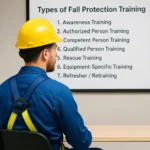
Read related article: 7 Types of Fall Protection Training You Can Take
What OSHA Requires: The Essentials You Need to Have
Fall protection training falls under two main OSHA regulations:
- Construction: 29 CFR 1926.503
- General Industry: 29 CFR 1910.30
While the exact wording differs slightly, both require the employer to provide training to any employee exposed to fall hazards—and to document it.
Here’s what OSHA specifically expects to see in your training certification record:
1. Employee’s Full Name or ID
The record must clearly identify the worker who received the training.
Nickname? No.
First name only? No.
Use a full legal name or a unique ID number.
2. Date(s) of the Training
OSHA accepts training that happened earlier in someone’s career—as long as the employer can verify it was adequate.
So dates matter.
A missing date is one of the easiest citations for OSHA to issue.
3. Signature of Trainer or Employer
This isn’t optional.
The certification must be signed—physically or electronically.
4. The Employer Must Keep the Most Recent Certification
You don’t need 10 years of old training files, but you do need the latest one.
Read related article: Not Fall Protection Certified? Here’s What OSHA Can Fine You
What the Training Itself Should Cover
A good fall protection training record shows that you covered the right topics. OSHA expects workers to be trained on:
- The fall hazards present in their specific work area
- How to erect, maintain, inspect, and use fall protection systems
- How to use guardrails, warning lines, safety nets, PFAS (harness + lanyard), and anchors
- How to use equipment safely
- Limitations of fall equipment
- Their role in any safety monitoring system
Even if OSHA doesn’t explicitly require all details to be listed on the record, it’s smart to include a topic checklist. It proves that training wasn’t just a quick “talk”—it was structured and compliant.
Read related article: How to Become Certified in Fall Protection? (A Guide)
What Makes a Training Record Truly “OSHA-Ready”?
Let’s be real. Having training records isn’t enough.
They have to be complete, clear, and instantly accessible.
Here’s what OSHA-ready looks like:
✅ All required elements included
Name, date, and trainer signature.
✅ Detailed training topics attached or referenced
A checklist or syllabus adds credibility.
✅ Retraining tracked properly
If a near-miss happened, the site changed, or new equipment was introduced, retraining is required—and the record should reflect that.
✅ Records organized & easy to retrieve
If it takes you 30 minutes to find a certificate, your system is broken.
✅ Stored safely (digital or paper)
Digital records should have backups.
Paper records should be protected from damage.
✅ Consistent formatting
Every certificate should look similar.
Clean. Professional. Verified.
OSHA inspectors often judge your compliance level by how your records look. Sloppy records suggest sloppy training.
Read related article: How to Renew Fall Protection Certification?
The Biggest Problems OSHA Sees (And How to Avoid Them)
Let me share the most common issues I see during site reviews, audits, and safety walkthroughs:
❌ Missing dates
A shockingly common problem. No date = automatic citation.
❌ No trainer signature
OSHA wants proof the training was legitimate.
❌ Generic certificates
A certificate that doesn’t mention fall protection topics is weak documentation.
❌ Workers can’t remember their training
Inspectors often walk around and ask employees questions:
“What’s your anchor point rated for?”
“How do you inspect your harness?”
“What’s your maximum free-fall distance?”
If workers can’t answer, it doesn’t matter what your paperwork says.
❌ Retraining wasn’t documented
New jobsite?
New harnesses?
New fall arrest system?
Near miss?
Employee misuse?
All these require retraining.
Step-By-Step Guide: How to Audit Your Own Records
Use this as a self-check:
Step 1: Collect All Training Records
Paper?
Digital?
Emails?
USB?
Find everything and put them in one place.
Step 2: Check for Missing Elements
Ask yourself:
- Is the employee name complete?
- Are the dates correct and readable?
- Is the trainer’s signature included?
- Does the document reference fall protection topics?
- Does a retraining date exist where needed?
If any box is unchecked, fix it now.
Step 3: Compare Training Dates with Job Changes
Think about:
- Did you switch from guardrails to PFAS?
- Did you add scaffolding?
- Did you start rooftop work?
- Did you introduce harnesses with SRLs?
If yes, retraining should have been done.
Step 4: Interview a Few Workers
Ask simple questions:
- “How do you inspect your harness?”
- “What’s the purpose of a shock absorber?”
- “What happens if your anchor point fails?”
If they hesitate, you need refresher training.
Step 5: Organize Your System
You can use:
- File folders (alphabetical)
- Excel tracking sheet
- Digital safety management system
- Cloud storage organized by job title or employee number
The key is consistency.
Best Practices That Go Beyond Minimum OSHA Requirements
If you want to create a bulletproof system, these tips help your records stand out:
✔ Keep a topic checklist for every training session
Attach it to every certificate. It proves thoroughness.
✔ Include trainer qualifications
Even a short line like “Trainer is a competent person in fall protection” gives added weight.
✔ Use digital storage
Google Drive, OneDrive, Dropbox, or a safety platform—anything with backup and fast search.
✔ Use employee ID numbers
This avoids mixing up workers with similar names.
✔ Keep equipment inspection logs with training files
They complement each other.
If training records say the worker knows how to use equipment, inspection logs show they’re actually maintaining it.
✔ Update training when the job evolves
Work conditions change.
Hazards change.
Procedures change.
Training must change with them.
What Happens If Your Records Are Not OSHA-Ready?
If an OSHA inspector visits and your documentation is incomplete, several things can happen:
⚠ 1. Citations
Fall protection training violations rank among OSHA’s top 10 most common citations. The fine varies but can reach thousands of dollars per violation.
⚠ 2. Increased scrutiny
If one record looks bad, inspectors often dig deeper into other training programs.
⚠ 3. Legal liability
If a fall happens and you can’t prove proper training, the employer can be held responsible—even if the worker was at fault.
⚠ 4. Insurance complications
Insurance companies look at training documentation when evaluating claims. Missing records can delay or affect payouts.
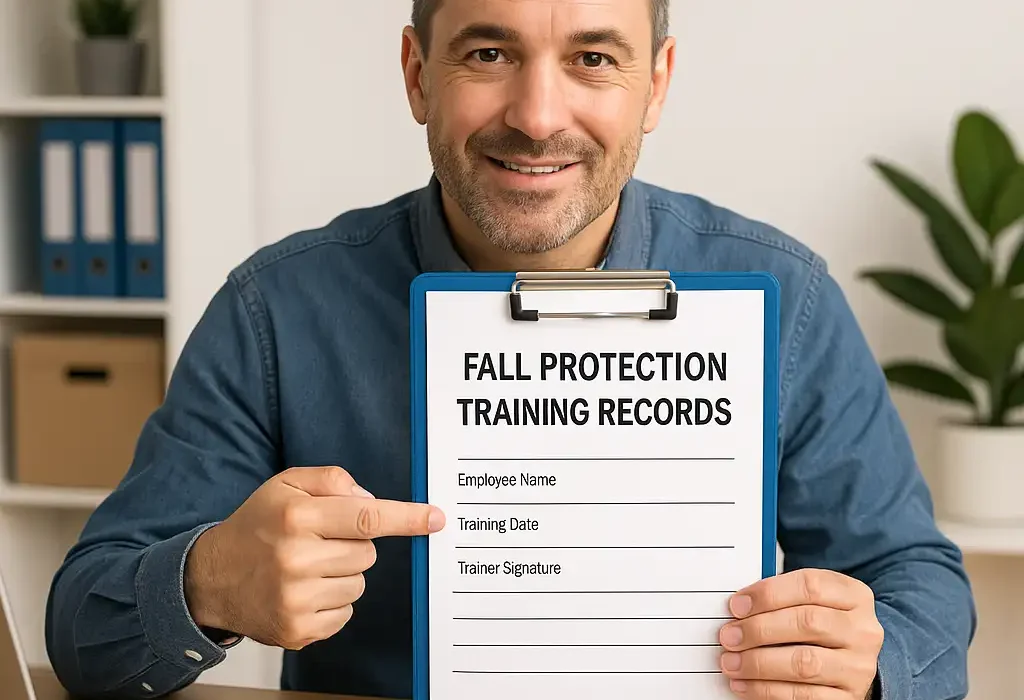
A Simple Template You Can Use Right Away
Here’s what a solid fall protection training record should contain:
- Employee name
- Job title
- Employer
- Date(s) of training
- Location of training
- Training topics covered
- Trainer name and signature
- Competency verification (written exam, hands-on evaluation)
- Notes on site-specific hazards
- Date of retraining (if applicable)
If your certificate has all of these, you’re in good shape.
Final Thoughts
Fall protection saves lives. Training records prove you’re doing your part—not just for compliance, but for the workers who trust your systems every day.
Your records don’t need to be fancy. They just need to be accurate, complete, organized, and easy to retrieve.
If you can pull out a clean certificate in 10 seconds…
If it has the right details…
If your workers can confidently answer basic fall protection questions…
Then yes—your fall protection training records are OSHA-ready.
And if not? You now know exactly how to fix it.

Mike Pattenson is a construction safety trainer who loves helping workers stay safe on the job. He explains safety in a simple, practical way so crews can easily understand what to do — and why it matters.
Mike Pattenson is a construction safety trainer who loves helping workers stay safe on the job. He explains safety in a simple, practical way so crews can easily understand what to do — and why it matters.
View All Articles