If you’re here because you’re wondering how to renew your fall protection certification, you’re not alone.
I’ve worked in safety training for years, and trust me—almost everyone gets confused about renewals. Workers ask me all the time:
“Does my certificate expire?”
“Do I need to take the whole training again?”
“Can I just do an online refresher?”
“Is there a deadline before I get in trouble?”
So if you’re feeling unsure, overwhelmed, or just trying to stay compliant for your job, you’re in the right place.
I’ll walk you through everything step-by-step, in plain language, the same way I explain it to new trainees on the jobsite.
Let’s make this simple.
Why You Even Need to Renew Fall Protection Certification
A lot of workers think, “But I already took this training—why do I need it again?”
Here’s the reality: OSHA doesn’t technically give your certification an expiration date. But they do require retraining “as needed.”
And in the real world?
“Needed” happens more often than people think.
You need renewal when:
- It’s been 1–2 years since you trained
- You switched jobs or employers
- Your company brought in new equipment
- There’s been a near-miss or incident
- A supervisor notices unsafe practices
- You simply forgot key steps (and it happens!)
I’ve seen workers who could put on a harness blindfolded… and others who wore it upside down after not using one for months. So yes, refresher training keeps everyone sharp—and safe.
Read Related Article: How to Pass the Written & Practical Fall Protection Tests?
How Often Should You Renew?
Here’s what I typically tell workers:
- Construction industry: every year
- General industry: every 1–2 years
Most employers follow an annual schedule because it’s easier, safer, and keeps them compliant during audits.
Here’s a simple rule of thumb:
If you can’t remember your last fall protection training… it’s time to renew.
Related Article: How to Become Certified in Fall Protection? (A Guide)
Signs Your Certification Is Due for Renewal
You might need to renew if:
✔ Your employer reminds you
Most companies track your certificate dates and will give you a heads-up.
✔ Your certificate is past the training date
Fall protection certificates often have the date printed right on them.
✔ You’re using new equipment
New SRLs, updated harness types, new anchorage systems—all require retraining.
✔ You haven’t practiced rescue or anchoring in a long time
If it’s been a while since you checked your harness for damage, that’s a clue.
✔ You changed jobs
Different employers = different systems, different rules.
If any of these feel familiar, don’t stress—renewal is easier than you think.
Read Related Article: 6 Best Places to Get Fall Protection Training
What You Need Before Renewing
You don’t need much, honestly. When workers ask what to bring, I tell them:
- Your old certificate (if you still have it)
- A good attitude
- Your schedule availability
- Information about your job tasks (so we tailor training)
You don’t have to study beforehand. You don’t need to memorize anything. You just need to show up ready to learn (or relearn) the safety basics.
How to Renew Fall Protection Certification: Step-by-Step
Let’s break this down into simple steps. This is the same process I use when scheduling worker renewals on jobsites.
Step 1: Choose a Training Provider
You have two main options:
👉 Online Refresher Courses
- Convenient
- Usually cheaper
- Great for theoretical learning
👉 In-Person Training
- Required by many employers
- Includes hands-on equipment use
- Ideal if you haven’t practiced in a while
If you’re not sure what your company accepts, just ask your safety manager.
Step 2: Enroll in Refresher or Full Training
Refresher courses are shorter and focus on updating your knowledge.
But you may need full training again if:
- You changed industries
- You haven’t worked at heights recently
- You’re using equipment you’ve never seen before
- Your last training was years ago
I’ve had workers renew after 5–10 years—yes, the full class is needed at that point.
Step 3: Attend the Classroom or Online Course
In the classroom, we usually cover:
- Fall hazards
- Harness inspection
- Anchorage selection
- Proper connection methods
- Fall arrest vs. fall restraint
- Rescue planning
- OSHA rules (explained in simple language)
Online courses cover the same but skip the hands-on part.
A friendly reminder I always give: “Don’t worry—refresher classes are way shorter than the original training.”
Step 4: Complete the Practical / Hands-On Portion
This is where most workers realize how much they’ve forgotten. I’ve seen it countless times.
You’ll practice:
- Inspecting a harness
- Donning it correctly
- Adjusting straps
- Connecting to anchors
- Understanding SRLs, lanyards, and shock absorbers
- Basic rescue concepts
Hands-on practice is the most important part of the renewal—this is what saves lives.
Step 5: Take the Written Test
Don’t let this scare you—it’s not meant to trick anyone. A typical test has:
- Simple multiple-choice questions
- Straightforward scenario questions
- Basic equipment identification
If you understand the training, you’ll pass. I’ve trained hundreds of workers, and almost all of them pass on the first try.
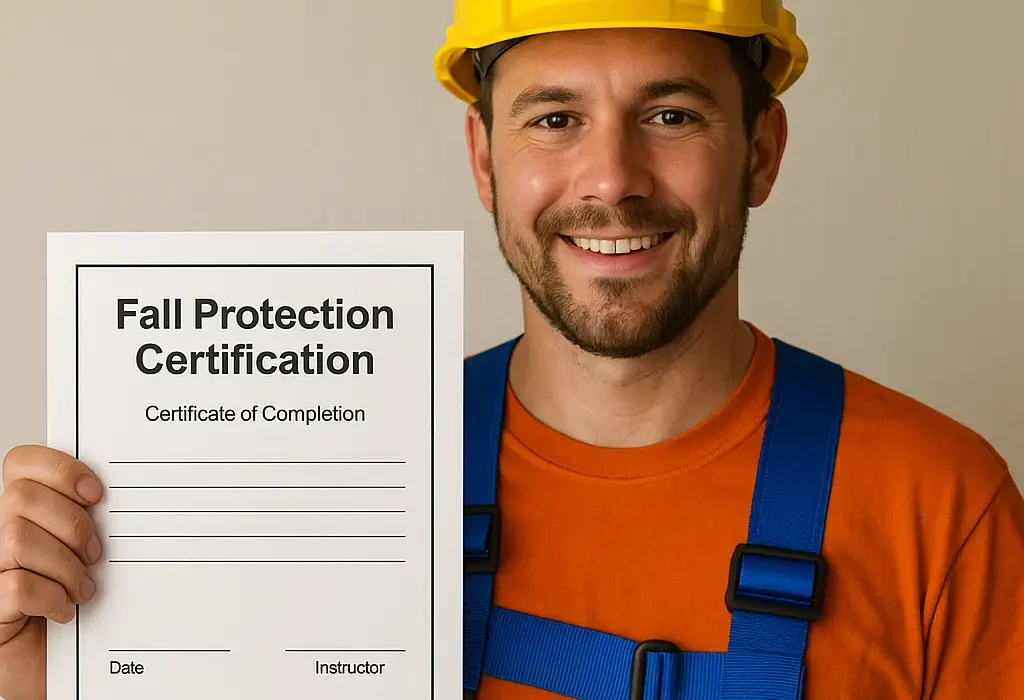
Step 6: Get Your Updated Certification
Most providers give you:
- A printed certificate
- A digital certificate
- A wallet card (optional)
- A record for your employer
Pro-tip:
Take a photo of your certificate with your phone. That way, you always have a copy during jobsite checks.
Read Related Article: Does Fall Protection Training Count in Other Countries?
How Much Does Renewal Cost?
Prices vary, but here’s what you can expect:
- Online refresher training: $20–$60
- In-person training: $75–$200
- Employer-sponsored training: often free
What’s included usually depends on the provider:
- Classroom training
- Hands-on exercises
- Written test
- Certificate
- Recordkeeping
If you pay out-of-pocket for a new job, choose a reputable provider—cheap isn’t always good in safety.
Can You Renew Fall Protection Certification Online?
Short answer: yes, but with conditions.
Online renewal works when:
- Your employer allows it
- You’re only refreshing knowledge
- You already use equipment regularly
Online renewal DOESN’T work when:
- You haven’t used fall protection in a long time
- You need hands-on practice
- Your company requires practical evaluation
- You’re switching equipment types
In many cases, employers ask for at least some practical demonstration.
Read related Article: Does Fall Protection Training Transfer Between Jobs?
What Happens If You Don’t Renew?
Let me be direct here.
If your fall protection training is expired:
- You may not be allowed to work at heights
- Supervisors can pull you off the job
- Auditors can write violations
- You could be sent home until you renew
- You increase your injury risk
Most importantly:
You’re not just risking your job—you’re risking your life.
A harness used incorrectly is just as dangerous as not wearing one at all.
How Employers Handle Renewal
Most companies:
- Track expiration dates
- Schedule annual safety days
- Provide training on-site
- Keep digital or paper records
- Partner with certified trainers
- Follow a 1-year refresher cycle
If you’re unsure what your employer requires, a quick conversation with your supervisor can save you a lot of guesswork.
Tips to Make Renewal Easier Next Time
Let me give you the same advice I give to workers after every class:
✔ Keep a photo of your certificate
You’ll need it more often than you think.
✔ Add a reminder in your phone
Set it for 10–11 months after your last training.
✔ Practice harness inspection regularly
Even 5 minutes a month keeps the knowledge fresh.
✔ Stick with the same training provider
It makes recordkeeping easier.
✔ Ask questions when unsure
Safety trainers love when workers ask questions—it shows you care about doing things right.
Final Thoughts
From my experience training thousands of workers, renewing fall protection certification is one of the simplest ways to stay safe—and stay employed.
And now that you know how to renew fall protection certification, the process should feel a lot less overwhelming.
Just remember:
- Renew every 1–2 years
- Choose a good provider
- Don’t skip the hands-on practice
- Keep your certificate accessible
Renewal isn’t just a requirement—it’s your protection when you’re working high above the ground.

Mike Pattenson is a construction safety trainer who loves helping workers stay safe on the job. He explains safety in a simple, practical way so crews can easily understand what to do — and why it matters.
Mike Pattenson is a construction safety trainer who loves helping workers stay safe on the job. He explains safety in a simple, practical way so crews can easily understand what to do — and why it matters.
View All Articles